2021

IMG_4261
Come at me!
(Bolick, J., dissenting)

We have a Wexis alert for “Kelo,” because that’s one of the ways we keep up on the latest developments in this area. That alert doesn’t ping all that often, so we were all excited when yesterday, we received an alert notifying us of the Arizona Supreme Court’s opinion in State of Arizona v. City of Tucson, No. CV-20-0244-SA (Apr. 14, 2021)? Was it a case of government-to-government takings? Prior public use? 

So imagine our disappointment when in reading the opinion, it turns out to be a question of municipal home rule, and election law. Now don’t get us wrong: we are muni law nerds as well as takings nerds, so we dig any opinion in which a court is looking at a local government’s power to frame its own “constitution” and how (or whether) it conflicts with state law. But
Continue Reading What Is A Kelo Reference Doing In An Opinion About Elections And Municipal Home Rule?

If you’re wondering what to do if, during the course of an eminent domain lawsuit or project, a condemnor (or anyone else with the power of eminent domain) invades, occupies, or affects more property than it acknowledges, check out the Indiana Court of Appeals’ opinion in Lake County v. House, No. 20A-PL-1675 (Apr. 14, 2021).

Short story: a part of a larger project, the county brought an eminent domain action seeking a partial take of the owners’ property, and offered to pay compensation and relocate a septic system that would be affected to somewhere else on the property. The owners claimed that because they could not relocate the septic system anywhere on property, the court should treat this as a total take of entire property. The trial court agreed.

So the county made new plans, which (it argued) avoided taking any of the owners’ property, and would therefore not

Continue Reading Indiana: Owner’s Remedy For Condemnor’s Trespass After Dismissal Of Eminent Domain Lawsuit Is Inverse Claim, Not Reopening The Condemnation

We’ve been meaning to post this one for a while, and it appears our procrastination has paid off: the Court has asked for a response.

Normally, we’d summarize the case and the issues, but in this instance, the cert petition‘s Question Presented lays it all out:

Petitioner, Next Energy, LLC, commenced acquiring blocks of five-year oil leases in 2011 to drill high volume horizontal hydraulic fracturing (horizontal hydraulic fracturing) wells to recover oil from shale formations. Shale oil leasehold interests, like all mineral interests, are separate, distinct leasehold interests from the surface of the land. Horizontal hydraulic fracturing is the only economically viable method to recover shale oil from Next’s leases. The value of the shale oil constitutes the entire value of Next’s leases. At the time the leases were acquired, Illinois law allowed the horizontal hydraulic fracturing process. In mid-2012, after the lease blocks were acquired but

Continue Reading New(ish) Cert Petition: Is Fracking Moratorium A Loretto Or Lucas Categorical Taking?

Screenshot_2021-04-12 Necessity Exceptions to Takings by Shelley Ross Saxer SSRN

Takings! Armstrong! Emergencies! Mahon! Jacobson!

Add lawprof Shelley Ross Saxer’s latest article (forthcoming in the University of Hawaii Law Review), “Necessity Exceptions to Takings” to your reading list.

Get it at SSRN here.

Rather than summarize it for you, we’ll just post the abstract:

The doctrine of necessity has strong roots in the common law of tort and property going back hundreds of years. In the United States the doctrine has been applied in various situations to negate judicial review of constitutional challenges to government action, most recently in some of the wildfire and flood claims resulting from disasters. But now, the states’ responses to the COVID-19 pandemic have brought one of these necessity doctrines—the public health necessity relying on Jacobson v. Massachusetts—to the forefront as courts across the country review constitutional challenges to state public health measures. With such intense review of Jacobson’s public health necessity

Continue Reading Must Read: “Necessity Exceptions to Takings” (Shelley Ross Saxer)

TPBToby Prince Brigham
November 24, 1934 – March 19, 2021

We haven’t posted in a few days, because we’ve been busy with a sad but important task – traveling to Miami to pay our respects to a true giant in the field of property rights and eminent domain, Toby Prince Brigham.

After a long and legendary life and career, Toby left us last month.

The accolades you know: constitutional lawyer, founder of Owners’ Counsel of America, one of the namesakes of William and Mary Law School’s Brigham-Kanner Property Rights Project, the essential man in the Brigham three-generation property rights “dynasty,” the person who boosted and promoted others around him, a committed advocate for his clients who never lost sight of the lawyer’s essential role as a champion, and a mentor who treated you like a valued colleague.

But maybe you didn’t know the “other” Toby: a gentleman in every sense

Continue Reading Farewell, Toby Brigham (1934-2021)

Here’s the Wisconsin Supreme Court’s 4-3 opinion in a case we’ve been following, Christus Lutheran Church of Appleton v. Wis. Dep’t of Trans., No. 2018AP 1114 (Apr. 1, 2021). Even though it was close, after oral arguments, we were hoping for a more positive result.

This is the case in which the Court of Appeals concluded that DOT’s jurisdictional offer was not based on the “full narrative appraisal” required by the statute. The offer was for $403k, but the appraisal on which it was based valued the compensation at $133k.

Wait, you ask, how so? True, the DOT offer was more than its appraisal, but it didn’t back up the increase with any appraisal other than its $133k appraisal. The increase was the result of DOT’s internal administrative review. Read that again: no appraisal supported the $403k offer.

Follow along: DOT’s appraiser opined that the owner incurred

Continue Reading Wisconsin Shrugs: Appraisal Omitting Severance Damages Qualifies As “Full Narrative Appraisal” Because DOT’s Valuation Later Went Up

Go read the Federal Circuit’s opinion in Sandwich Isles Communications, Inc. v. United States, No. 20-1446 (Apr. 1, 2021), especially the very-dense fact section. There’s a lot there: acronyms, bureaucracy-speak, family-insider politician dealings, tax fraud convictions, and the like. So what’s a case like this doing in the Court of Federal Claims and the Federal Circuit, which (for our purposes) deals with takings claims against the United States?

Skip forward to page 7, where we get to the heart of the plaintiff’s complaint:

In January 2019, SIC filed this suit in the Claims Court, alleging that the cumulative effect of the FCC’s reductions in SIC’s federal subsidies resulted in a taking of property without just compensation.

Slip op. at 7 (footnote omitted).

Yes, you read that right: this was a violation of the Givings Clause.

Consequently, the CFC dismissed the complaint for lack of subject matter jurisdiction. First, because

Continue Reading Fed Cir: FCC Giving Isn’t A Taking – Don’t Disguise Your Challenge To Reduction In Subsidies As A Takings Case

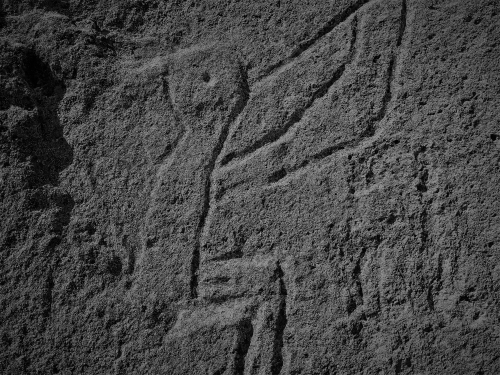
PXL_20210329_222643947This is either a petroglyph of an alien astronaut who visited Earth and gave
ancient peoples wonderful space technology like how to build
the Pyramids, or it’s a guy playing a flute.

(I’ll go with ancient astronaut.)*

When an opinion starts off by characterizing your complaint as asserting “a bevy of claims,” you know you are probably not going to be happy with the outcome.

So it is with the U.S. Court of Appeals’ opinion in Santa Fe Alliance for Public Health and Safety v. City of Santa Fe, No. 20-2066 (Mar. 30, 2021), a case in which the Alliance challenged the federal Telecommunications Act, the the New Mexico statute, and the city’s ordinance that foster the installation of cell towers on public rights-of-way. Collectively, these statutes impede or bypass the usual land-use process, which results in these (alleged) effects:

The Alliance’s membership consists of Santa Fe residents concerned


Continue Reading CA10: Plaintiffs Lacked Standing To Assert Cell Towers Took Their Property

Check out the North Dakota Supreme Court’s opinion in Cass County Joint Water Resource District v. Aaland, No. 20200171 (Mar. 24, 2021). It’s a quick read, and worth your time.

North Dakota has one of those “precondemnation entry” statutes allowing a (potential) condemnor to enter private property to check it out to see if this property is suitable for the anticipated public use. Indeed, North Dakota’s statute is modeled on California’s pre-1963 entry statute (the one analyzed by the California Supreme Court in the somewhat-recent decision in Property Reserve):

In all cases when land is required for public use, the person or corporation, or the person’s or corporation’s agents, in charge of such use may survey and locate the same, but it must be located in the manner which will be compatible with the greatest public benefit and the least private injury and subject to the provisions of

Continue Reading N. Dakota: We Understand The Right To Exclude – Non-Permanent Precondemnation Entries Went Too Far

Pop quiz: in eminent domain valuation proceedings, may an owner who is not qualified as an expert witness testify about the value of her or his own property?

If you said “yes,” most courts would agree with you, either as percipient witness testimony or as lay expert testimony. As would the U.S. Court of Appeals for the Fourth Circuit in most circumstances. As the court noted, “federal courts routinely permit landowners to testify as to the value of their real property in eminent domain cases.”

But as shown in the court’s (unpublished) per curiam opinion in Mountain Valley Pipeline, LLC v. 0.47 Acres of Land, No. 20-1306 (Mar. 23, 2021), there are limitations.

There, the owner opposed the pipeline condemnor’s motion for summary judgment on valuation by submitting his counter-declaration in which he testified about the value of his own property. Did that create a triable issue of

Continue Reading CA4 (unpub): Owner Can Testify About Valuation Of Own Property, Unless He Also Testifies About Other Stuff