


2021

Frontpage

Not our usual takings fare, but our readers are pretty forgiving about our occasional sidebars. And this one is otherwise relevant if you are wondering how governors and other executive state and municipal officials have the power to do things in events deemed to be emergencies. 

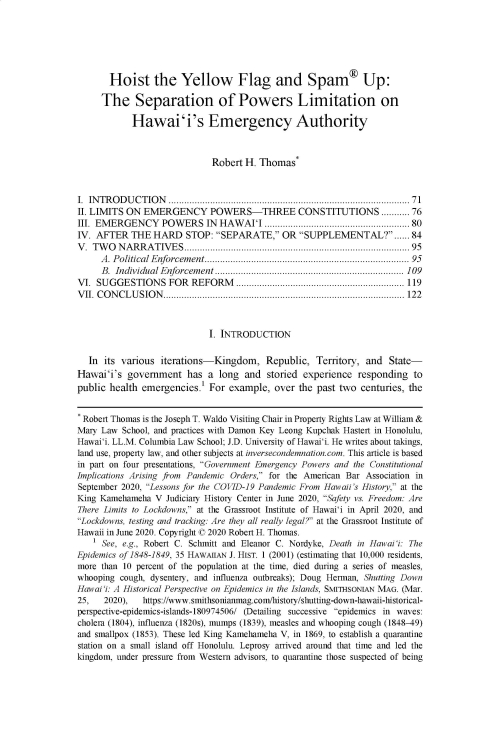
So here’s the final, as-published version of the law review article we wrote up on Hawaii’s emergency powers and suggestions for making the statute less bad, Hoist The Yellow Flag and Spam® Up: The Separation of Powers Limitation on Hawaii’s Emergency Authority, 43 U. Hawaii L. Rev. 71 (2020). 

From the Intro:

Even though legal challenges to similar emergency restrictions have developed in other jurisdictions, Hawai‘i’s courts have not dealt with many objections to the governor’s exercise of these emergency powers. Perhaps because it is mostly predictable how a court would analyze a challenge to emergency powers under the U.S. Constitution. The
Continue Reading Hoist the Yellow Flag and Spam® Up: The Separation of Powers Limitation on Hawaii’s Emergency Authority, 43 U. Haw. L. Rev. 71 (2020)

We suggest you take a read through the California Court of Appeal’s opinion in Felkay v. City of Santa Barbara, No. B304964 (Mar. 18, 2021). It’s all there: Lucas wipeout takings, futility and exhaustion, coastal zone property rights.

This is an inverse condemnation case, seeing compensation for the city denying the owner any economically beneficial use of his property, because it was on a bluff face. Under the city’s ordinances, bluff faces can’t be built on. The planning commission staff said so, but they also recommended to the commission that this would be a taking, and the commission should therefore employ the takings safety-valve provision in the ordinance which allows the city to approve development if denial would be a taking (to paraphrase that old lung-dart commercial, “it’s better to switch than to fight”).

“No deal” the commission said, rejecting staff’s recommendation, “we’ll show ’em who is boss!

Continue Reading Cal App: Taking Verdict Affirmed – When City Asserts That Its No-Development Law “trumps whatever you might submit,” It Would Have Been Futile For Property Owner To Submit Development Application

You listened live. Or you missed that, and listened to the recording. Or, you preferred to review what others thought of the arguments. Now you can read it yourself.

Here’s the transcript of Monday’s oral arguments in Cedar Point Nursery v. Hassid, No. 20-107, the case in which the Supreme Court is considering whether California’s forbidding of agricultural property owners from keeping union organizers off their land is a taking.

Some highlights, in our opinion:

  • Several of the Justices wanted to know whether it was important that the property owners called the access required by the regulation an “easement,” even though it is not formally an easement (you know, the thing where the dominant and servient estate owners agree that one can use the land of another, that is recorded, that runs with the land, and the like. Lawprof Josh Blackman writes about that here (“


Continue Reading Read And Listen To The Oral Arguments In SCOTUS’ Latest Takings Case

In which we join the Pendulum Land Podcast (again, thank you hosts!) to talk about the Virginia Supreme Court’s recent opinion in Johnson v. City of Suffolk, the case we label the “oyster takings” case in which Hampton Roads oystermen claimed that their property was taken when the City of Suffolk and the Sanitation District dumped sewage into the river and declared a “condemnation zone” (i.e., no oyster harvesting).

Short story: the court concluded that the leases of Commonwealth-owned bottomlands in the Nansemond River did not confer a property interest. Or at least not a property interest worthy of constitutional protection. Thus, no takings claim when Suffolk and the Sanitation District dumped sewage into the river and pretty plainly interfered with some kind of right the plaintiffs owned in the lease. Just not enough of a right to require compensation.  

Our thoughts on the court’s decision

Continue Reading We Join Pendulum Podcast To Debate Oysters, Property Rights, Takings

Here are links to the summaries and analysis of yesterday’s oral arguments in Cedar Point Nursery v. Hassid, No. 20-107, the case asking whether California’s forbidding of agricultural property owners from keeping out union organizers is a taking:

Neutral


Continue Reading Cedar Point Oral Arguments Round-Up

PICT1199

Here’s the recorded arguments.

  1. California will try and push the Court to seeing this as an “anti-union” lawsuit: this is not that big of an intrusion, we’ve been doing it for 50 years under both Cal and federal law, and a ruling for the property owners will upset this apple cart and prevent unions from organizing.
  1. The property owners will try and push the Court to seeing the case as one upholding the “keep out” nature of private property. There are other means of contacting the workers, so why need to do it on this private property? Convenience? [Disclosure: my law firm, Pacific Legal Foundation, represents the property owners.]
  1. Is this case different from Kaiser and Nollan in that California’s invitation to access the nursery property is not to the general public and only to union organizers?
  1. Is this case different from PruneYard in that the owner did not


Continue Reading In California, Can A Landowner Really Say “Keep Out?” Things To Look For In Today’s SCOTUS Cedar Point Nursery Arguments

Hold on. What is a criminal appeal, Comm’w of Pennsylvania v. Solomon, No. 1407 MDA 2018 (Mar. 16, 2021) doing on inversecondemnation.com?

The case involved a theft of collectible coins. The defendant was sentenced (inter alia) to pay restitution to the victim. The issue: how to value those coins.

After starting off with the timeless legal maxim “[a] penny saved is a penny earned,” slip op. at 1, the majority concluded that the coins’ value would not be calculated by their market value at the time of the crime, but by the victim’s acquisition cost. The victim testified that it took him eight years to acquire the coins and over the years between acquisition and Solomon’s theft, some of the coins increased in value while others declined. Original cost (from the victim’s receipts): $86k. Current value (derived from looking for comps on Ebay): $58k. Trial judge:

Continue Reading “A theft of property and an eminent domain proceeding both involve the involuntary transfer of property on a particular day.”

Dig this: property owners assert that the County’s right of way dedication ordinance is an unlawful exaction. You know the drill – logical nexus, rough proportionality, etc. Nollan, Dolan, Koontz. Here’s the short story: the owners sought subdivision plat approval without the dedication for public roads required by the ordinance. No deal. The County’s process allows for consideration of variances based on extraordinary hardship. The owners assert that the variance procedures violate their right to procedural due process. The District Court granted the County summary judgment.

In Pietsch v. Ward County, No. 20-1728 (Mar. 16, 2021), the Eighth Circuit affirmed. This is a Nollan/Dolan/Koontz claim. The property owners disavow that they are raising a takings claim. But you can’t fool us, property owners, we know a takings claim when we see one. “Plaintiffs’ due process and unconstitutional conditions claims are an impermissible attempt to recast a Takings claim.” Slip

Continue Reading CA8: You Can’t Fool Us, Property Owner, We Know That Nollan/Dollan/Koontz Claim Isn’t A Due Process Or Unconstitutional Conditions Claim, But Really A Takings Claim

You remember that Seventh Circuit case challenging (as, inter alia, a no-public-use taking) the location of the Obama Center in Chicago’s Jackson Park under the public trust (from the home of the American public trust doctrine, Chicago)? We wrote about it in “Friends Without Benefits: CA7 Rejects Takings Claim For Obama Center Because Citizen’s Group Lacks Property Interest In Public Park.”

This was then-Seventh Circuit Judge Amy Barrett’s first (and only) takings or property rights opinion she authored prior to her promotion to the Supreme Court.

A citizen’s group asserted it has a property interest in Jackson Park by virtue of being the beneficiary of the public trust, and that the handing over of the Park to the Obama Foundation was a private benefit regulatory taking. The plaintiff sought an injunction stopping the transfer, and did not seek just compensation.

The district court and the

Continue Reading New Cert Petition: Judge Barrett’s (Sole) CA7 Takings Opinion Is Wrong

Check out the unusual facts in the West Virginia Supreme Court of Appeals’ opinion in Scherich v. Wheeling Creed Watershed Protection and Flood Prevention Comm’n, No. 19-1065 (Mar. 15, 2021).

This started back in 1990, when the Commission instituted a condemnation action to take two parcels belonging to the Scheriches for a dam, as part of a flood prevention project. Okay, nothing too unusual there. The Commission deposited $97k (its estimate of just comp), the owners objected to the amount, and the court approved the quick take. Defeasible title transferred to the Commission, subject to the adjudication of the actual just compensation owed. The owners withdrew the deposit. Again, nothing out of the ordinary there.

But “[f]ollowing such payment, nothing further occurred in the matter for nearly three decades.” Slip op. at 4. Twenty-eight years to be exact. Flash forward to 2018. Someone noticed something. Hey, whatever happened in

Continue Reading West Virginia: Thirty-Year-Old Quick-Take Wasn’t That Quick