2021

Programming note: as we noted here, we’ve recently moved our email subscribers to a new service. If you are already subscribed to our email updates you should not need to do anything, except look for the emails coming from Feedblitz, not Feedburner. If you want to sign up for email updates anew, go here. If you experience technical issues, or receive duplicate email notifications, please let me know.

Now back to your regularly scheduled programming…
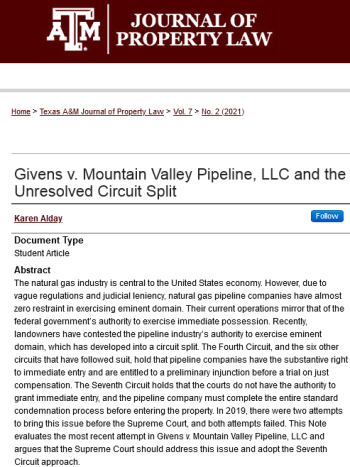
Screenshot 2021-07-26 at 09-25-52 Givens v Mountain Valley Pipeline  LLC and the Unresolved Circuit Split

Be sure to take a read of an article we’ve had in our queue to read for a while: Karen Adlay, Givens v. Mountain Valley Pipeline, LLC and the Unresolved Circuit Split, 7 Tex. A. & M. J. Prop. L. 137 (2021).

Several federal courts of appeals — including the Fourth Circuit in Givens — have upheld giving prejudgment possession of property to a private pipeline condemnor once a

Continue Reading New L Rev Article: “Givens v. Mountain Valley Pipeline, LLC and the Unresolved Circuit Split” (Tex. A. & M. J. Prop. L.)


Talk amongst yourselves.

We’ve had our say, so in this post — the sixth and final post in a series of deeper dives about June’s U.S. Supreme Court opinion in Cedar Point Nursery v. Hassid , No. 20-107 (June 23, 2021) — we’re linking to what others are saying about the case.

Here are all of the posts in our Cedar Point series:

And in case you missed the live webcast on Friday, July 16, 2021 that featured expert analysis of the case, please don’t miss listening to the recording of ALI-CLE’s “Takings and Eminent Domain After Cedar Point: What Practitioners

Continue Reading Cedar Point Part VI: What Others Are Saying

We don’t have our own regular podcast (should we?) but have had the privilege of appearing on others’ podcasts, and have posted our own audio from time-to-time. Here’s a list:


Continue Reading Podcasts

Screenshot 2021-07-23 at 17-02-01 Subscribe to inversecondemnation com

A note for those of you who subscribe to the blog for email updates and notifications. Our longstanding email feed distributor, Feedburner (by Google) has announced that it is spinning down, and will no longer provide subscriptions and updates to blogs by email.

As a consequence, as of today, Friday, July 23, 201, we’ve migrated our email subscribers to Feedblitz.

For those of you who already receive email updates, you should not need to do anything to continue to receive our updates (although you may need to ensure that the inbound emails are not routed to your Junk Mail or spam folder — look for the email sender “inversecondemnation@outlook.com” or “Feedblitz” if you are not receiving the updates as expected). Drop me a line if you need any help.

Only if you are wanting to add a new email recipient, do you need

Continue Reading Admin Note For Email & RSS Subscribers: Feedburner Is Dead – Long Live Feedblitz

In this post — the fifth and penultimate post in a series of deeper dives that we’re posting about June’s U.S. Supreme Court opinion in Cedar Point Nursery v. Hassid, No. 20-107 (June 23, 2021) — we’ll be trying to take some educated guesses about what the decision means for the future.

Here are all of the posts in our Cedar Point series:

And in case you missed the live webcast on Friday, July 16, 2021 that featured expert analysis of the case, please don’t miss listening to the recording of ALI-CLE’s “Takings and Eminent Domain After Cedar Point: What

Continue Reading Cedar Point Part V: Help Us Help You

IMG_20170323_142808

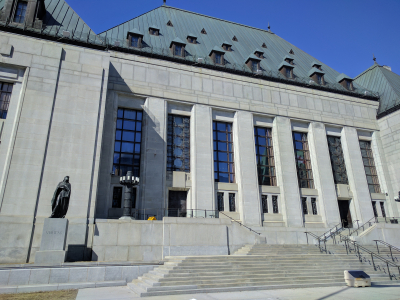
Here’s one we’re now following, thanks to a heads-up from a northern colleague.

The Supreme Court of Canada has granted leave to appeal in a case involving what Canadian law calls “de facto expropriation” (what we’d call “regulatory takings”).

Before you review the Application for Leave to Appeal by the property owner, and the responsive memorandum for the government, recall that even though Canada’s approach to “takings” is not a constitutional question, but nonetheless like the southern version of the doctrine, focuses on whether some government act has the effect of acquiring from the owner a beneficial interest, or removed all reasonable uses. See Canadian Pacific Railway v. Vancouver (City), 1 S.C.R. 227, 2006 SCC 5 (2006).

In Annapolis Group Inc v. Halifax Regional Municipality, the Supreme Court will consider whether Halifax’s refusal to approve Annapolis’ development applications (consistent with its residential zoning, more specifically “future serviced

Continue Reading Canada Supreme Court To Review De Facto Expropriation (aka Regulatory Takings) Case

The State of New York needed a strip of the owner’s property for a “greenway” for walkers and bikers. The State and the owner agreed that if the owner believed that the advance payment of $300k was not enough, it could ask the Court of Claims for more. But they also agreed that if that court concluded the amount for the taking was less than advance payment, the owner would owe the State the difference, plus interest.

After trial, the claims court concluded that the advance payment exceeded the amount of compensation owed — indeed, was below the range of values testified to by each side’s expert — and the owner thus owed the State in the neighborhood of $18k. 

In Elpa Builders, Inc. v. State of New York, No. D66949 (July 14, 2021), the Appellate Division (Second Department) made typically short work of the owner’s claim that the

Continue Reading NY App Div: If Deposit Exceeds Adjudicated Compensation, Owner May Be Liable To Pay The Difference

We’re not going to pretend that we can actually read what the Supreme Court of Puerto Rico’s opinion in Administración de Terrenos de Puerto Rico v. Ponce Bayland Enterprises, Inc., No. CC-2019-212 (June 29, 2021) says. It’s in Spanish and we don’t know Spanish. Wish we did, truly.

But hey, that’s what Google Translate is for, right? And if that service can be believed, here’s what the summary of the case roughs out to:

Compulsory Expropriation – The Expropriation Chamber of the Court of First Instance has jurisdiction to consider evidence of environmental pollution and the costs of remedying it in forced expropriation lawsuits to determine the market value of the expropriated property at the time of seizure. The admissibility of evidence about contamination and the costs of remedying it is subject to the provisions of the Rules of Evidence.

We’re not posting the case because the opinion raises

Continue Reading El Tribunal Supremo De Puerto Rico: Evidence Of Environmental Contamination Is Admissible In Eminent Domain Valuation

What do you think about these facts in RLR Investments, LLC v. City of Pigeon Forge, No. 20-6375 (July 13, 2021), a decision by the U.S. Court of Appeals for the Sixth Circuit on what we might charitably call an obscure legal doctrine (RookerFeldman)?

City wanted some of RLR’s property to build a walkway and replacement parking for RLR’s parking that the walkway would displace. Eminent domain ensued. RLR objected to the take: no public use. The Tennessee trial court considering the condemnation suit disagreed, and concluded twice (once at the hearing on immediate possession, the other on a motion for summary judgment) that the taking was supported by a public use or purpose. 

Next step, valuation trial right?

Not in the view of the property owner, who, continuing to maintain that the taking was defective, filed its own civil rights lawsuit in federal

Continue Reading CA6: Rooker-Feldman Bars Federal Lawsuit Challenging State Court’s Public Use Determination

20151205_145902

Today’s case: a short per curiam opinion from the Federal Circuit, Straw v. United States, No. 21-1596 (July 14, 2021).

The court affirmed the Court of Federal Claims’ dismissal of a takings claim that alleged that the plaintiff’s property was taken when the Eleventh Circuit affirmed a district court’s dismissal of the plaintiff’s Federal Tort Claims Act claim for missing the statute of limitations deadline. 

You know it wasn’t going to go well for the plaintiff when the court’s analysis (slip op. at 3) begins with this: “This appeal is frivolous.” The CFC takings claim was merely a “collateral attack” on the district court’s judgment, the court concluded. “Because Mr. Straw’s takings claim depends on him challenging the Georgia district court’s decision—which is final and preclusive—the Claims Court correctly held that it cannot grant the relief he seeks.” Slip op. at 4.

Besides, this isn’t really a takings claim

Continue Reading Fed Cir: No Judicial Taking When CA11 Dismissed Tort Claims