2021

Floodsfiresarticle

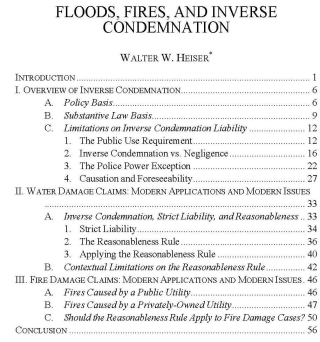
Here’s what we’re reading today (inter alia): Walter W. Heiser, Floods, Fires, and Inverse Condemnation, 29 N.Y.U. Envtl. L. J. 1 (2021).

From the Introduction:

This Article examines the proper application of the doctrine of inverse condemnation in two important areas: flood damage to private property caused by a public improvement (e.g., a flood control, storm drain, or sewer project), and wildfire damage to private property caused by a project (e.g., electricity or telephone lines) undertaken by either a public or privately-owned utility. Under the doctrine of inverse condemnation, a plaintiff may recover for a physical injury to private property caused by a public improvement as deliberately designed, constructed, or maintained.

….

How courts define the standard of liability in inverse condemnation cases will become increasingly important in both the flooding and wildfire contexts. The continuing nature of climate States and more wildfires in others. This Article examines

Continue Reading New L Rev Article: “Floods, Fires, and Inverse Condemnation”
Permanentortemporary

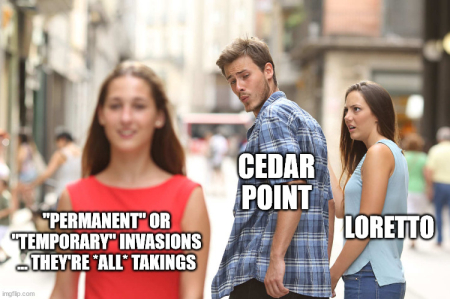
In this post — the fourth in a series of deeper dives that we’re posting about June’s U.S. Supreme Court opinion in Cedar Point Nursery v. Hassid, No. 20-107 (June 23, 2021) — we’ll be discussing the two separate opinions, Justice Kavanaugh’s concurrence, and the Justice Breyer-authored dissent.

Here are all of the posts in our Cedar Point series:

And in case you missed the live webcast on Friday, July 16, 2021 that featured expert analysis of the case, please don’t miss listening to the recording of ALI-CLE’s “Takings and Eminent Domain After Cedar Point: What Practitioners Need to Know

Continue Reading Cedar Point Part IV: The Other Opinions

Our thanks to our friends and colleagues at the ABA Section of Real Property, Probate & Trust Section’s Land Use and Environmental Group for inviting us to a discussion of the latest and greatest decisions of interest.

We only had an hour together, so naturally could not cover everything of interest (indeed, we reserved a big discussion of the biggest item, the Supreme Court’s decision in Cedar Point, assuming that the Group will schedule a full session on that decision alone). So here is our curated list of what we think are the most interesting recent decisions in areas of interest to the Group:


Continue Reading Links From Today’s ABA RPTE Session

It can be somewhat of a challenge to blog about many of the opinions from New York’s appellate courts (dun-dun) because they are typically short. What more (or less!) can you say about an opinion that is very short? We mean really short. Like 3 pages short.

Such it is with the Appellate Division’s opinion in Gabe Realty Corp. v. City of White Plains, No. D66651 (June 30, 2021). A total of 4 pages, actually, but when you cut out the caption, introductory fluff, and the clerk’s signature, you are down to a grand total of two pages of single-spaced text. It would take us more time to write about the decision than it would take you to just read the darn thing.

Highlights:

  • A New York court invalidates an urban renewal taking, supported by a claim of blight remediation. Read that again: this is from a


Continue Reading NY App Div: Potential Future Public Benefit Won’t Support Eminent Domain

Here’s the latest (maybe last?) in a case we’ve been following for a long time.

On Friday, the Court denied the petition for writ of certiorari, with three Justices noting that they would have granted the petition. Justice Thomas, joined by Justice Gorsuch dissented from the denial of cert, while “Justice Kavanaugh would grant the petition[.]” 

Here’s Justice Thomas:

We should grant certiorari for two reasons.

First, this petition provides us the opportunity to correct the mistake the Court made in Kelo. There, the Court found the Fifth Amendment’s “public use” requirement satisfied when a city transferred land from one private owner to another in the name of economic development. See 545 U. S., at 484. That decision was wrong the day it was decided. And it remains wrong today. “Public use” means something more than any conceivable “public purpose.” See id., at 508–511 (Thomas, J., dissenting).

Continue Reading So Close: SCOTUS Declines To Revisit Kelo (For Now)

001q

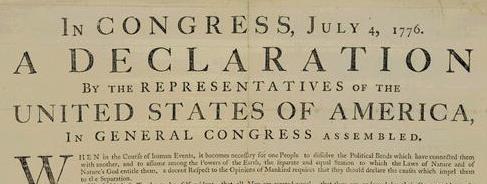
It’s not quite “Yes Virginia…” but here is our annual Independence Day missive on the legal angle on the Declaration. This may have special significance as the nation is in the process of reexamining many of our assumptions and history. But though the Founders may have been flawed individuals, there’s really no question about the ideas they captured, and thankfully put down on paper for posterity.

Civil Beat published a version of this post here.

—————————————————————————————

We know lawyers are easy targets (we enjoy lawyer jokes as much as the next person, i.e., What’s the difference between a good lawyer and a great lawyer? A good lawyer knows the law; a great lawyer knows the judge.). Still, as we celebrate our independence, we note that author Thomas Jefferson and 23 other of the 56 signers of the Declaration of Independence were lawyers, and that the document


Continue Reading The Verified Complaint In Equity: The Declaration Of Independence, 2021 Version

In this post — the third in a series of deeper dives that we’ll be posting about last week’s U.S. Supreme Court opinion in Cedar Point Nursery v. Hassid, No. 20-107 (June 23, 2021) — we’ll be discussing whether the “right to exclude” is absolute, what exceptions the Court laid out, and how it responded to the arguments that the ruling will bring the system crashing down.

Here are all of the posts in our Cedar Point series:

And in case you missed the live webcast on Friday, July 16, 2021 that featured expert analysis of the case, please don’t miss

Continue Reading Cedar Point Part III: No, Chicken Little, The Sky Isn’t Falling

DSCF3357

Another takings opinion from the Supreme Court, this time in a (putatively) eminent domain case we’ve been following.

In PennEast Pipeline Co., LLC v. New Jersey, No. 19-1039 (June 20, 2021), the majority (Roberts, CJ, joined by an unusual, cross-aisle lineup of Justices Breyer, Alito, Sotomayor, and Kavanaugh) concluded that a private pipeline which has been delegated the federal power of eminent domain in the Natural Gas Act, may, in a federal court lawsuit, condemn property owned by the State of New Jersey. 

The case asked whether New Jersey – not some mere private landowner – can be haled into a federal court as a defendant in a NGA private pipeline taking. The issue isn’t the same as a typical NGA pipeline case in which a private landowner can’t assert Eleventh Amendment immunity. As a consequence, here we witnessed a much different result in the way the lower

Continue Reading SCOTUS: Eminent Domain Is Eminent Over Everything, Even A State’s 11th Amendment Immunity

In which we pay a return visit to Clint Schumacher’s Eminent Domain Podcast to catch up with Clint about our new gig, Cedar Point (briefly, since the opinion came down the day we recorded the podcast), just compensation and attorneys’ fees, assessing severance damages in appraisals supporting jurisdictional offers, public use, and our favorite cool courthouses (let’s just say that they range from historic courtrooms to converted doublewide trailers).

If you are not already a regular listener to the Eminent Domain Podcast, you should be! It’s a great one-stop convenient way to keep current on the latest goings-on in the takings business. Continue Reading We Pay A Return Visit To The Eminent Domain Podcast To Talk Takings