June 2022

20160126_163953

Here’s the latest in a case we’ve been following.

Now before you get all worked up about the Texas Supreme Court agreeing that the private company proposing to build a bullet train between Dallas and Houston may exercise the sovereign power of eminent domain (see Miles v. Texas Central RR & Infrastructure, Inc., No. 20-0393 (June 24, 2022), remember that this is a case involving only the construction of Texas statutes. Not the court deciding whether the state’s delegation of eminent domain power conforms to some constitutional public use standard. 

That being said, the opinion may have limited reach (thank goodness) but is still worth reviewing for those of you not in Texas.

Property owners objected to the company taking their property, arguing that it did not qualify under Texas statutes delegating the state’s eminent domain power to a “railroad” and to “interurban electric railways.” This thing may
Continue Reading Texas: Proposed Bullet Train Is An “Interurban Electric Railway” And May Exercise Eminent Domain (At Least It Isn’t A Fish)

The owners of the Hollymead Town Center (Route 29, LLC) located, perhaps not surprisingly along U.S. Route 29 in Albemarle County outside of Charlottesville, needed the County to rezone a portion of the property.

Part of the rezone was something called a “conditional proffer” that required a cash donation of $50,000 “[w]ithin thirty days after demand by the County after public transportation service is provided to the Project,” and then additional donations of fifth large each year for 9 years for a total of a half-million.

There was some discussion among the public and County officials about whether this condition would ever be actually realized because public transportation service might not be provided in the future, but in the end the County approved the “Commuter Route” that is projected to run “from northern Albemarle County to downtown Charlottesville.” But the owner objected to the cash payment, throwing up the Nollan

Continue Reading Virginia: Property Owner Can Object To Permit Condition As Unconstitutional, Even After Accepting The Permit

A long-ish opinion from the Alabama Supreme Court in Douglas v. Roper, No. 1200503 (June 24, 2022). But a short post because the good stuff is relatively brief.

Bottom line: property owners have a vested interest in excess money generated from a tax sale of their property, and the Alabama legislature cannot prohibit the owners from claiming that excess equity.

Quick background: the legislature enacted a statute that required property owners who had their properties sold to satisfy tax debts first have redeemed the property before they could claim the excess funds, if any, from the sale. This had the effect of permitting the government in many cases to keep that excess (i.e., the property’s equity), as a little something extra — what our New Orleans friends might call lagniappe. Property owners objected, arguing that retroactively applying the statute would be a taking.

There’s a lot to

Continue Reading Alabama: Government Can’t Keep The Change After A Tax Sale

In Haggart v. United States, No. 21-1660 (June 22, 2022), the U.S. Court of Appeals for the Federal Circuit held that the Uniform Relocation Act is like a lot of other fee-shifting statutes, and does not authorize attorneys fees for work performed by a lawyer if that lawyer is one of the litigants. Slip op. at 8 (“We see no sound reason to read the URA’s fee provision to authorize an attorney pro se litigant to receive attorney’s fees when 42 U.S.C. § 1988 and other fee-shifting statutes do not.”).

We’re posting this here because the underlying case involves a rails-to-trails takings claim, and because we know you are interested in any decisions interpreting and applying the URA.

Haggart v. United States, No. 21-1660 (Fed. Cir. June 22, 2022)

Continue Reading Fed Cir: Uniform Relocation Act Doesn’t Authorize Fees For Pro Se Lawyering

Untitled Extract Pages

In honor of property rights advocate and trial lawyer Toby Prince Brigham (1934-2021), Owners’ Counsel of America has endowed a scholarship for a second- or third- year law student to attend the annual three-day ALI-CLE Eminent Domain and Land Valuation Litigation Conference (the upcoming Conference will be in Austin, Texas, February 2-4, 2023.

In honor of Toby’s legacy of professionalism and achievement, in 2021 OCA established the Toby Prince Brigham OCA Scholarship to pay for all expenses of a second or third year law student to attend the ALI-CLE Eminent Domain conference and associated OCA events held annually in January. This unique scholarship affords the student the opportunity to learn about the substantive law of eminent domain and property rights, while also meeting and networking with the leading lawyers in these practice areas from across the country. This is what the very first Toby Prince Brigham OCA scholar, Nina Sawaya

Continue Reading Owners’ Counsel Toby Prince Brigham Scholarship – Applications Being Accepted!

Here’s the latest – a cert petition in a case (and an issue) we’ve been following that asks can a government action that is a violation of copyright also be a taking?

Bynum wrote, researched, and edited a book, a biography of Texas A & M’s famed “12th Man” of the football squad. During his research, he met with officials from the university’s athletic department and later emailed them a “PDF of the full book,” noting that it was not final and only for the recipient’s review. 

Next up, trouble: the official (allegedly) “directed his secretary to re-type the Biography and to remove any reference to Bynum of to Epic Sports’ copyright information. [The official] rewrote the PDF’s byline to [indicate that another author had written the book] and changed the title. And “[o]ver the next 72 hours, the Department disseminated the full Biography to hundreds of thousands

Continue Reading New Cert Petition: Copyright Or Takings? (And State 11th Amendment Immunity)

Here’s what we’re reading today:

Continue Reading Monday Round Up: Aina Lea Out With A Whimper, 30 Years Of Mabo, Seneca Village

Magna_Carta_(British_Library_Cotton_MS_Augustus_II.106)

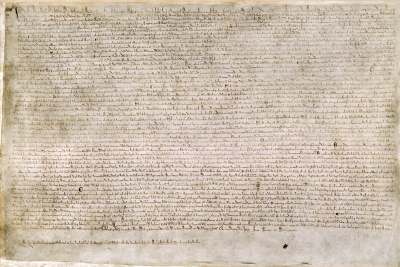
807 years ago today on a grassy plain down by the river, the barons convinced bad King John to affix his seal to Magna Carta. And boy was that guy bad even by the standards of medieval royals: when you type “bad king…” in your search engine, the first suggested search is “bad king … John.”

There’s a lot of good stuff in Magna Carta — and a lot of stuff that has been rendered irrelevant or quaint by the passage of time, and even some stuff that we’d consider cringe-worthy today (see art. 10, for example).

But we takings geeks all know and continue to appreciate article 28:

Nullus enarius aries, vel alius ballivus noster, capiat enar vel alia catalla allcujus, nisi statim inde reddat enarius, aut respectum inde habere possit de voluntate venditoris.

Magna Carta art. XXVIII (1215).

If, like us, you don’t know Latin,

Continue Reading Happy 807th Birthday, Magna Carta. We Need Just Compensation “Stat!”

Whatpropertydoes

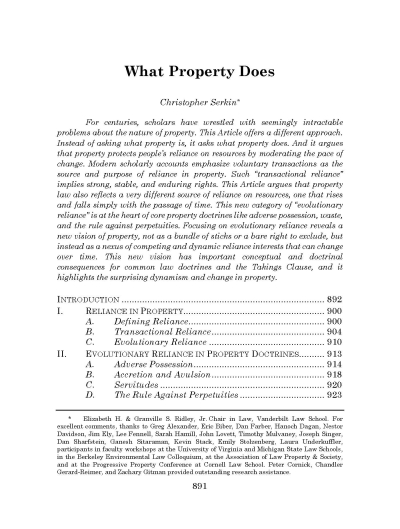
Worth checking out: Christopher Serkin, What Property Does, 75 Vand. L. Rev. 891 (2022).

Covering (inter alia) property, rule against perpetuities, adverse possession, Lucas background principles, judicial and regulatory takings, Mahon v. Keystone Bituminous, and vested rights and amortization of preexisting uses.

Here’s the abstract:

For centuries, scholars have wrestled with seemingly intractable problems about the nature of property. This Article offers a different approach. Instead of asking what property is, it asks what property does. And it argues that property protects people’s reliance on resources by moderating the pace of change. Modern scholarly accounts emphasize voluntary transactions as the source and purpose of reliance in property. Such “transactional reliance” implies strong, stable, and enduring rights. This Article argues that property law also reflects a very different source of reliance on resources, one that rises and falls simply with the passage of time. This new category

Continue Reading New Article: Serkin, “What Property Does,” 75 Vand. L. Rev. 891 (2022)

We’ve been meaning to post the U.S. Court of Appeals for the Sixth Circuit’s opinion in Barber v. Charter Twp of Springfield, No. 20-2298 (Apr. 11, 2022) for a while because it emphasizes an important point about “final decision” ripeness, and the sometimes ridiculous arguments made to support an argument that a takings claim isn’t ripe.

In many situations a takings claim is backwards looking, and seeks compensation or some other remedy for something the government has already done. You flooded my property, or your project encroached on my land, or you designated my property for future acquisition and prevented me from using it in the interim are good examples. But not always. Sometimes takings claims are forward looking. Your regulations require me to allow a cable TV company to install a box on my building’s roof, or you are threatening to open my private marina

Continue Reading CA6: Dammed If You Do – Takings Claim Is Ripe When Govt Decides To Physically Invade And You Don’t Need To Wait ‘Til It Actually Invades