June 2022

Book_475

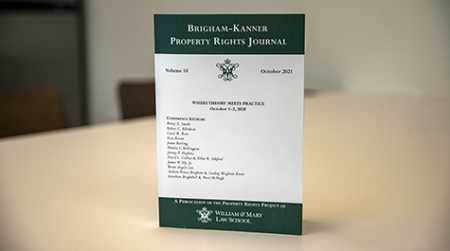
In case you have not already obtained your printed copy (you really should subscribe), it is now available in pdf format.

The theme for the issue is “Where Theory Meets Practice,” and with articles on “Property Beyond Flatland,” “Property Rights and the Modern Resurgence of Rent Control,” “Hurdles to Just Compensation,” “Implied Preemption in the Regulation of Land,” and “‘Equitable Compensation’ as ‘Just Compensation’ for Takings.” And more.

Check out the complete article list here, or below.

And don’t forget to mark your calendars for the 2022 Brigham-Kanner Property Rights Conference, in Williamsburg and the William and Mary Law School, September 29-30, 2022. Plan on joining us in the fall for what is, in our opinion, the best single-day conference on property rights.

Table of Contents, Brigham-Kanner Prop. Rts. J. vol. 10 (2021) Continue Reading Brigham-Kanner Property Rights Journal Vol. 10 Now Available

20151205_145854

We’ve covered some of the litigation against the federal government for its actions flooding property during Hurricane Harvey, including at least one from the “upstream” owners. Well here’s one from the case involving the “downstream” owners.

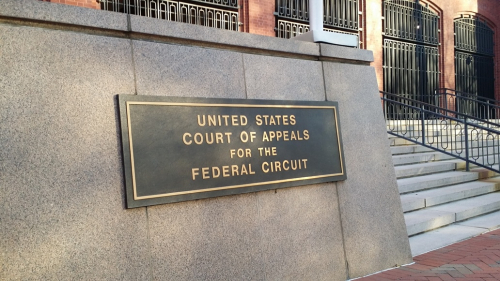
In Milton v. United States, No. 21-1131 (June 2, 2022), the U.S. Court of Appeals for the Federal Circuit addressed the first question in every takings claim: does the plaintiff possess “private property?” The court held that the plaintiffs indeed have a property interest.

Now that may seem like an obvious conclusion. After all, it’s right there in the first sentence of the opinion that the plaintiffs are owners of … property: “[a]ppellants Virginia Milton and hundreds of other individuals and companies owned property downstream from the Addicks and Barker Dams in Houston, Texas.” Slip op. at 1 (emphasis added). But as you takings mavens know, owning property doesn’t mean you truly

Continue Reading CAFED: Flooded Property Owners Owned Property

Screenshot 2022-06-06 at 08-22-58 Search - Supreme Court of the United States

A hearty congratulations to our Pacific Legal Foundation colleagues Jeff McCoy (counsel of record), Jim Manley, Damien Schiff, and Ethan Blevins for today’s cert grant in a case that brings together dirt lawyers and federal courts nerds.

Wilkins v. United States asks whether the (federal) Quiet Title Act’s statute of limitations is “jurisdictional,” or whether it is simply a claim processing rule. “Jurisdictional” things as you know can be raised any time, even by the court on its own initiative. A “claim processing” rule, by contrast, is just a defense – it must be raised at a certain stage of a case, and may be waived or forfeited, or equitably tolled.

Lawyers and judges tend to employ these terms casually (especially “jurisdictional”), which has resulted in the Supreme Court in recent years taking a more disciplined approach, after acknowledging that even the Justices themselves use the terms rather

Continue Reading Cert Granted: Is The Quiet Title Act’s Statute Of Limitations Jurisdictional?

Its deja vu all over again: like it did just a short while back, in Lafave v. City of New Orleans, No. 21-30358 (June 1, 2022), the U.S. Court of Appeals for the Fifth Circuit once again has rejected a takings claims “based on the city’s failure to honor a judgment of the Louisiana state courts.” Slip op. at 1.

Unlike the previous case, here the judgment being dishonored was not for just compensation, but a state court order that “call[ed] for the return of personal property acquired by the government unlawfully.” Id.

Here’s the story. New Orleans likes traffic cameras, and “used mail to collect fines for traffic violations captured by street cameras.” A class action lawsuit challenged the scheme, and eventually a Louisiana court determined the city lacked the authority to designate the Department of Public Works (and not the police department) as the enforcement authority.

Continue Reading The Keepings Clause: CA5 (Again) Throws Up Its Hands When Local Gov Refuses To Pay Back Money It Owes

IMG_20170801_132241

Here’s the latest in a case we’ve been following.

A Utah statute requires that if a condemnor doesn’t actually use property it acquired “under a threat of condemnation,” it must try and sell it back to the (former) owner. The statute defines “threat of condemnation” as when “an official body of the state or a subdivision of the state, having the power of eminent domain, has specifically authorized the use of eminent domain to acquire the real property.” 

So what does “specifically authorized” mean? The Utah Court of Appeals held it means only when the potential condemnor takes a “final vote” and actually and finally “approves the use of eminent domain powers.”

In Cardiff Wales, LLC v. Washington County School District, No. 20210221 (May 26, 2022), however, the Utah Supreme Court disagreed, concluding it means any specific threat to take. The condemnor must do something more than indicate

Continue Reading Utah: Sale “Under Threat Of Condemnation” Means Only A “Specific Threat To Take,” Not That Govt Authorized Condemnation Lawsuit

On one hand, there’s nothing terribly surprising about the Texas Supreme Court’s opinion in Hlavinka v. HSC Pipeline Partnership, LLC, No. 20-0567 (May 27, 2022) holding that yes, “polymer-grade propylene” qualifies as an “oil product” under Texas statutes that allow a private pipeline company to take property to transport oil products, and that yes, a private pipeline counts as a public use. After all, the first sentence of the opinion sets the context for those of you who may not realize how important the energy industry is to that state:

Recognizing the important role that pipeline development plays in meeting our state’s manufacturing and energy needs, the Legislature grants common carriers the right to condemn private property for the construction of pipelines that transport certain products.

Slip op. at 1.

But on the other hand, the very last portion of the opinion gives a hint that maybe the court

Continue Reading Texas: At Least One Customer Is Served So Pipeline Is A Public Purpose, But Let’s Loosen Valuation Rules For Energy Corridors