2022

In Haggart v. United States, No. 21-1660 (June 22, 2022), the U.S. Court of Appeals for the Federal Circuit held that the Uniform Relocation Act is like a lot of other fee-shifting statutes, and does not authorize attorneys fees for work performed by a lawyer if that lawyer is one of the litigants. Slip op. at 8 (“We see no sound reason to read the URA’s fee provision to authorize an attorney pro se litigant to receive attorney’s fees when 42 U.S.C. § 1988 and other fee-shifting statutes do not.”).

We’re posting this here because the underlying case involves a rails-to-trails takings claim, and because we know you are interested in any decisions interpreting and applying the URA.

Haggart v. United States, No. 21-1660 (Fed. Cir. June 22, 2022)

Continue Reading Fed Cir: Uniform Relocation Act Doesn’t Authorize Fees For Pro Se Lawyering
Untitled Extract Pages

In honor of property rights advocate and trial lawyer Toby Prince Brigham (1934-2021), Owners’ Counsel of America has endowed a scholarship for a second- or third- year law student to attend the annual three-day ALI-CLE Eminent Domain and Land Valuation Litigation Conference (the upcoming Conference will be in Austin, Texas, February 2-4, 2023.

In honor of Toby’s legacy of professionalism and achievement, in 2021 OCA established the Toby Prince Brigham OCA Scholarship to pay for all expenses of a second or third year law student to attend the ALI-CLE Eminent Domain conference and associated OCA events held annually in January. This unique scholarship affords the student the opportunity to learn about the substantive law of eminent domain and property rights, while also meeting and networking with the leading lawyers in these practice areas from across the country. This is what the very first Toby Prince Brigham OCA scholar, Nina Sawaya

Continue Reading Owners’ Counsel Toby Prince Brigham Scholarship – Applications Being Accepted!

Here’s the latest – a cert petition in a case (and an issue) we’ve been following that asks can a government action that is a violation of copyright also be a taking?

Bynum wrote, researched, and edited a book, a biography of Texas A & M’s famed “12th Man” of the football squad. During his research, he met with officials from the university’s athletic department and later emailed them a “PDF of the full book,” noting that it was not final and only for the recipient’s review. 

Next up, trouble: the official (allegedly) “directed his secretary to re-type the Biography and to remove any reference to Bynum of to Epic Sports’ copyright information. [The official] rewrote the PDF’s byline to [indicate that another author had written the book] and changed the title. And “[o]ver the next 72 hours, the Department disseminated the full Biography to hundreds of thousands

Continue Reading New Cert Petition: Copyright Or Takings? (And State 11th Amendment Immunity)

Here’s what we’re reading today:

Continue Reading Monday Round Up: Aina Lea Out With A Whimper, 30 Years Of Mabo, Seneca Village

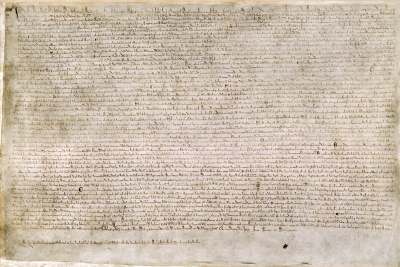
Magna_Carta_(British_Library_Cotton_MS_Augustus_II.106)

807 years ago today on a grassy plain down by the river, the barons convinced bad King John to affix his seal to Magna Carta. And boy was that guy bad even by the standards of medieval royals: when you type “bad king…” in your search engine, the first suggested search is “bad king … John.”

There’s a lot of good stuff in Magna Carta — and a lot of stuff that has been rendered irrelevant or quaint by the passage of time, and even some stuff that we’d consider cringe-worthy today (see art. 10, for example).

But we takings geeks all know and continue to appreciate article 28:

Nullus enarius aries, vel alius ballivus noster, capiat enar vel alia catalla allcujus, nisi statim inde reddat enarius, aut respectum inde habere possit de voluntate venditoris.

Magna Carta art. XXVIII (1215).

If, like us, you don’t know Latin,

Continue Reading Happy 807th Birthday, Magna Carta. We Need Just Compensation “Stat!”

Whatpropertydoes

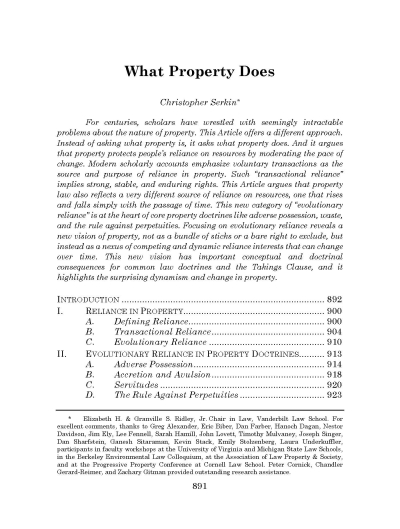
Worth checking out: Christopher Serkin, What Property Does, 75 Vand. L. Rev. 891 (2022).

Covering (inter alia) property, rule against perpetuities, adverse possession, Lucas background principles, judicial and regulatory takings, Mahon v. Keystone Bituminous, and vested rights and amortization of preexisting uses.

Here’s the abstract:

For centuries, scholars have wrestled with seemingly intractable problems about the nature of property. This Article offers a different approach. Instead of asking what property is, it asks what property does. And it argues that property protects people’s reliance on resources by moderating the pace of change. Modern scholarly accounts emphasize voluntary transactions as the source and purpose of reliance in property. Such “transactional reliance” implies strong, stable, and enduring rights. This Article argues that property law also reflects a very different source of reliance on resources, one that rises and falls simply with the passage of time. This new category

Continue Reading New Article: Serkin, “What Property Does,” 75 Vand. L. Rev. 891 (2022)

We’ve been meaning to post the U.S. Court of Appeals for the Sixth Circuit’s opinion in Barber v. Charter Twp of Springfield, No. 20-2298 (Apr. 11, 2022) for a while because it emphasizes an important point about “final decision” ripeness, and the sometimes ridiculous arguments made to support an argument that a takings claim isn’t ripe.

In many situations a takings claim is backwards looking, and seeks compensation or some other remedy for something the government has already done. You flooded my property, or your project encroached on my land, or you designated my property for future acquisition and prevented me from using it in the interim are good examples. But not always. Sometimes takings claims are forward looking. Your regulations require me to allow a cable TV company to install a box on my building’s roof, or you are threatening to open my private marina

Continue Reading CA6: Dammed If You Do – Takings Claim Is Ripe When Govt Decides To Physically Invade And You Don’t Need To Wait ‘Til It Actually Invades

Book_475

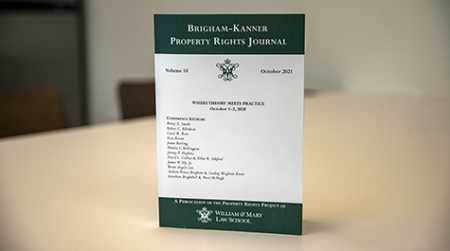
In case you have not already obtained your printed copy (you really should subscribe), it is now available in pdf format.

The theme for the issue is “Where Theory Meets Practice,” and with articles on “Property Beyond Flatland,” “Property Rights and the Modern Resurgence of Rent Control,” “Hurdles to Just Compensation,” “Implied Preemption in the Regulation of Land,” and “‘Equitable Compensation’ as ‘Just Compensation’ for Takings.” And more.

Check out the complete article list here, or below.

And don’t forget to mark your calendars for the 2022 Brigham-Kanner Property Rights Conference, in Williamsburg and the William and Mary Law School, September 29-30, 2022. Plan on joining us in the fall for what is, in our opinion, the best single-day conference on property rights.

Table of Contents, Brigham-Kanner Prop. Rts. J. vol. 10 (2021) Continue Reading Brigham-Kanner Property Rights Journal Vol. 10 Now Available

20151205_145854

We’ve covered some of the litigation against the federal government for its actions flooding property during Hurricane Harvey, including at least one from the “upstream” owners. Well here’s one from the case involving the “downstream” owners.

In Milton v. United States, No. 21-1131 (June 2, 2022), the U.S. Court of Appeals for the Federal Circuit addressed the first question in every takings claim: does the plaintiff possess “private property?” The court held that the plaintiffs indeed have a property interest.

Now that may seem like an obvious conclusion. After all, it’s right there in the first sentence of the opinion that the plaintiffs are owners of … property: “[a]ppellants Virginia Milton and hundreds of other individuals and companies owned property downstream from the Addicks and Barker Dams in Houston, Texas.” Slip op. at 1 (emphasis added). But as you takings mavens know, owning property doesn’t mean you truly

Continue Reading CAFED: Flooded Property Owners Owned Property

Screenshot 2022-06-06 at 08-22-58 Search - Supreme Court of the United States

A hearty congratulations to our Pacific Legal Foundation colleagues Jeff McCoy (counsel of record), Jim Manley, Damien Schiff, and Ethan Blevins for today’s cert grant in a case that brings together dirt lawyers and federal courts nerds.

Wilkins v. United States asks whether the (federal) Quiet Title Act’s statute of limitations is “jurisdictional,” or whether it is simply a claim processing rule. “Jurisdictional” things as you know can be raised any time, even by the court on its own initiative. A “claim processing” rule, by contrast, is just a defense – it must be raised at a certain stage of a case, and may be waived or forfeited, or equitably tolled.

Lawyers and judges tend to employ these terms casually (especially “jurisdictional”), which has resulted in the Supreme Court in recent years taking a more disciplined approach, after acknowledging that even the Justices themselves use the terms rather

Continue Reading Cert Granted: Is The Quiet Title Act’s Statute Of Limitations Jurisdictional?