2022

In City of Baytown v. Schrock, No. 20-0309 (May 13, 2022), the Texas Supreme Court held that it isn’t a taking when a city, in violation of state law, cuts off utility services to property.

The issue, as the court restated it, was “whether a claim of economic harm to property resulting from the improper enforcement of a municipal collection ordinance alleges a regulatory taking.” Slip op. at 6. Schrock owned property in Baytown on which he had a mobile home he planned to rent. The water bill wasn’t paid, and Baytown has an ordinance that requires property owners to guarantee utility payments, or file a statement that the owner would not guarantee these payments. Schrock didn’t file a disavowal statement until after had already assessed him nearly two grand for unpaid water bills. Slip op. at 3. 

He didn’t pay, so when one one of Schrock’s prospective tenants
Continue Reading Texas: City Illegally Cutting Off Utilities Isn’t A Taking – It Needs To Be Regulating “Land Use”

After the U.S. Supreme Court in Cedar Point Nursery reminded everyone that the Court’s longstanding focus on the right to exclude others as one of the most fundamental of property rights is as fresh today as it ever was (see Kaiser Aetna (uninvited boaters), Loretto (cable TV box), Nollan (beachcombers) and Horne (segregating raisins, for example), we were left with some questions. Most importantly, some of us were wondering “what’s next?”

Well try this one on for size. Virginia property owners recently sued the Department of Wildlife Resources over the state’s “right to retrieve” law, Va. Code § 18.2-136 (“Fox hunters and coon hunters, when the chase begins on other lands, may follow their dogs on prohibited lands, and hunters of all other game, when the chase begins on other lands, may go upon prohibited lands to retrieve their dogs, falcons, hawks, or

Continue Reading Who Let The Dogs In? Property Owners Challenge Virginia’s “Right to Retrieve” Law That Allows Hunters (& Dogs) To Trespass

The Cass County Water Resource District wanted to acquire the Sauvageau property for a flood control project. That means flooding the property, removing all trees and vegetation, and taking dirt. Putting the land underwater, permanently. Cutting off the public access road. And removing the Sauvageau home.

The District offered to buy the fee interest from the Sauvageaus for $460,000, the appraised value of the fee interest. They declined. So the District offered $460,000 for a permanent easement. Also declined.

Next up, eminent domain, with the District seeking a “permanent right of way easement” by quick take. We’re taking it now, so you have a few months to get out of your home and get off the land. The Sauvageaus objected. You might be able to take our property for a flood control project, but you can’t take our property by quick take. Under the North Dakota Constitution, quick take is

Continue Reading It Isn’t An “Easement” When Condemnor Is Taking Everything, Permanently

Anyone who reads this blog regularly knows Tiburon, California, even if you’ve never stepped foot there. Yes, that Tiburon. Well, the beat goes on: the Agins litigation wasn’t the only time that the town and its residents combined forces to try and draw up the drawbridge and prevent the building of more homes in this very exclusive and chichi Marin County waterfront and hilltop community with commanding multi-million dollar views of San Francisco and the Bay. 

For the latest example, read the California Court of Appeal’s opinion in Tiburon Open Space Committee v. County of Marin, No. A159860 (May 12, 2022). It’s 110 pages, but don’t let that discourage you (it’s not necessary to dig into the details, unless you are a true California Environmental Quality Act nerd). The facts alone are hair-raising. But on the other hand, the story may be an old story to

Continue Reading “Something is very wrong with this picture.” Cal Ct App Calls Out CEQA (“fearsome weapon”), Tiburon’s “official hostility,” And “combined animus of two levels of local government”

Here’s one we’ve been meaning to post for a while. In Bd. of Comm’rs of Mill Creek Park Metro Dist. v. Less, No. 20MA0074 (Apr. 14, 2022), the Ohio Court of Appeals held that the Park District lacked the authority to condemn Less’s property for a bike path, which did not qualify under the authorizing statute as the “conservation of natural resources.”

The District adopted a resolution to build a bike path on an old railroad right of way, a portion of which had already been constructed, and a resolution to acquire a perpetual easement. Ohio statues require the condemnor to provide written notice to the owner 30 days before filing of an eminent domain case. Ohio law also limits the power of agencies such as the District to take to property for forest reserves, and “the conservation of natural resources.”

The owners objected to the taking, asserting that

Continue Reading Rational Basis, My Butt! Taking For Bike Trail Isn’t For “Conservation of Natural Resources”

Screenshot 2022-05-02 at 11-51-57 Display event - 2022 Hawaii Land Use Law Conference (LIVE)

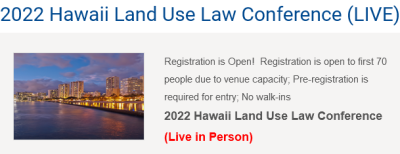
It’s back! After a hiatus on the in-person program, the bi-annual Hawaii Land Use Conference is back in-person (see here for a sample of one of our prior presentations at this conference).

May 25 and 26, 2022, downtown Honolulu.

The full agenda and speaker list has not yet been published, but here’s a summary of the program:

Sponsored by the Hawaii State Bar Association and the Real Property and Financial Services Section. Coordinated by David Callies and Benjamin Kudo, his 2-day conference is a must attend for any attorney or professional whose practice involves land use and development. Distinguished land-use practitioners, scholars, planners, and regulators from Hawaii and the Mainland will discuss timely and relevant issues, including:

• Takings 

• Transit Oriented Development (TOD) 

• Seawalls and Shoreline Access 

• Climate Change 

• Affordable/Workforce Housing 

• Ethical Considerations for Real Property Practitioners and Other Professionals

We’ll be speaking during

Continue Reading Hawaii Land Use Law Conference, May 25-26, 2022, Honolulu – Join Us!

Bergerpage

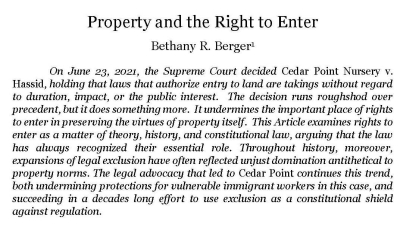
A new article by lawprof Bethany Berger, “Property and the Right to Enter,” criticizing the Supreme Court’s ruling in Cedar Point Nursery. The article builds on the amicus brief in the case, also authored by Prof Berger.

Here’s the Abstract:

On June 23, 2021, the Supreme Court decided Cedar Point Nursery v. Hassid, holding that laws that authorize entry to land are takings without regard to duration, impact, or the public interest. The decision runs roughshod over precedent, but it does something more. It undermines the important place of rights to enter in preserving the virtues of property itself. This Article examines rights to enter as a matter of theory, history, and constitutional law, arguing that the law has always recognized their essential role. Throughout history, moreover, expansions of legal exclusion have often reflected unjust domination antithetical to property norms. The legal advocacy that led to Cedar Point continues this trend, both undermining protections for vulnerable immigrant workers in this case, and succeeding in a decades long effort to use exclusion as a constitutional shield against regulation.

Definitely worth reading.
Continue Reading New Article (Bethany Berger): “Property and the Right to Enter”

PXL_20220422_171653637

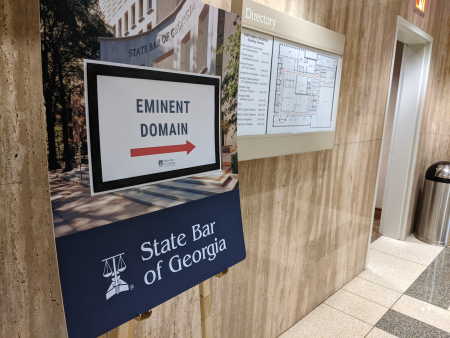
Here are the links to the cases and other materials that we talked about last Friday at the Georgia Bar Association’s annual Eminent Domain Conference. Our talk was entitled “It’s the Chief Justice’s Property World, We Just Live In It: National Trends in Takings, Property, & Eminent Domain,” and was part of the Eminent Domain Section’s (yes, the Georgia Bar has a Section entirely devoted to eminent domain!) annual conference on the topic. I was honored to have been asked to chat with this august and expert group of lawyers.


Continue Reading Links From Last Week’s Georgia Bar Association Eminent Domain Conference

FedCtsTakingsArticlepage1

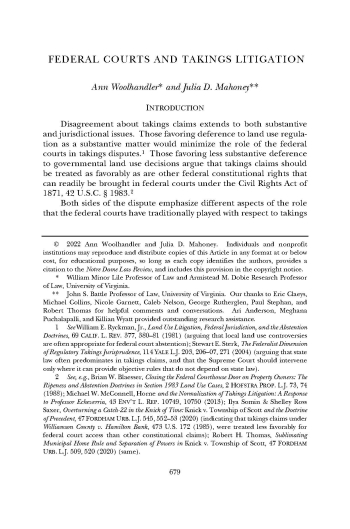
A new article on takings from U. Virginia Law School profs Ann Woolhandler and Julia Mahoney in the Notre Dame Law Review, “Federal Courts and Takings Litigation.” Get the pdf here.

Rather than try and summarize the piece, we’re just going to cut-and-paste the highlights from the article’s Introduction:

While Knick clearly expands the lower federal court role in takings claims, many questions remain. We do not know how federal courts will respond to the increase in claims—whether they will embrace a robust federal role in land use cases, or use various abstention doctrines to rein them in. While pro-regulatory and pro-property rights scholars have predictably taken sharply contrasting positions as to the appropriate federal court role post-Knick, this Article will recommend a middle-of-the-road approach, based partly on history and partly on an assessment of where the lower federal courts may most usefully contribute to the

Continue Reading New Article: Woolhandler & Mahoney, Federal Courts and Takings Litigation, 97 Notre Dame L. Rev. 679 (2022)

Even if the world were open today, the doors to most Hawaii state, county, and city offices would still be locked. Because today is the day that Hawaii celebrates Good Friday.

Yes, Good Friday is an an official state-sanctioned holiday in the 808 area code, so we’re reposting our annual recounting of how it came to be that the State commemorates the date of the crucifixion, and how that squares with the Establishment Clause of the First Amendment

Turns out that we don’t really commemorate today as the crucifixion date, and it is just coincidence that the official State “spring holiday” occurs on the same day. (And this being Hawaii, in the end it’s really a public worker’s union thing.)

Good Friday is a legal holiday in the State of Hawaii pursuant to Haw. Rev. Stat. § 8-1. [Barista’s note: here’s a case we argued a couple

Continue Reading Today Is Hawaii’s Secular Good Friday Holiday – A Day To Celebrate Public Worker Unions