2022

Not too long ago, we posted the Fifth Circuit’s panel opinion in a case where the court held that there’s nothing a federal court can do if a local government does not pay a state-court just compensation judgment. We filed an amicus brief in that case arguing “[t]he Takings Clause does not permit the Sewerage Board to take property and hand the owner an IOU the Board might pay sometime in the future if and when it feels like it. Instead, it requires the Sewerage Board to pay the court ordered just compensation without ‘unreasonable delay.'”

Well, in the interim we’ve traded in our amicus hat for a co-counsel hat, and last week asked the Fifth Circuit to rehear the case en banc, via this en banc petition.

Since we’re now co-counsel in the case, we won’t go into further detail, but will leave it there for you to

Continue Reading Are The Federal Courts Powerless When A Condemnor Doesn’t Pay Just Compensation?


Another takings challenge to a Co-19 shutdown, another “no taking” result.

This time, it is from the Florida District Court of Appeal (Fifth District). In Orlando Bar Group, LLC v. Desantis, No.5D21-1248 (Apr. 8, 2022), the court affirmed dismissal of takings challenges to the governor’s emergency order that barred certain alcohol sales, and limited the service in bars. Orlando-area bar owners sued for inverse condemnation.

The Fifth District concluded that this did not result in a taking. First, the court held that it would not apply a categorical physical rule, because Cedar Point Nursery is not applicable. In that case, the owners were asserting their right to exclude the public, but here the bar owners claimed that the restrictions abrogated their right to include patrons and others. Slip op. at 7 (“The COVID orders at issue here did not permit third parties to access Appellants’ property; they did

Continue Reading Fla App: No Taking, Because COVID Is A Really Good Reason To Shut Bars Down

Here’s the latest case challenging a pandemic-related eviction moratorium, this one from Minnesota and the U.S. Court of Appeals for the Eighth Circuit.

In Heights Apts, LLC v. Walz, No. 21-1278 (Apr. 5, 2022), the court reversed the district court’s dismissal of a property owner’s takings claims. The owner challenged the Minnesota governor’s residential eviction moratorium and later extensions. Like a lot of these things, the Minnesota version was not a rent “holiday” (tenants were still, technically speaking, on the hook for the rent, and there were several limited exceptions under which the property owner could evict). But for the most part, the Minnesota measure, like a lot of these things, effectively left property owners holding the economic bag (good luck collecting thousands in back rent), and turned their units into public pandemic housing. 

The owner’s complaint raised Contract Clause, Petition Clause, and Takings claims.

Before we get to

Continue Reading CA8: Yee v. Escondido Doesn’t Save Eviction Moratorium From Takings Review

6a00d83451707369e20240a4eeb054200d-800wi

When we met for the 39th ALI-CLE Eminent Domain & Land Valuation Litigation Conference in-person in Scottsdale a couple of months ago, we hinted that you’d like the venue for the 2023 Conference. We say “hinted” because without an executed contract with the venue, we could not officially announce it.

But the good folks at ALI-CLE have let us know that signed, sealed, and delivered the agreement, and that we can make the official announcement. So here it is: for the 40th ALI-CLE Eminent Domain & Land Valuation Litigation Conference, we will be returning to one of our favorite cities, Austin, Texas. Details:

Date: February 2-4, 2023 (as usual, the week between the playoffs and the Super Bowl)

Conference hotel: Sheraton Austin Hotel at the Capitol

Programming: the same high-quality presentations you know and love.

We were last in Austin in 2016, and even though the city has

Continue Reading It’s Official, So Mark Your Calendars: ALI-CLE Eminent Domain & Land Valuation Litigation Conference: Feb 2-4, 2023, Austin, Texas

Here’s an issue that we’ve been following for a while. What will a court do when a condemnor is ordered to pay (the property owner has a judgment in hand), but the condemnor says “no thanks”?

The latest incarnation is the U.S. Court of Appeals’ opinion in Ariyan, Inc. v. Sewerage & Water Board of New Orleans, No. 21-30335 (Mar. 21, 2022). There, a group of property owners successfully brought Louisiana law takings claims against the Board after its flood control project caused “property damage and economic loss.” In the various cases, verdicts were rendered, and judgments were issued from 2018 through 2020.

Well, you know what is supposed to happen next. Judgment debtors are supposed to pay up, or else the judgment creditor may satisfy the judgment by other means.

But when the government is the judgment debtor, the creditor can’t just put a lien on City

Continue Reading What Can A Property Owner Do When A Condemnor Doesn’t Pay? (Fifth Circuit: Nothing)

JayMassey

From the “too modest” department: when you find out that a fellow you knew only as an appraiser/MAI (who once mentioned offhand that he was “in the Army for a bit before I became an appraiser”) was so much more than what you knew him as.

Yes, he was the one who taught you about appraisal science and art, and helped you pick apart the other side’s valuation. But only in his obituary do you learn that Jay Massey MAI was one of the legendary MAC-V/SOG operators; indeed a “One-Zero” (team leader), and spent years at the front lines and behind the lines. Master Blaster. One STRAC individual. One of the old school Green Berets, who answered JFK’s call to do for his country, and lived up to the label “the Quiet Professionals.”

Jay, I wish you had been less modest, a bit less quiet. You and I would

Continue Reading Adieu To A Quiet Professional – Jay Massey

Check out the U.S. Court of Appeals for the Eighth Circuit’s opinion in 301, 712, 2103 and 3141 LLC v. City of Minneapolis, No. 20-3493 (Mar. 14, 2022), in which the court held that a Minneapolis ordinance prohibiting property owners from rejecting a prospective tenant because of the applicant’s criminal, credit, or rental history isn’t a taking.

The challenged ordinance “requires landlords to evaluate applicants for rental housing by either (1) ‘inclusive screening criteria’ or (2) ‘individualized assessment.'” Slip op. at 2. That’s a roundabout way of saying that a property owner cannot reject an applicant for their criminal or credit background, unless the owner first considers other “supplemental evidence” to justify why the applicant should become a tenant in spite of these problems, and notifies the tenant why this evidence isn’t enough to outweigh the problems. 

The court first rejected the owners’ claim that the ordinance allows third

Continue Reading CA8: Ordinance Making It Really Really Hard To Reject Tenants Isn’t A Physical Taking

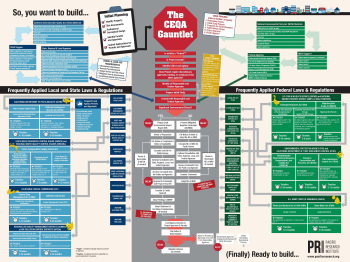
CEQAflowchartSee if you can navigate this maze.

Even if you are not in California, this thing called “CEQA” (the California Environmental Quality Act) is something you might have heard of. An environmental reporting statute on steroids, CEQA is, according to this new report from the Pacific Research Institute, the main reason why California is home to the unbeatable combination of sky-high home prices and nation-leading poverty rate, and has become as famous for its homeless problem as its beaches

In “The CEQA Gauntlet,” the authors report that the above problems are products of the fact that it is “very, very hard to build homes in California.” And the reason it is hard to build homes in California? That’s right, CEQA.

What started off as a data-gathering and informational requirement (so that the decision makers could incorporate environmental considerations) has become the tail that wags the dog

Continue Reading Death By A Thousand Days: Presenting “The CEQA Gauntlet” Report

When you are building a sewer, grading is important. Otherwise, the stuff might not “flow” correctly, if you get our drift. Okay Public Works Authority built a sewer, and guess what? “The work performed by OPWA caused extensive damage” to private property, and the “lines installed by OPWA had not been properly graded.”

Not good. The jury in the inverse condemnation lawsuit that followed awarded $73k in compensation. The court of appeals, however, tossed the verdict because OPWA did not possess the power of eminent domain to take property for sewage lines. And to be liable for inverse in Oklahoma, the defendant must possess the eminent domain power.

In Barnett v. Okay Public Works Authority, No. 117792 (Mar. 8, 2022), the Oklahoma Supreme Court concluded that the utility possesses the eminent domain power to take property for sewer lines. The decision turned on the language in the statute delegating

Continue Reading OK: Inverse Is A Two-Way Street – Utility Has Eminent Domain Power, So Is On The Hook For Inverse

Here’s a really short one from the U.S. Court of Appeals for the Fourth Circuit. Not published, so even shorter than you might expect.

In Virginia Hospital & Healthcare Ass’n v. Kimsey, No. 20-2176 (Mar. 1, 2022), the court rejected the Commonwealth’s argument that the sole remedy for a takings claim is just compensation.

The plaintiff challenged a statute which limited their ability to obtain reimbursement for medical services rendered to Medicaid patients, which instead keys reimbursement to the patients’ diagnoses. According to the plaintiffs, this scheme leaves them holding the financial bag in situations were they render services that the statute deems avoidable because of the final diagnosis. 

The complaint alleges a regulatory taking, because the statute “denies just compensation for federally-mandated emergency services by predicating reimbursements on the final diagnosis only – and not on the services actually provided,” and for reimbursing at only 1/2 the usual

Continue Reading CA4: Just Comp Isn’t The Only Remedy For A Taking