


2022

Screenshot 2022-09-13 at 14-12-11 Feed LinkedIn

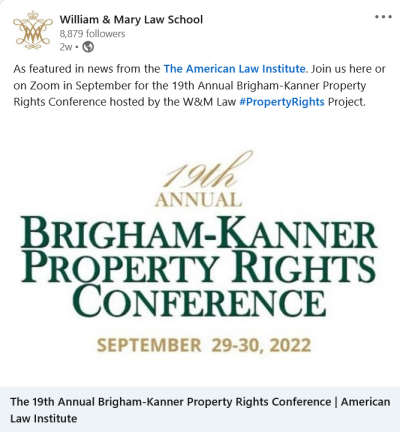
One last reminder that there’ still time to register for the upcoming Brigham-Kanner Property Rights Conference at the William and Mary Law School in Williamsburg, Virginia, September 29-30, 2022. If you can’t make it to the historic campus, there’s an option to attend remotely.

In our opinion, the Conference is the best of its kind because it brings together legal scholars and the practicing bar to talk dirt law theory and practice. We also a have a full supplemental program for law students, that covers property law and careers in eminent domain law, a recruiting session, a program on international property rights, and a program on land use law.

Registration for the Conference is ongoing, and you can sign up here.

Here is the full agenda. (We’ll be speaking on Panel #2, “Reshaping the Framework Protecting Property Under the Roberts Court.”)

Come on, join us!
Continue Reading Still Time To Join Us (In-Person Or Remote) For The 19th Annual Brigham-Kanner Property Rights Conference

A short one (unpublished) from the U.S. Court of Appeals for the Sixth Circuit, considering an issue we’ve been following: what is the effect of the government’s claim that it is regulating property for what looks like a valid “police power” purpose?

As noted, that’s a road we’ve been down before. Here’s a sampling:

In Bojicic v. Dewine, No. 21-4123 (Aug. 22, 2022), the Sixth Circuit was considering a takings and due process challenge to the governor’s Co-19 shutdown orders. The court rejected the district court’s rationale

Continue Reading CA6: No “Police Power” Exception To Takings (But It’s Nonetheless Dispositive As Penn Central’s Character)

Screenshot 2022-09-11 at 21-59-15 Northwestern University Law Review Vol 117 Iss 1

Be sure to check out Northwestern Law Review’s symposium issue on “Reimagining Property Rights in the Era of Inequality.” which brought together “scholars of legal history, property, tax, land use, fair housing, environmental law, natural resources and water rights, family law, education, and constitutional law, to highlight new scholarship at the intersection of these fields.”

We found the essay by Professor Fennell (“Streamlining Property,” and the essay by Timothy Mulvaney (“Compulsory Terms in Property“) to be of particular interest. Full list of essays above, or here.Continue Reading New Symposium: Northwestern L. Rev.’s Property Issue

Screenshot 2022-09-08 at 11-03-58 Cedar Point Nursery and the End of the New Deal Settlement

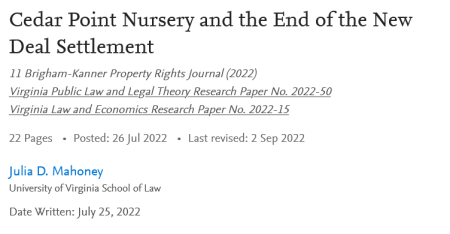
Here’s your must-read for today, a new article from U. Va. lawprof Julia D. Mahoney, “Cedar Point Nursery and the End of the New Deal Settlement.”

Disclosure: we show up in footnote * along with others for offering “comments and conversations” about the piece. 

Here’s the Abstract:

In Cedar Point Nursery v. Hassid, the United States Supreme Court ruled that a California state regulation granting labor organizations a limited “right to take access” to agricultural employers’ property constitutes a per se physical taking. Cedar Point has sparked intense criticism, with critics arguing that the decision threatens to transform the law of property rights so as to “hobble” government land use regulation and even undermine democracy. This Article explains why the objections of Cedar Point’s detractors are misplaced. Far from disabling government regulation or fomenting stasis by favoring the “already haves,” Cedar Point is best understood as another

Continue Reading New Must-Read Article: “Cedar Point Nursery and the End of the New Deal Settlement” – Property Rights Are Civil And Human Rights

Be sure to check out Anthony Alderman (MRICS, SR/WA, CRE, Senior Managing Director at Cushman & Wakefield), who guests on Episode 98 of Clint Schumacher’s Eminent Domain Podcast, “Eminent Domain in Pop Culture.”

You know we are going to really appreciate an episode “about depictions of eminent domain in popular culture – often a juror’s only prior exposure to condemnation law.” Whether it’s the vibe of contitution, or how eminent domain can show up in novels, Netflix, Russian and Australian movies, memes (and meme briefs), or nerding out on Star Trek metaphors. We love this topic.

But it’s not all distractions, because the episode also covers “what makes appraising for eminent domain acquisitions different from other appraisal projects as well as current issues of interest in the appraisal field.”

What a fun episode. Don’t miss it. Continue Reading It’s The Vibe! – Eminent Domain In Pop Culture

Here’s the latest in a controversy we’ve been following.

In 624 Broadway LLC v. Gary Housing Authority, No. 22S-CT-140 (Aug. 29, 2022), the Indiana Supreme Court held that the Authority failed to provide the property owner adequate notice that it would be taking its property as part of a redevelopment project.

The Gary Housing Authority wanted to redevelop 624 Broadway’s commercial property in downtown Gary into mixed-use residential. The Authority instituted an “administrative taking” under Indiana law, which is “an alternative to the ‘traditional’ lawsuit route” that “occurs when an authorized governmental body condemns property and awards damages through resolutions.” Slip op. at 2.

The administrative taking statute only requires notice to the property owner by publication. And that’s exactly the notice the Authority gave 624 Broadway. “It twice published notice of the resolution and upcoming meeting in two area newspapers of general circulation.” Id. Broadway’s agent found

Continue Reading Indiana: Before Taking Property, Condemnor Must Provide Notice Reasonably Calculated To Put The Owner On Actual Notice

Every year at this time, it seems, we’re realizing again that as you get older, you forget birthdays. It occurred to us only over this past weekend that that this blog’s “birthday” was looming and we almost let it slip by without notice. It hardly seems like sixteen years ago that we posted here for the first time.

In law blog years, that’s quite a while.

Because doing this in a vacuum would not be worthwhile, we’d like to recognize those who send us items, who make comments, who give us feedback, who gently prod with suggestions, and who simply read and subscribe. You guys make the efforts that go into this thing all worth it. You are why we keep it going: this blog has allowed us to connect with many of you over the years all over the country and even internationally, an opportunity we’d otherwise

Continue Reading They Say It’s Your Birthday, Well It’s Our Birthday Too, Yeah!

The facts are pretty straightforward in the U.S. Court of Appeals’ opinion in Frein v. Pennsylvania State Police, No. 21-1830 (Aug. 30, 2022):

Eric Matthew Frein is on death row for cold-blooded murder. In 2014, he ambushed two Pennsylvania State Troopers, killing one and injuring the other. For a while, he evaded capture. Police knew he had used a .308-caliber rifle. So they got a warrant to search the home that he shared with his parents and seize that type of rifle and ammunition.

When they executed the warrant, state police did not find a .308-caliber rifle. Instead, they found forty-six guns belonging to the parents: twenty-five rifles, nineteen pistols, and two shotguns. None was a .308. Even so, the officers got a second warrant and seized them all.

Slip op. at 3.

The police eventually got their man, and Frein was tried and convicted. His appeals (including discretionary

Continue Reading CA3: Claim That Govt Is Keeping Property Seized (But Not Used) As Evidence “checks all the Fifth Amendment boxes.”

You remember our earlier posts about the issue (known as “home equity theft”). In a series of decisions mostly by state supreme courts, those courts have asked whether it is legal for a state or local government to “keep the change” after seizing and selling a tax debtor’s property. For examples, see these cases:

For more on the issues, check out the video above.

Thing is, not every court so far has seen it this way. At least two have held that there’s no takings or other constitutional problem. Nebraska said no, as did the U.S. Court of Appeals for the Eighth Circuit.

With a divergence in the lower courts you know what comes next, don’t you? That’s right, certiorari. Here are two new takings cert petitions, recently

Continue Reading New Cert Petitions: “Keeping The Change” After Tax Foreclosure Is A Taking

You remember that case we posted recently, from the U.S. District Court for the Eastern District of Texas in which the court granted summary judgment to a property owner after the city police damaged her home in the course of the police’s apprehension of a suspect. The court rejected the Tenth Circuit’s rationale in a similar case (which concluded that these are “police power” actions, and thus never a taking).

After that ruling, the remaining issues (was the city liable under section 1983, and if so what is the just compensation owed) were tried by a jury.

On June 20, 2022, this case went to trial. Two days later, the jury returned its verdict (Dkt. #74). The jury found the City was liable under § 1983 because it acted under color of state law when it violated Baker’s constitutional rights under the Fifth Amendment of the United States Constitution by

Continue Reading District Court Declines To Back Off Its “SWAT Takings” Verdict