July 2023

The Eleventh Circuit’s short opinion (really short – 1.5 pages) in Sabal Trail Transmission, LLC v. 3-921 Acres of Land, No. 22-10435 (July 25, 2023), is straightforward: to resolve whether a Florida property owner subject to a private condemnor taking under the federal Natural Gas Act has a property right in attorneys fees and costs, the court applied a recently-decided circuit panel opinion that held yes:

The Natural Gas Act authorizes private entities who have received a certificate of public convenience and necessity to acquire property “by the exercise of the right of eminent domain.” 15 U.S.C. § 717f(h). Sabal Trail Transmission, LLC, invoked this power of eminent domain to acquire easements to build a pipeline on land owned by Sunderman Groves, Inc. In the condemnation proceeding, the district court determined that the Act incorporates state eminent domain law, and it consequently applied Florida law to grant attorneys&rsquo

Continue Reading CA11’s Eminent Domain Attorneys Fees Ruling Is Controlled By Prior Panel
A short (but interesting) one from the Ohio Supreme Court. In State ex rel. Balunek v. Marchbanks, No. 2021-1469 (July 25, 2023), the court held that a physical takings claim alleging the DOT cut off access to property was ripe, even though the owner might have applied for permit to gain access.

As part of a road construction project, ODOT removed and didn’t replace two driveways to the property, landlocking it. ODOT admitted it did so, but didn’t include the lost access in the compensation by arguing “that access could be [re]established if Balunek obtains a ‘street opening permit’ from Cleveland. Slip op. at 3.

The owner sued, seeking a writ to compel ODOT to formally condemn the access. Remember that Ohio does not recognize the usual inverse condemnation remedy, but in situations where an owner asserts its property has been taken and the government has not paid compensation

Continue Reading Ohio S Ct Rejects Attempt To Import Regulatory Takings Ripeness Into Physical Takings

Here’s what we’re reading today:


Continue Reading Tuesday Property Round-Up (International Edition)

The city told an owner whose three parcels were outside of the city’s jurisdiction that if it wanted the city’s permission to replat into 74 parcels, it would need city water and sewer service to each of the proposed lots.

So the owner asked to connect to the city’s water and sewer system (deliberately overbuilt to account for future users, apparently), and in response, the city told the developer that it would have to do two things. First, it would have to contribute to the cost of building the system by purchasing water/sewer chits (our term). When the system was built, the city anticipated future connections and created a chit system by which future connections would help pay for the cost of construction. Second, in order to purchase these chits, the buyer’s property must be included within the city’s jurisdiction. And that meant a voluntary annexation. Annexation does not come

Continue Reading Tex App: Nollan/Dolan Challenge To Annexation Fees Not Ripe: You Have To Apply For Annexation To Find Out What The Fee Will Be

PC PREL

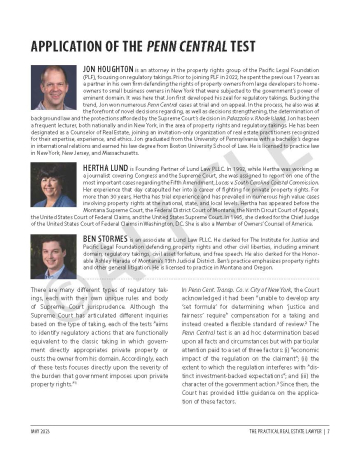
Here’s a recently-published article (ALI-CLE’s The Practical Real Estate Lawyer) on a subject that we know you will want to read about: Jon Houghton, Hertha Lund, and Ben Stormes, Application of the Penn Central Test, 7 Prac. Real Estate Lawyer 7 (May 2023).

Check it out. It’s short, practical (naturally), and worth your time.

Jon Houghton, Hertha Lund, and Ben Stormes, Application of the Penn Central Test, Prac. Real Estate Lawyer…

Continue Reading New Article: Application of the Penn Central Test

The latest in a case we’ve been following doesn’t get to the substantive issue: is a local park district authorized to take private property for a bike path when the statute authorizes takings for “conservation of natural resources?”

Instead, the Ohio Supreme Court dismissed the appeal for a familiar reason: lack of a final judgment. In Mill Creek Metro. Park District v. Less, No. 2022-0628 (July 11, 2023), the court did not consider the issue, but instead concluded the trial court proceedings were not yet final.

Here’s how the case set up procedurally. The district instituted state court eminent domain actions to take Less’s land for the bike path. Less objected, asserting that the district lacked the power to take land for a bike path. Less sought summary judgment on that issue, which the trial court denied. Normally, in the absence of some kind of interlocutory appeal, denials of

Continue Reading Ohio S Ct In Power-To-Take Case: Too Soon!

Screenshot 2023-07-16 at 08-30-00 SLG Section News 06-21-2023 2023 Jefferson Fordham Award Honorees Screenshot 2023-07-16 at 08-29-44 SLG Section News 06-21-2023 2023 Jefferson Fordham Award Honorees

Join us in Denver in a few weeks at the American Bar Association Annual Meeting where our section, the Section of State and Local Government Law, will be presenting the Jefferson Fordham Awards.

The Jefferson B. Fordham Awards, the highest honors given by the ABA Section of State and Local Government Law, recognize the accomplishments of those who have been active in the various areas of state and local government law. The award is named for the section’s first chair in 1949. Fordham diligently served and made the section the national resource for the advancement of state and local government law practice.

The Lifetime Achievement award will be presented to a lawyer that every reader of this blog already knows well, Michael Berger:

Berger, one of the top land use and condemnation attorneys in the United States, is a California lawyer and a senior counsel at

Continue Reading Property Rights Icon To be Recognized By ABA With Lifetime Achievement Award (Aug. 4, 2023)

PXL_20221211_185826126
The Mahon Property

Join us on Friday, August 4, 2023 (10:30-11:30am, MT) in Denver at the ABA Annual Meeting for our CLE session on “The 100th Anniversary of Pennsylvania Coal v. Mahon: How the Takings Clause Became the Primary Check on Government Power When SCOTUS Abandoned Review Under the Due Process and Contracts Clauses During the New Deal.”

The program description:

The Takings Clause and 100 years of the Pennsylvania Coal v. Mahon doctrine have become the primary check on governmental power that the Due Process and Contracts Clause used to serve, before the Supreme Court finally and formally abandoned judicial review under those doctrines during the New Deal. Mahon transcended its primary relevance as to compensation for the taking of private property to become the fundamental means by which the Rule of Law determines of the individual’s relation with the government.

This session will survey the evolution

Continue Reading Aug 4, 2023: “The 100th Anniversary of Pennsylvania Coal v. Mahon: How the Takings Clause Became the Primary Check on Government Power” (ABA Annual Meeting, Denver)

When a condemnor is told “no” (or voluntarily drops an eminent domain lawsuit), many jurisdictions require it to pay attorney fees to the parties on the target end of the vs.

Colorado is one of those jurisdictions, and as the Colorado Court of Appeals noted in Mulberry Frontage Metro. Dist. v. Sunstate Equip. Co., No. 22CA0680 (July 13, 2023), the “[t]he General Assembly has provided that when a court rejects a condemnation petition on the grounds that the petitioner isn’t authorized to acquire the subject property, ‘the property owner who participated in the proceedings’ is entitled to recover their reasonable attorney fees and costs.” Slip op. at 2. Sounds good, Colorado.

Clear enough when the “property owner” claiming fees is the title (fee) owner. And here, the trial court concluded that Mulberry did not have the power to take. The fee owner plainly had the right to recover

Continue Reading Colorado App: Lessees Are Not “Property Owners” Under Attorney Fees Statute

Not saying Kelo

A big thanks to friend and colleague Paul Henry for bringing to our attention this article by Andrew Stuttaford, UFOs and Eminent Domain.

No, it (unfortunately) is not the latest tenure-making scholarly law journal article (but we can dream, can’t we?), but a piece in National Review.

It details a proposal to release federal documents relating to UFOs. Nice. But buried in the measure is this (according to Reuters):

Under the measure, records must be publicly disclosed in full no later than 25 years after they were created unless the U.S. president certifies that continued postponement is necessary because of a direct harm to national security.

It also establishes that the federal government would have “eminent domain” over any recovered technologies of unknown origin and any biological evidence of “non-human intelligence” that may be controlled by private individuals or entities.

Who among us is going to be

Continue Reading New Article: “UFOs and Eminent Domain”