July 2023

Every law school graduate surely remembers that 1L Contracts case about the two ships named “Peerless” and the doctrine of mutual mistake.

In Marchbanks v. Ice House Ventures, LLC, No. 2022-0047 (June 8, 2023), the Ohio Supreme Court rejected the DOT’s claim that a previously-agreed-upon agreement to settle an eminent domain action did not reflect a meeting of the minds, because it was the product of a mutual mistake.

Here’s the story. ODOT instituted an eminent domain case to take the property of Ice House Ventures for a freeway improvement project. A few days before the jury trial on valuation was to get underway, the parties settled. ODOT agreed to two things: (1) pay $900k compensation, and (2) transfer to IHV a separate small parcel of land owned by the City of Columbus, to be used by IHV for a 12-car parking lot. ODOT believed the city would be

Continue Reading “Peerless” Eminent Domain Settlement Agreements: No Mutual Mistake In “Damages” Term

 A short one from the Florida District Court of Appeals (First District).

In D’Arcy v. Florida Gaming Control Comm’n, No. 1D21-3606 (May 24, 2023), the court held that the voters of Florida adopted Amendment 13 to the Florida Constitution that outlawed betting on greyhound racing (indeed betting all dog racing), it did not effect a Penn Central taking of the property of the owner of a greyhound racing business.

The trial court granted the state summary judgment, and the appeal court affirmed. The court also pointed out that the Amendment didn’t ban dog racing outright, merely betting on dog racing. Slip op. at 3. The court focused on a single Penn Central factor, the “expectations” question and held that “given then heavily regulated field of gambling, D’Arcy did not have a reasonable expectation that the investment in dog racing could not be severely impacted by regulation.” Id.

It is

Continue Reading Don’t Release The Hounds! No Taking When Florida Voters Outlawed Dog Race Gambling

Screenshot 2023-07-08 at 12-41-47 Property as Service Streams

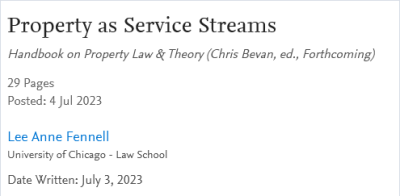
New noteworthy dirt law scholarship, from U. Chicago’s Prof. Lee Anne Fennell, “Property as Service Streams.” Here’s the Abstract:

Property’s job is to help people derive benefits from resources. But often it cannot do this work well. A core problem is an outmoded model of benefit production that treats the individually owned parcel or “thing” as the relevant unit of analysis. In this paper, I argue for a conceptual shift from a property-as-thing-ownership (PATO) paradigm to a property-as-service-streams (PASS) model. I start with the simple point that resources are only valued for the streams of beneficial services that they can provide. Further, owned items can only stream services to their users when combined with other resources and entitlements, many of which are controlled by other parties. Keeping discrete owned assets at center stage misdirects energy towards allocating and protecting things, when we should be examining how to nurture

Continue Reading New Scholarship: “Property as Service Streams” (Prof. Lee Anne Fennell)

Update: someone blinked – between the time we drafted this post and the time is actually posted, we understand that this case settled. But the “spite takings” issue remains of interest, so we’re leaving this post up.

——————————————————————————————

You already know about the prior public use issue, often arising in government-to-government takings. The Fifth Amendment requires a public use and compensation for the taking of “private property,” so does it apply where the condemnor is seeking to take property owned not by a private owner, but by the public or by the government?

The Kentucky Supreme Court has agreed to review a case with an interesting twist on that scenario. In City of Cold Spring v. Campbell County Bd. of Education, No. 2021-CA-001470 (Dec. 16, 2022), a county board of education sought to exercise eminent domain to take property owned by a city. The

Continue Reading Kentucky SCT To Review Prior Public Use Case Where City Purchased Property To Thwart School Board’s Acquisition

The voters of South Lake Tahoe, California, adopted an ordinance that forbade the city from issuing short-term rental permits for properties in residential zones unless the owner was a permanent resident of the city, and declared that all short-term rental permits would expire three years later. The trial court granted the city summary judgment on all claims raised by an association of property owners who rented short-term. 

In South Lake Tahoe Property Owners Group v. City of South Lake Tahoe, No. C093603 (June 20, 2023), the California Court of Appeal mostly agreed, holding that the owners’ vested rights and state law preemption claims did not survive. But the court disagreed with the trial court’s dismissal of a (dormant) Commerce Clause challenge to the residency component. As noted in this recent Fifth Circuit decision, local ordinances that discriminate between residents and non-residents are (or at least could be) too

Continue Reading Cal Ct App: Prohibition On Short-Term Rentals Might Have A Commerce Clause Problem

Screenshot 2023-07-03 at 20-07-59 Texas A&M Journal of Property Law Vol 9 No. 4

The Texas A & M Journal of Property Law is always a good read, with many articles worthy of your time. But the Journal‘s latest, Volume 9, No. 4 (2023) stands out because it includes the papers for the Symposium on Natural Property Rights.

Check out these titles and authors:


Continue Reading New(er) Articles: Texas A & M Journal of Property Law – Natural Property Rights Symposium

Here’s a short one from the Kansas Supreme Court. In Kansas Fire and Safety Equipment v. City of Topeka, No. 123,063 (June 30, 2023), the court concluded that the requirements of the Kansas Relocation Act do not give rise to a private right of action, and that relocation costs are not a component of just compensation. 

We’re not going to dwell on the decision too much, since it is limited to Kansas law. But here are your highlights:

  • “Kansas Fire and Safety Equipment, Hal G. Richardson d/b/a Bueno Foods Brand and Topeka Vinyl Top, and Minuteman Solar Film (the tenants), were forced to relocate when the City of Topeka (the City) bought the real property the tenants leased for their business operations. The tenants alleged that the property was acquired before a condemnation action. And they sued the City to recover relocation expenses in an action filed directly with


Continue Reading Kansas: No Private Enforcement Of State Relocation Act (And Relocation Isn’t Part Of Just Compensation)

As you can tell from the date of the opinion, we’ve been meaning to post the South Carolina Supreme Court’s ruling in Braden’s Folly, LLC v. City of Folly Beach, No. 2022-000020 (Apr. 5, 2023) for a while. Something else always intervened, but it remains a decision worth reviewing.

The city adopted an ordinance that erased lot lines for certain contiguous properties under common ownership, merging two distinct parcels into one and prohibiting their separate sale. The ordinance recognized nonconforming uses. Braden’s properties are covered by the ordinance.

When Braden’s Folly acquired the Lots in 1999, there was a small house on Lot A, and Lot B was undeveloped because it was either underwater or part of the active beach. Following a beach renourishment in 2005, Lot B became developable because it had been transformed into mostly sandy beach. Therefore, between 2006 and 2007, Braden’s Folly received building permits

Continue Reading SC: No Penn Central Taking For City Ordinance Merging Contiguous-But-Separate Parcels

001q

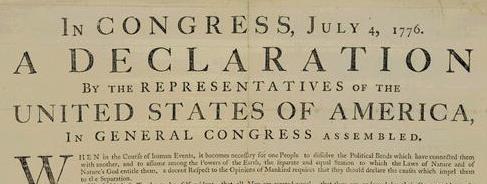
It’s not quite “Yes Virginia…” but here is our annual Independence Day missive on the legal angle on the Declaration. This may have special significance as the nation is in the process of reexamining many of our assumptions and history. But though the Founders may have been flawed individuals, there’s really no question about the ideas they captured, and — thankfully — put down on paper for posterity.

Civil Beat published a version of this post here.

—————————————————————————————

We know lawyers are easy targets (we enjoy lawyer jokes as much as the next person, i.e., What’s the difference between a good lawyer and a great lawyer? A good lawyer knows the law; a great lawyer knows the judge.). Still, as we celebrate our independence, we note that author Thomas Jefferson and 23 other of the 56 signers of the Declaration of Independence were lawyers, and that


Continue Reading The Verified Complaint In Equity: The Declaration Of Independence, v.247

As we’ve noted before, we think courts generally don’t like it when they are asked to revisit a dispute that was settled by agreement. Yes, settlement agreements are contracts, and just like every other contract they are subject to enforcement, breach actions, and the like.

But our experience is that courts are not keen on revisiting, because when you settle, you settle. Write up that settlement agreement well, counsel, because if everyone isn’t going in with eyes wide open about what they are agreeing to, what they aren’t agreeing to, and what are the potential risks down the road, you probably won’t get a second judicial bite to complain. 

The Colorado Court of Appeals’ opinion in Denver v. Monaghan Farms, No. 22CA0956-PD (June 29, 2023) just might reflect that sense (or maybe the party arguing that the settlement agreement didn’t do what the other party said just didn’t

Continue Reading Courts Don’t Like Trying To Unwind Settlement Agreements (Esp. Condemnation Settlements)