August 2023

Every year at this time, it seems, we realize once again that as you get older, you overlook birthdays. Time speeds up, or maybe slows down. Very Proustian.

Thus, it occurred to us only yesterday that that this blog’s “birthday” was looming and we almost let it slip by without notice. It hardly seems like seventeen years ago this day that we posted here for the first time.

In law blog years, that’s quite a while. Thanks to you, our readers and contributors, we’re still here, and still going pretty strong over 4,500 posts and nearly two decades later. 

Because doing this in a vacuum would not be worthwhile, we’d like to recognize those who send us items, who make comments, who give us feedback, who gently prod with suggestions, and who simply read and subscribe. You guys make the efforts that go into this thing all worth

Continue Reading They Say It’s Your Birthday, Well It’s Our (17th) Birthday Too, Yeah!

This is one of ours — argued by our Pacific Legal Foundation colleague Kady Valois — so we won’t be offering any commentary.

But we just have to post the U.S. Court of Appeals’ opinion in Iten v. County of Los Angeles, No. 22-55480 (Aug. 30, 2023), because it discusses two significant issues, and sets out a roadmap for how to successfully plead a Contracts Clause claim.

First, standing. The court held that a commercial property owner — a retired auto mechanic who leased his premises to an auto repair shop — has Article III standing to challenge the County’s commercial eviction moratorium which prevented the owner from evicting the tenant when it stopped paying rent but did not vacate. The court distinguished the standing requirement of “demonstrating injury in fact” from the question of whether the plaintiff has actually been injured. The first is a pleading requirement and

Continue Reading CA9: Property Owner Has Standing To Challenge Commercial Eviction Moratorium Under Contracts Clause

Screenshot 2023-08-26 at 10-33-05 Brigham-Kanner Property Rights Conference

Heads-up: the registration page for the 20th Brigham-Kanner Property Rights Conference, October 26-27, 2023, at the William and Mary Law School in Williamsburg, Virginia, is now up.

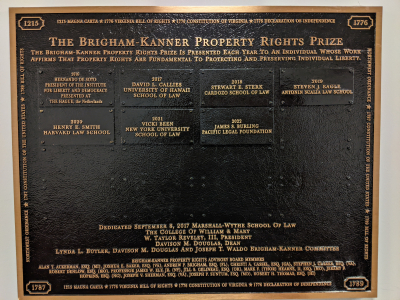
Early registration is a good thing because space is limited, especially at the Wren Building banquet on the 26th, at which the 2023 B-K Property Rights Prize will be presented to Prof. Gregory Alexander.

So please don’t miss out.

2022 BK plaque
The Property Rights Hall of Fame (second plaque)

If you are not already familiar with the Conference, it is (in our opinion) the best one-day event on property and property rights theory and practice. Expressly designed to bring together the legal academy and the practicing dirt law bar, the conference is where we discuss the burning property and property rights issues of the day. Here’s the 2023 Program:

  • Property and Propriety (or a Well-Ordered Society): A Tribute to Gregory S.


Continue Reading Register Now For The 20th Brigham-Kanner Property Rights Conference, Oct. 26-27, 2023

The buried lede in the U.S. Court of Appeals for the D.C. Circuit’s opinion in Valancourt Books, LLC v. Garland, No. 21-5205 (Aug. 29, 2023) is that the government doesn’t have that big of a role in copyrights, at least in the bare minimum of copyright protections.

We’re no copyright experts (that’s an understatement), but we knew the basics here: in order to have a copyright and all the rights that entails, the owner need do nothing more than fix the work in a tangible medium. No formalities are necessary, including publication. As the court put it, “[c]opyright thus accrues automatically upon creation of an original work in a tangible medium, and creators need not take any further action such as publication or registration to gain the protection.” Slip op. at 4.

You may register your copyright to obtain certain other benefits — for example, registration is prima facie

Continue Reading DC Circuit: US Copyright Office’s Requirement To Turn Over Copies Is A Taking

Remember that recent First Circuit case which held that just compensation judgements cannot be subject to a governmental bankruptcy plan (cert denied, by the way)? There, the court concluded that “[t]he Fifth Amendment provides that if the government takes private property, it must pay just compensation. Because the prior [bankruptcy] plan proposed by the Board [the bankruptcy trustee] rejected any obligation by the Commonwealth [of Puerto Rico] to pay just compensation, the Title III [bankruptcy] court properly found that the debtor was prohibited by law from carrying out the plan as proposed.”

Well, here’s the other shoe dropping. In In re Financial Oversight & Management Board for Puerto Rico v. Cooperativa de Ahorro y Credito Abraham Rosa (Suiza Dairy Corp.), No. 22-109 (Aug. 22, 2023), the same court held that a just compensation judgment may not be subject to reduction or discharge in a subsequent bankruptcy, but

Continue Reading CA1: Settling A Just Compensation Claim Trades Your Property Rights For Contract Rights – Which, Unlike Just Compensation Claims, Can Be Wiped Out In Bankruptcy

Here’s our colleague and friend, Pepperdine lawprof Shelley Saxer, an expert on inverse condemnation and its use in mass disaster cases, on the use of inverse condemnation as a theory of recovery for the Maui disaster. Here’s the description from Bloomberg Law Podcast:

“Shelley Ross Saxer, a law professor at Pepperdine University, discusses the Lahaina fire victims using a legal shortcut to secure compensation from Hawaiian Electric. June Grasso hosts.”

Worth a listen.Continue Reading Lawprof Shelley Ross Saxer Joins Bloomberg Law Podcast On Maui Wildfires And Inverse Condemnation

On this morning’s drive-time program, we joined KHVH’s Rick Hamada about whether Hawaii might adopt California’s version of inverse condemnation liability in wildfire cases. We also tried to clear up a few misconceptions (gad, I used “disinformation,” a term I try to eschew).

Here’s the program description:

Inverse Condemnation and Maui Wildfires: A Conversation with Robert Thomas

Tune in to a thought-provoking episode where we engage in a conversation with legal expert Robert Thomas on the topic of inverse condemnation in relation to the recent Maui wildfires. As the community grapples with the aftermath of the devastating fires, we delve into the legal aspects of property rights, government accountability, and compensation for affected individuals. Join us as we explore the implications of inverse condemnation, a legal doctrine that holds governments accountable for taking private property without just compensation. Gain insights into the challenges faced by property owners in the wake

Continue Reading Our Drive-Time Conversation About Hawaii Inverse Condemnation And Wildfires

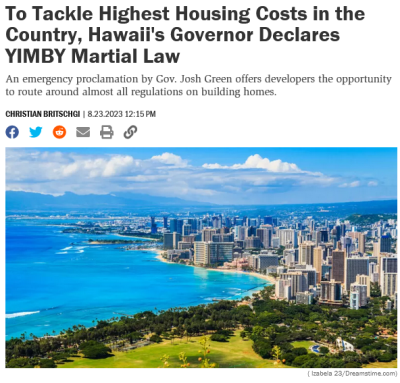
Screenshot 2023-08-23 at 16-13-54 To tackle highest housing costs in the country Hawaii's governor declares YIMBY martial law

Here’s an excellent report on a situation we’ve been following, the Hawaii governor’s proclamation of a housing emergency. In “To Tackle Highest Housing Costs in the Country, Hawaii’s Governor Declares YIMBY Martial Law,” Christian Britschgi at Reason writes:

Developers with a [Beyond Barriers] working group [what we cheekily referred to as the “Privy Council”]–certified project wouldn’t have to comply with normal zoning restrictions. They wouldn’t have to go through Hawaii’s cumbersome environmental review process (which can add months or years to a project’s approval). They could avoid historic preservation regulations, and get relief from normal impact fees and taxes. They could also skip the need to get approval from the state’s Land Use Commission—a duplicative zoning body.

The story is an excellent summary of the substance of the emergency proclamation, the support and objections it has received, and some prognostication (including ours):

Thomas says that

Continue Reading “YIMBY Martial Law” – More On Hawaii Gov’s Gordian Knot Cutting

Here’s the latest in a case we’ve been following.

In this cert petition, the property owner is asking the U.S. Supreme Court to review an unpublished decision of the Ninth Circuit which rejected both Lucas and Penn Central takings claims.

Here are the Questions Presented:

1. Should this Court overrule in its entirety, or reconsider parts of, Penn Central Transportation Co. v. City of New York, 438 U.S. 104 (1978)?

2. Does the “economic impact” of a regulation on the subject property have to approach total loss of use and value to weigh in favor of a taking under Penn Central, as the District Court and Ninth Circuit held below?

3. Can a property owner ever have “distinct investment-backed expectations” for the beneficial use of property, for purposes of alleging a Penn Central taking, if restrictive downzoning is adopted before development of the property is undertaken?

Continue Reading New Cert Petition: Overrule Penn Central!

Screenshot Capture - 2023-08-18 - 08-32-14
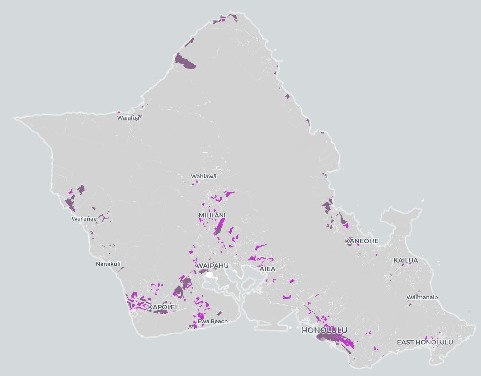
Where you can build 1-4 family residences by right

The Hawaii Zoning Atlas project has announced publication of the Hawaii Zoning Atlas, an “interactive map [that] explores how restrictive zoning laws can make it difficult to build diverse, affordable housing.”

The official announcement notes:

The map is based on an original dataset compiled by over 30 students [including some of our U.H. Law students!] and volunteers who combed nearly a thousand pages of regulations to extract key policy details, including whether housing units are legally allowed in an area and how many; restrictions on height, yards, and lot coverage; and parking requirements. All in all, more than 100 data points were collected for each zone in three counties–Honolulu, Maui, and Hawaiʻi. Kauaʻi will be available in a future release.

This is designed for people who are not land use insiders, to help understand how land use regulations restrict

Continue Reading “Zoning is the most important local law you’ve never heard of” – Hawaii Zoning Atlas Published