August 2023

A fairly short one from the U.S. Court of Appeals for the Fifth Circuit.

In Sheffield v. Buckingham, No. 22-40350 (July 31, 2023), the court affirmed the district court’s declining to issue a preliminary injunction enjoining State of Texas officials from enforcing the Open Beaches Act.

The presumptive public/private boundary on beaches in Texas is the mean high tide line, although the public may obtain an easement to access the beach landward of the MHTL through prescription or dedication. But as the Texas Supreme Court held, abrupt shifts in the topography of a beach caused by hurricanes and tropical storms does not automatically “roll” the line landward under the state’s Open Beaches Act. 

After the Texas court issued that ruling, the legislature amended the statute to permit the State to “suspend action on conducting a line of vegetation determination for a period of up to three years from

Continue Reading The Downside Of Seeking Injunctive Relief In Takings Cases
Untitled Extract Pages

Two years ago, Owners’ Counsel of America endowed a scholarship in the name of its founder, property rights advocate and trial lawyer Toby Prince Brigham (1934-2021). The scholarship is for a second- or third- year law student to attend the annual three-day ALI-CLE Eminent Domain and Land Valuation Litigation Conference (the upcoming Conference will be in New Orleans, Louisiana, February 1-3, 2024).

The Conference affords the Scholar an all-expenses-covered opportunity to meet and network with leading property rights and eminent domain lawyers from across the country, while also learning about property law and practice. 

Here’s the official description from OCA:  

In honor of Toby’s legacy of professionalism and achievement, in 2021 OCA established the Toby Prince Brigham OCA Scholarship to pay for all expenses of a second or third year law student to attend the ALI-CLE Eminent Domain conference and associated OCA events held annually in January. This unique

Continue Reading Owners’ Counsel Toby Prince Brigham Scholarship – Applications Being Accepted

Well, that was quick. As reported here (“HECO Kept The Power Flowing In Lahaina Even As Poles Toppled“), we’ve already seen the first lawsuit filed seeking recovery for the Maui wildfire that destroyed Lahaina town — a class action even before there’s been any official word about what caused or contributed to the conflagration:

Meanwhile, a group of Honolulu- and California-based law firms filed a class action suit Saturday against HECO on behalf of victims and survivors of the Lahaina fire.

The suit alleges that HECO’s downed power lines caused the fire. Graham Lippsmith of the firm Lippsmith LLP said Saturday that the suit was also largely based on HECO’s decision not to de-energize the power Tuesday in West Maui.

A separate Honolulu attorney also said Saturday that his firm is weighing whether sue HECO on behalf of its clients, also largely based on the downed poles.

They

Continue Reading First Lawsuit Filed (Incl. Inverse Condemnation) For Maui Wildfire: Is California-Style Inverse Condemnation Coming?

In Masloka v. Public Utility District No. 1, No. 101241-1 (Aug. 3, 2023), the Washington Supreme Court held that a takings claim did not automatically transfer to a new property owner when the property was sold.

Your first reaction might be like ours, “what about Palazzolo!?” Didn’t that case say that transfer of property after an alleged taking does not wipe out the transferee’s right to assert a takings claim:

Were we to accept the State’s rule, the postenactment transfer of title would absolve the State of its obligation to defend any action restricting land use, no matter how extreme or unreasonable. A State would be allowed, in effect, to put an expiration date on the Takings Clause. This ought not to be the rule. Future generations, too, have a right to challenge unreasonable limitations on the use and value of land.

Palazzolo, 533 U.S. at 607.

So

Continue Reading Washington: “The right to inverse condemnation belongs to the property owner at the time of the taking; the right does not pass to a subsequent purchaser unless expressly conveyed.”

Screenshot 2023-06-16 at 07-52-47 How Did Property Rights Fare at the Supreme Court What Happened in the 2022 Term and What's Next ALI CLE

Tomorrow, Wednesday, August 9, 2023 at 1:00 – 2:00 p.m. (Eastern Time), please join us for ALI-CLE’s web program, “How Did Property Rights Fare at the Supreme Court? What Happened in the 2022 Term and What’s Next.”

Here’s the course description:

This has been a blockbuster U.S. Supreme Court term for property law, with the Court deciding three major property cases: Tyler v. Hennepin County (government’s keeping the excess value when seizing and selling a home to satisfy a property tax debt is a taking), Wilkins v. United States (is the federal Quiet Title Act’s statute of limitations a jurisdictional bar?), and Sackett v. EPA (the scope of Clean Water Act wetlands jurisdiction). To gain a better understanding these opinions, the current state of takings and property law, and what these cases mean for your practice, join a distinguished panel of experts for this one-hour webcast. The faculty

Continue Reading Still Time To Join Us Wed Aug 9: ALI-CLE’s “How Did Property Rights Fare at the Supreme Court? What Happened in the 2022 Term and What’s Next”

We recently attended the American Bar Association’s Annual Meeting in Denver to speak at the Section of State and Local Government Law’s program, “The 100th Anniversary of Pennsylvania Coal v. Mahon: How the Takings Clause Became the Primary Check on Government Power When SCOTUS Abandoned Review Under the Due Process and Contracts Clauses During the New Deal.

But the real highlight of the Meeting was the Jefferson Fordham Awards which, as we noted earlier, were presented to property rights icon Michael Berger, who the Section recognized with the Daniel J. Curtin, Jr. Lifetime Achievement Award.

Also noteworthy: the presentation of the Anita P. Miller Advocacy Award to land use law giant, Professor John R. Nolon, and the Up and Comer Award to a former William and Mary student (and now colleague) of ours, Makenna X. Johnson. 

Professor Frank Schnidman introduced Michael Berger

Continue Reading Recognizing A Property Rights Icon: “Mentors, A Path to Fairness, and the Joy of Taking”

PXL_20230426_222217568
(Tip for applicants: understanding the symbology of the
Law School’s logo will show you know the score.)

Here’s your chance to teach Property and Land Use in what might be most interesting venue on Planet Earth for those subjects: the University of Hawaii School of Law has put out a call for applications for a tenured lawprof (along with six other openings in other subjects):

The University of Hawaiʻi at Mānoa, William S. Richardson School of Law seeks to fill up to seven tenured or tenure – track positions . For doctrinal faculty, we are seeking to fill positions in Constitutional Law (tenured or tenure – track) and Property /Land Use (tenured). We welcome candidates who, in addition to one of those two fields, have expertise in Administrative Law, Business and Commercial Law, Environmental Law, Family Law, Health Law, Intellectual Property, Labor and Employment Law, Native Hawaiian Law

Continue Reading Live The Dream! Teach Dirt Law In Hawaii: UH Law School Looking For Property & Land Use Lawprof

ExecOrder

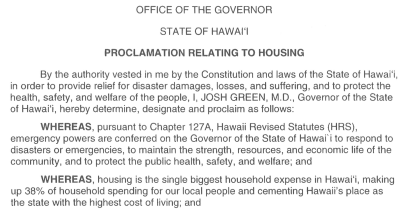
The two-plus years under the declared Co-19 emergency surely have given Hawaii’s executive-branch officials a clear vision of how much easier they could get their agendas accomplished without all that pesky democracy.

Hawaii’s Sweeping Emergency Management Act: Governor is the “Sole Judge”

Hawaii’s Emergency Management Act gives state and county executives broad and nearly unreviewable authority to suspend a wide spectrum of the usual laws, regulations, and rules. As we wrote in Hoist The Yellow Flag and Spam® Up: The Separation of Powers Limitation on Hawaii’s Emergency Authority, 43 U. Hawaii L. Rev. 71 (2020), Hawaii’s Act confers among the nation’s most muscular and sweeping powers. For example, the governor is the “sole judge of the existence of the danger, threat, or circumstances giving rise to a declaration of a state of emergency.” The Act’s one limitation — the 60-day time limit on how long an

Continue Reading What If The Hawaii Governor’s Cutting Of The Gordian Land Use/Environmental Knot Actually Works?

Screenshot 2023-07-31 at 08-01-31 Necessity Exceptions to Takings

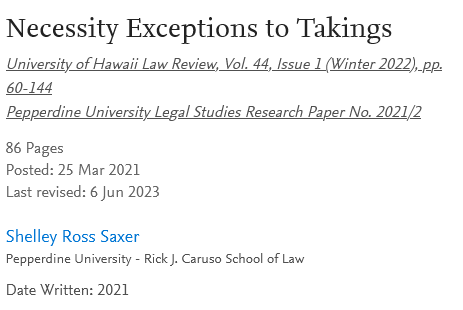
Worth checking out: a new article from Pepperdine Law School’s Shelley Ross Saxer, published in the University of Hawaii Law Review, “Necessity Exceptions to Takings,” 44 U. Haw. L. Rev. 60 (2022). [Disclosure: as noted in the author’s note, we reviewed an earlier draft of the piece and provided some thoughts.]

Here’s the Abstract:

The doctrine of necessity has strong roots in the common law of tort and property going back hundreds of years. In the United States the doctrine has been applied in various situations to negate judicial review of constitutional challenges to government action, most recently in some of the wildfire and flood claims resulting from disasters. But now, the states’ responses to the COVID-19 pandemic have brought one of these necessity doctrines—the public health necessity relying on Jacobson v. Massachusetts—to the forefront as courts across the country review constitutional challenges to state public

Continue Reading New Article – “Necessity Exceptions to Takings” (Shelley Ross Saxer)