February 2024

Screenshot 2024-02-28 at 13-12-21 Call for Papers Too Far Imagining the Future of Regulatory Takings PDF Justice Crime & Violence

Have thoughts about where regulatory takings are (or should be) headed? Here’s your chance to get in on the conversation, and to shape the future of the law. Our outfit, the Pacific Legal Foundation, in cooperation with the Antonin Scalia Law School’s Journal of Law, Economics, and Policy, are calling for papers on “Imagining the Future of Regulatory Takings.” There will be an in-person discussion of these papers at the Law School in October 2024.

Here’s the full description:

A century ago, Oliver Wendell Holmes, speaking for the Supreme Court, assured us that “[t]he general rule at least is that while property may be regulated to a certain extent, if regulation goes too far it will be recognized as a taking.” In the ensuing one hundred years, courts have struggled to draw the line defining “too far.” Some still wonder whether such a line should even exist. As Justice Clarence

Continue Reading Call For Academic Papers: “Too Far: Imagining The Future of Regulatory Takings”
In Rhone v. City of Texas City, No. 22-40551 (Feb. 14, 2024), the U.S. Court of Appeals for the Fifth Circuit held that a municipality’s conclusion that Rhone’s apartment building had not been properly maintained, and a subsequent municipal court demolition order, might be a taking … or it might not be.

We won’t get too far into the facts, except to say that Rhone argued that the city had it out for him, and that the municipal court judge who issued the demolition order was in a contractual relationship with the city by which the judge had to submit for approval all of the court’s decisions to the city attorney (the very party pressing the nuisance claims against Rhone). Weird, but apparently a product of Texas law. Short story, according tot the court: “[a]ll of this, facially at least, is a declaration of a lack of independence of

Continue Reading Too Soon For CA5 To Figure Out Whether City Demolishing Property For Code Violations Is A Taking

Screenshot 2024-02-27 at 16-35-17 Post Feed LinkedIn

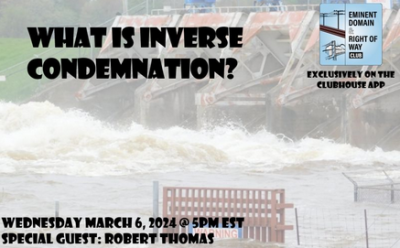
Save the date (and time): next Wednesday, March 6, 2024, at 5:00 p.m., Eastern Time, as we rejoin our friends and colleagues Patrick McAllister and Beth Smith, as they co-host the Eminent Domain and Right of Way Club.

We’ll be joining them to try and answer that question, “What is Inverse Condemnation?” As Patrick and Beth note, “[w]e will find out what it is, how it works and when does it happen….and probably a lot more.” Sounds intriguing.

For those of you who may not have participated in one of these sessions before, you may be wondering “what is this ‘Clubhouse’ thing?” Here’s the description, straight from their site:

The Eminent Domain & Right of Way Club is on the Clubhouse Drop in audio app. This Club is geared toward right of way professionals & anyone interested in the acquisition of land rights for infrastructure projects.

In short, it

Continue Reading “What is Inverse Condemnation?” Join Us In the EDROW Clubhouse, March 6, 5pm, To Find Out (And More)

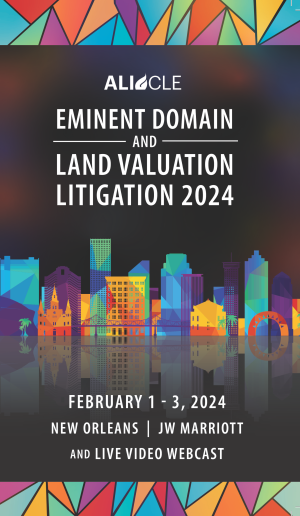
ALI-CLE brochure cover page

When it comes to the longstanding ALI-CLE American Law Institute-CLE Eminent Domain and Land Valuation Litigation Conferences, we’re always ready to go. You know that. But this year’s version — the 41st — was buzzing like no other in recent memory.

Maybe it was the New Orleans venue with its atmo, food, and music for our after-class activities, or even the timing (the second-to-last week on the Mardi Gras parade season, and our conference hotel was right on the routes). It might have been the nice weather (oh, it rained buckets one evening, but there wasn’t an ice storm like we experienced in Austin in 2023). Or maybe it was the capacity crowd, and new topics and speakers on the agenda. Or maybe it was just the prospect of seeing our friends and colleagues again after a year.

Here’s a photo essay of some of the Conference highlights.

And

Continue Reading Pass A Good Time: Our Report From The 41st ALI-CLE Eminent Domain & Land Valuation Litigation Conference, Feb 1-3, 2024, New Orleans

The DC Court of Appeals’ (note: not the U.S. Court of Appeals for the D.C. Circuit) opinion in Gordon v. District of Columbia, No. 20-CV-0568 (Feb. 15, 2024), presents a good cross-section of property rights issues. Not a good outcome on property rights issues, mind you.

If nothing else, be sure to check out the outrageous facts in the case. They will make your toes curl. 

The Gordon brothers own a home in the District, in the Forest Hills area. They didn’t want to be owners of this home, and instead wanted to sell it. Consequently, they took some of the usual steps one takes when one wants to sell a home – they retained a real estate agent, authorized certain entries for looky-looks (but did not ok free access or open house showings), and the like.

This aroused the ire of some of the area’s residents, who were

Continue Reading DC App: $350k Loss In Value Due To Home’s Historic Designation Not A Penn Central Taking

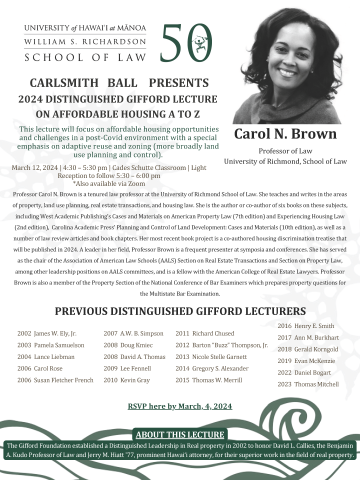
2024 Gifford Lecture Carol N. Brown Professor of Law flyer

Join us and our Land Use class, in-person on the campus of the University of Hawaii Law School (or online via Zoom, where it will be livestreamed), as Richmond Law lawprof Carol Brown delivers the 2024 Distinguished Gifford Lecture in Real Property, on March 24, 2024, at 4:40 p.m. Hawaii Time in the Cades Schutte classroom.

Her talk is titled “Affordable Housing A to Z” and is very timely. More details on this flyer.

Made possible by the generosity of one of Hawaii’s premiere dirt law firms, Carlsmith Ball, LLP.

Space is limited, so please RSVP here.

2024 Distinguished Gifford Property Lecture – Professor Carol N. Brown (Richmond Law) (March 12, 2024, U. H…

Continue Reading 2024 Distinguished Gifford Property Lecture – Professor Carol N. Brown (Richmond Law) (March 12, 2024, U. Hawaii Law School)

Yesterday, the other shoe dropped. In this order the U.S. Supreme Court denied review to a case that we’ve long been following, which challenged aspects of New York’s draconian rent control laws as a taking, 74 Pinehurst v. New York.

We say the “other shoe” because ever since the Court denied review months ago to other challenges to rent control (yet kept relisting Pinehurst, which was always among the two strongest of the multiple challenges), it appeared this round of petitions was doomed, and the Court was holding off denying review, to allow one or more Justices to write something. To us, it was unlikely that the Court would deny some of the petitions outright, while at the same time agreeing to take up the issue in another case. Grant-and-hold seemed the most likely scenario there. Absent that, we didn’t expect these last two to be granted. 

So

Continue Reading SCOTUS Denies Review To Remaining Rent Control Takings Petitions: “Important and pressing question” (Just Not In This Case)

PXL_20231205_215400398.PORTRAIT.ORIGINAL
Professor Lynda L. Butler

[Barista’s note: this is the text of our introduction of William and Mary Law School Professor Lynda L. Butler during the Owners’ Counsel of America presentation of the Crystal Eagle award earlier this month in New Orleans.]

* * * *

For over four decades, Professor Lynda Butler of the William and Mary Law School has been at the forefront—raising the national and international recognition and standing of property rights.

Her academic and scholarly accomplishments and accolades are long—much too long to be repeated here. Her expertise includes many of the topics that are so important to us: Eminent Domain and Takings; Environmental Law; Land Use and Zoning; Water Law; Property Law. And, of course, she is a student of the Constitution.   

She has mentored generations of lawyers now spread across the country, including OCA members and affiliates right here in this room. Her

Continue Reading Presentation of the Owners’ Counsel of America Crystal Eagle to Professor Emerita Lynda L. Butler of the William & Mary Law School (Feb. 3, 2024)

Check out the U.S. Court of Appeals’ opinion in Peace Ranch, LLC v. Bonta, No. 22-16063 (Feb. 13, 2024), where the court concluded that the owner of a mobilehome park could bring a federal court challenge to a California statute, even before the state applied the statute and enforced it.

There’s a mobilehome park in Southern California — Rancho La Paz — that straddles the line between two separate municipalities, Anaheim and Fullerton. When the owner of the park upped the rent, the municipalities undertook efforts to impose a form of rent control. But those efforts ultimately failed.

Not to be outdone, the state representative from the area pushed for, and got adopted a state statute that seems curiously tailored to cover only Rancho La Paz: certain “qualified” mobilehome parks can only raise the rent a certain amount. The definition of a “qualified” park in the statute is limited

Continue Reading Peace Out: CA9 OK’s Pre-Enforcement Challenge To Rent Control Statute

PXL_20230509_183011703

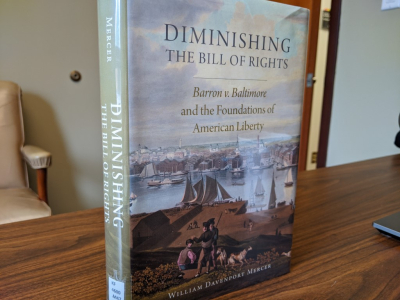
Today’s the day, 191 years ago, when — a mere 5 days after oral arguments — the U.S. Supreme Court issued its (in)famous opinion in Barron ex rel. Tiernan v. Mayor and City Council of Baltimore, 32 U.S. 243 (1833).

Generations of law students study this one in their Con Law classes, and it is mostly known as the case which held that the Bill of Rights limits only the federal government and does not limit the power of states. For the latter, one must look to state constitutions. Barron, of course, was overruled or otherwise neutralized by the Fourteenth Amendment (privileges or immunities clause or the due process clause, take your pick).

But the reason we’re posting our sad birthday wishes today isn’t for that reason, but more because in our estimation, Barron was the first “takings” case considered by the U.S. Supreme Court.

The case was instituted

Continue Reading Sad 191st Birthday To You, Barron v. Baltimore (Feb. 16, 1833) – The First SCOTUS Takings Case?