February 2024

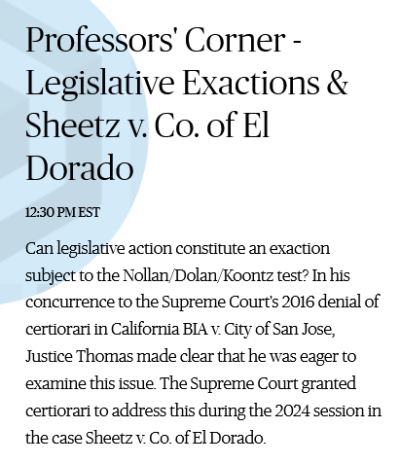
Screenshot 2024-02-13 at 06-58-13 Professors' Corner - Legislative Exactions & Sheetz v. Co. of El Dorado

Join us at 12:30pm ET today, Tuesday, February 13, 2024, for the ABA’s Section of Real Property, Trust and Estates’ monthly Professor’s Corner, where we will join exactions experts Prof Tim Mulvaney, Andrew Gowder, and Prof Elizabeth Elia to discuss the Supreme Court arguments, the issues in the case, and what may be down the road.

Here’s the description:

Can legislative action constitute an exaction subject to the Nollan/Dolan/Koontz test? In his concurrence to the Supreme Court’s 2016 denial of certiorari in California BIA v. City of San Jose, Justice Thomas made clear that he was eager to examine this issue. Justice Thomas’s wait is over; the Supreme Court granted certiorari to address this very question during the 2024 session in the case Sheetz v. Co. of El Dorado. Our expert panel will discuss all sides of this extremely interesting case and its implication for takings jurisprudence.Continue Reading Today, 12:30pm ET: Professor’s Corner – Legislative Exactions & Sheetz v. County of El Dorado (ABA RPTE)
Illinois adopted a statute that tweaked public pensions:

On January 1, 2020, Public Act 101-610 became effective and amended, in pertinent part, portions of the pension code to consolidate all applicable local police and firefighter pension fund assets into two statewide pension investment funds, one for police and the other for firefighters. Pursuant to the Act, the local pension funds were required to transfer custody and investment responsibility for their fund assets to the respective statewide funds, which are now tasked with collectively investing and administering the pooled assets. The Act provided a transition period that ended on June 30, 2022, for the transfer of securities, assets, and the investment function from the local funds to the statewide investment funds.

There’s more detail on the statute in the Illinois Supreme Court’s opinion in Arlington Heights Police Pension Fund v. Pritzker, No. 129471 (Jan. 19, 2024), but we’ll leave those

Continue Reading No State Takings Problem In Amending Public Pension Plan

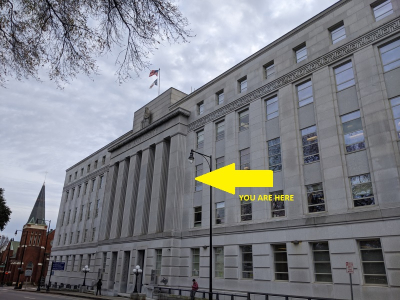
NCSCT
The historic Supreme Court of North Carolina.

Here’s the latest in a somewhat strange case we’ve been following about what happens after a court determines that a taking lacks a public use — but the condemnor goes ahead and just seizes the property anyway.

The Town of Apex, North Carolina, sought to take an easement across Rubin’s land. She objected, asserting the taking was not for a public use or purpose, but rather to benefit a private party: a developer who needed the easement to connect two of his non-contiguous parcels to the municipal sewer system, a precondition of the Town’s development approvals for his proposed residential subdivisions.

While Rubin’s public use objection was pending, the Town went ahead at installed the sewer line, purportedly under its quick-take power. That was not the best of moves, however, because the courts eventually agreed with Rubin that the taking violated the public

Continue Reading The Public Use Requirement Is Self-Executing: “In a free society, we should not expect that when a court tells the government that a taking is illegal and unconstitutional, that it would just go ahead and seize the property anyway.”

A quick per curiam from the Ohio Supreme Court.

In State ex rel. AWMS Water Solutions, LLC v. Mertz, No. 2023-0125 (Ohio Jan. 24, 2024), the court issued a gentle (or maybe not-so-gentle) “benchslap” to the court of appeals. Here’s the scenario.

First of all, recall that Ohio does not recognize a claim for “inverse condemnation” or “regulatory taking.” Instead, if a property owner believes that the government has de facto taken property but has not provided just compensation, the owner seeks a writ of mandamus asking the court to compel the government to institute an eminent domain action (what CJ Roberts calls “an upfront taking”).

AWMS thought this was the case and sought a writ to compel Mertz, an official with the state Department of Natural Resources, to take and pay. The court of appeals entered summary judgment for Mertz, but the Ohio Supreme Court held

Continue Reading Ohio: We Really Meant It When We Remanded For Weighing Of Evidence – Appeals Court Had No Business Dismissing

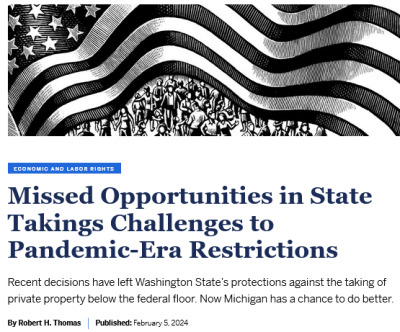
Screenshot 2024-02-05 at 12-23-56 Missed Opportunities in State Takings Challenges to Pandemic-Era Restrictions

Thank you to the Brennan Center for Justice at NYU Law School’s State Court Report (#statecourtreport) for publishing our piece “Missed Opportunities in State Takings Challenges to Pandemic-Era Restrictions.” The title gives a hint about what this is about: how state and local government’s reaction to Co-19 spurred challenges not only under the U.S. Constitution, but under state constitutions. We give examples of — and comment on — missed opportunities and out-and-out errors in several approaches.

Here are the opening paragraphs:

Responding to the Covid-19 pandemic, the federal government and many state and local governments imposed a variety of restrictions on individuals and businesses. The Centers for Disease Control and Prevention, for example, purported to suspend the ability of property owners to evict nonpaying tenants — a move the U.S. Supreme Court rejected as beyond the agency’s power. State and local governments adopted similar eviction moratoria, and many directed

Continue Reading New Article: Missed Opportunities in State Takings Challenges to Pandemic-Era Restrictions (Brennan Center’s State Court Report)

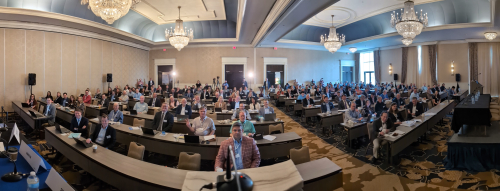
PXL_20240201_150817859.PANOOur annual “proof of life” photo –
Yes, this is New Orleans,

but nearly 300 of us are in the room
to talk eminent domain and property rights shop

A fantastic turnout at the ALI-CLE Eminent Domain & Land Valuation Litigation Conference.

Some numbers:

  • Eleven. The number of attendees from a single firm, Frederikson & Byron. We think that is some kind of record.  Impressive!
  • Nine. The number of law students who joined us of their own initiative to learn about eminent domain and takings, and to network.
  • Five. The number of members of the legal academy who are on the faculty. Our programs have a good mix of theory and practice.
  • Three. Attendees who are sporting bow ties.
  • Forty-one. The number of these conferences we’ve had so far. And going strong.

Wish you were here.Continue Reading 2024 ALI-CLE Eminent Domain & Land Valuation Litigation Conference, New Orleans