August 2024

Every year at this time, it seems, we realize once again that as you get older, you overlook birthdays. Time speeds up, or maybe slows down. Very Proustian. Thus, it occurred to us only yesterday that that this blog’s “birthday” was looming and we almost let it slip by without notice.

It hardly seems like eighteen years ago tomorrow that we posted here for the first time.

In law blog years, that’s quite a while. Thanks to you, our readers and contributors, we’re still here, and still going pretty strong over 4,700 posts and nearly two decades later. We can’t post every day, but we can try.

Because doing this in a vacuum would not be worthwhile, we’d like to recognize those who send us items, who make comments, who give us feedback, who gently prod with suggestions, and who simply read and subscribe. You guys make the

Continue Reading They Say It’s Your Birthday, Well It’s Our Birthday Too, Yeah! Entering Our Eighteenth Year

This would not be authorized.

Here’s the latest in an issue that found new vitality after the U.S. Supreme Court’s decision in Cedar Point affirming that government-authorized physical entry to private property is presumptively a taking.

This is the “precondemnation entry” issue in eminent domain which several courts have addressed:

This is where a condemnor contemplates taking property and wants to get on site to check it out. Do things like surveys, examinations, tests, and sample-taking. Often, the owner of the property doesn’t mind: pay me a bit for my trouble, indemnify me in the event someone gets injured, and you can have limited access to do your business and then go on your way, condemner. But sometimes, an owner says no.

In Betty Jean Strom Trust v. SCS Carbon Transport, No. 30317 (Aug. 21, 2024), SCS is planning a CO2 pipeline though South

Continue Reading S Dakota: Only Way To Read Precondemnation Entry Statute Constitutionally Is Allowing “minimally invasive superficial inspections” and “minor soil disturbances”

Here’s the latest takings cert petition. This one seeks review of the Seventh Circuit’s affirming the district court’s sua sponte abstaining from considering a property owner’s challenge to a Wisconsin municipality’s exercise of eminent domain.

The court concluded that federal courts could — but shouldn’t — consider the owner’s public use challenge because there were ongoing parallel state proceedings (this this case, an eminent domain case in a Wisconsin court). That alone doesn’t seem terribly controversial.

But as the petition points out, there was not actually a “parallel” state court proceeding here, because Wisconsin law apparently doesn’t permit an owner to challenge public use in the proceeding the Village filed. As the Petition puts it:

The Seventh Circuit Court of Appeals’ particularly broad approach to the Colorado River doctrine stands out among the circuits. In the case at hand, the court of appeals expanded the doctrine even

Continue Reading New Cert Petition: When State Law Bars Owner From Challenging A Taking, Can Federal Court Abstain?

Russell standard

It is worth your time to check out the Pennsylvania Supreme Court (Middle District)’s decision in Wolfe v. Reading Blue Mountain & Northern RR Co. No. J-10A-2024 (Aug. 20, 2024).

The court invalidated an exercise of eminent domain by a railroad, concluding the taking was not for a public purpose because it was intended to keep open a road used to access a single business.

The conflict arose after the property owners exercised their right to close off the railroad’s two easements on which rail siding track and a road crossing had been located. The owners’ predecessor-in-title had obtained the property from the railroad’s precedessor, and the grant contained express reservations of those two easements. The grant also contained a termination provision. which required the railroad to remove the siding within 90 days of the owners’ demand.

The railroad had stopped using the siding and the road crossing in

Continue Reading PA: No Funny Business – It Isn’t A Public Purpose For Railroad To Take Property To Benefit Single Customer

2024.08
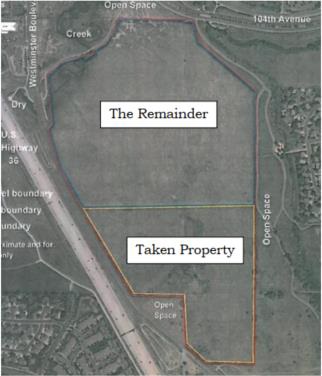
We appreciate it when courts include photos and maps in opinions.

A quick one from the Colorado Court of Appeals on an issue of first impression in that state.

In City of Westminster v. R. Dean Hawn Interests, No. 23CA0315 (Aug. 1, 2024), the court concluded “for the first time, that an executory contract for the purchase and sale of land is relevant and admissible, at the district court’s discretion, as evidence of the value of the condemned property.” Slip op. at 1.

Short story: the city sought to take RDHI’s a 37-ish acre portion of its 105-ish acre land to build a water treatment facility. The property is zoned for mixed-use development, and everyone agrees the highest and best use was for large-scale mixed-use development (including retain, office, and multifamily housing). Slip op. at 4. In addition to just comp for the property taken, RDHI sought severance damages

Continue Reading Colorado App: Executory Contracts Admissible To Prove Value Of Condemned Property

PXL_20240819_120202700.MP
Yes, the mysterious ducks remain — and seem to have multiplied.

It’s that time of the year again. Fall’s-a-coming, and that means that starting today, we’re back at the William and Mary Law School in Williamsburg, Virginia to lead two courses:

  • Eminent Domain and Property Rights (W&M is one of the few law schools in the country that offer a course in eminent domain, just compensation, and takings)
  • Land Use Controls (an especially hot topic at the moment)

The registration numbers for both courses are good (really good), and two full classrooms of Dirt Law goodness tells us something about this area of law — it’s really interesting, and a good place to make your way in the practice, and law students recognize that.

PXL_20240819_121031630.MP
We don’t use $400 casebooks in either class.

Time to jack back into the (takings and land use) Matrix.

6a00d83451707369e20240a476d216200c-800wiContinue Reading Back To School For Dirt Law @ William & Mary, Season VII

Check this out, a recently-filed cert petition asking whether, in order to sue for compensation for a taking, the government must first affirmatively provide a cause of action (an issue recently left unanswered by the U.S. Supreme Court). That’s an issue we’ve been following closely (our outfit recently filed this cert petition also). 

This one is a takings challenge to California’s unclaimed property scheme and the State’s immunity, vel non, to being sued for just compensation.

Here are the Questions Presented:

The State of California, pursuant to its unclaimed property laws, regularly seizes possession of owners’ unclaimed personal property, holds it in custody and trust for the owners, uses it for the state’s purposes to pay its obligations, without paying the owners of that unclaimed property any compensation for its use of the owners’ property pursuant to California Code of Civil Procedure §§1540(c) and 1562. That is an

Continue Reading New Cert Petition: Can An Owner Whose Property Has Been Taken Sue A State Directly Under The Fifth Amendment?

Be sure to read the entirety of Lawprof Ilya Somin’s recent post on Volokh,Federal Appellate Court Rules in Favor of Takings Lawsuit Against the CDC’s Covid-Era Eviction Moratorium.”

There, he analyzes the Federal Circuit’s recent 2-1 opinion in Darby Dev. Co., Inc. v. United States, No. 22-1929 (Aug. 7, 2024) (we wrote up the case here: “Deepening A Lower Court Split, Fed Cir (2-1) Reinstates CDC Co-19 Eviction Moratorium Temporary Takings Claim“).

Professor Somin does a better job that we did offering his thoughts on the “authorized” issue, concluding:

To me, the decisive factor should be that the Takings Clause nowhere says that compensation is only required for legal government actions or for those specifically authorized by statute. Rather, the Clause imposes a general rule that compensation must be paid whenever the government takes private property for “public use.” That, of course, can happen

Continue Reading Lawprof Somin: “Federal Appellate Court Rules in Favor of Takings Lawsuit Against the CDC’s Covid-Era Eviction Moratorium”

Here’s the latest in the solved-but-not-quite-solved issue of whether the government can keep the surplus which remains after a tax-foreclosure sale (see Tyler v. Hennepin County), the Michigan Supreme Court’s opinion in Schafer v. Kent County, No. 164975 (July 29, 2024), where the court concluded that its earlier decision in Rafaeli v. Oakland County is applicable not merely going forward (prospectively) but applies to those cases which are not final and closed out.

There’s a lot there — especially on the nuances of whether judicial decisions on constitutional rights apply only prospectively, or govern cases instituted in the past — but we are focused on the opinion’s analysis of property rights and takings as matters of history and tradition. We’re not going to comment here because this case is one of ours, argued by Christina Martin and Pacific Legal Foundation’s Home Equity Theft team. That said, here’s

Continue Reading Michigan: “few rights and legal principles have greater legal, historical, and constitutional pedigrees than the protection against uncompensated takings”

You remember that old adage (or maybe its a cliché?) that “a conservative is a liberal who has been mugged?” Well, here’s your environmentalist analog.

In Echeverria v. Town of Tubridge, No. 23-AP-291 (Aug. 2, 2024), the Vermont Supreme Court held that property owners’ lawsuit asserting their right to prohibit the town from allowing bicycling on hiking trails on their land, and to prohibit it from allowing members of the public onto the property to maintain the trails, is ripe. The owners asserted that as the owners, they alone have the authority “whether and how to maintain the legal trails that cross their property.” Slip op. at 2. Here are the details: the owners assert

sole and exclusive authority to decide whether and how to maintain the legal trails that cross their property. They alleged that the expected entry onto their property by volunteers seeking to exercise

Continue Reading A Property Rights Advocate Is An Environmentalist Who Has Been Overregulated: Anti-Takings Advocate Argues For The Right To Exclude