February 2025

You should already know Short Circuit is the Institute for Justice’s frequently-updated podcast on important and interesting decisions from the federal courts of appeals (the “Circuit” part of the title, we assume).

If you are not already a regular listener you are missing out, because it is a fantastic and easy way to keep up with what is going on, and to hear insightful analysis.

We’ve visited the SC studios in the past, and this week made a return visit, joining host Anthony Sanders (Director of the Center for Judicial Engagement), and guest Justin Pearson (Managing Attorney of IJ’s Florida offices), to talk cattle feedlots, “new” vs. “old” property, North Carolina’s Law of the Land Clause, and methods of constitutional interpretation.

Here’s the episode summary, and show notes, from the Short Circuit site:

A long-time friend of the Institute for Justice, Robert Thomas, joins us this week. For
Continue Reading “I Like Old Property” – We Return To The “Short Circuit” Podcast To Talk Law Of The Land & Magna Carta

PLF_PR_event

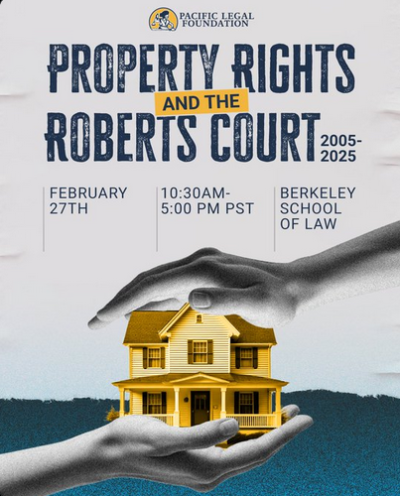
If you are looking for us tomorrow but we don’t respond, that’s because we’ll be in the audience in rapt attention at “Property Rights and the Roberts Court, 2005-2025” at the U.C. Berkeley Law School (fka “Boalt Hall”).

Here’s the description:

For much of the past century, property rights were relegated to second-class status compared to the rest of the Bill of Rights. However, under the Supreme Court leadership of Chief Justice John Roberts, this trend has begun to shift.

In recognition of the 20th anniversary of the Chief Justice’s elevation to the Supreme Court, Pacific Legal Foundation is partnering with Berkeley Law’s Public Law and Policy Program to host a day-long conference exploring the major property rights developments and future of property rights law in the Roberts Court.

We’ll hear from two different panels of renowned legal scholars and accomplished litigators, as well as a keynote lunch

Continue Reading “Property Rights and the Roberts Court, 2005-2025” (Feb. 27, 2025, UC Berkeley Law School)

In our earlier post today, we noted that on the same day last month, the U.S. Court of Appeals for the Fourth Circuit issued two published opinions about the admissibility of evidence in federal eminent domain cases under the Natural Gas Act

In our post about the other case, we focused on the admissibility of the owner’s testimony regarding the value of her land, and noted that the second issue in that case — the admissibility of expert valuations — relied on the case we’re delving into in this post, Mountain Valley Pipeline, LLC v. 9.89 Acres of Land, No. 23-2129 (Jan. 27, 2025).

These are takings under Fed. R. Civ. P. 71.1. The district court excluded the valuation opinion of the owner’s appraiser. That opinion might have passed muster for admissibility under Federal Rules of Evidence 702 and Daubert, but the court concluded

Continue Reading District Court: Fed R Civ P 71.1 Increases Discretion To Exclude Experts. CA4: No It Doesn’t

As the title should inform you, Mountain Valley Pipeline, LLC v. 0.32 Acres of Land, No. 23-1935 (Jan. 27, 2025) is a federal taking. Here, a taking where a private pipeline condemnor is exercising the delegated federal power of eminent domain under the Natural Gas Act.

The issue we’re focusing on in this case is the district court’s exclusion of the property owner’s testimony about the value of her land. As you courtroom lawyers are keenly aware, a judge’s decision to allow or exclude evidence is, generally speaking, a discretionary matter and subject to the very deferential “abuse of discretion” standard of review on appeal.

But here, the Fourth Circuit concluded that the district court abused its discretion. Slip op. at 8. We won’t be going into great detail in this post, but instead urge you to review the opinion starting at page 8. “The threshold for admissibility of

Continue Reading CA4: Owner With Personal Knowledge Can Testify About Value Of Her Land

Screenshot 2025-02-22 at 17-56-19 The Supreme Court’s Big “Kelo” Mistake Was Trusting Economic Development Plans – The Center for Economic AccountabilityBy John C. Mozena

Students of the Supreme Court’s infamous-the-day-it-was-decided decision in Kelo v. City of New London know that the legal issue presented and decided by the Court was somewhat narrow, but that the decision had a broad cultural impact such that Susette Kelo’s SCOTUS 5-4 loss was merely a precursor to widespread political and moral victories.

Legally narrow issue? Yes, recall that the question presented in that case was whether takings for “economic development” are so particularly untrustworthy and susceptible to abuse that they require the judiciary to depart from the usual rational basis review and cast a more skeptical “heightened scrutiny” eye on what the Court in Berman said was a legislative judgment “well-nigh conclusive,” and Midkiff equated with run-of-the-mill exercises of the police power.

The Kelo majority held no, that at least in the case as presented, the taking of a home and neighborhood on the

Continue Reading Is Having A “Redevelopment Plan” Enough To Justify Public Use Rational Basis Review?

A short one from the California Court of Appeal, Shehyn v. County of Ventura Public Works Agency, No. B337452 (Feb. 20, 2025).

Bottom line: the court reversed the trial court’s demurrer, which had dismissed a flood inverse claim. Good news, the owner gets to press its claim. 

The plaintiff here is the owner of a commercial avocado orchard. The complaint alleged that sediment from the County’s water district damaged irrigation pipes on the owner’s land, and inversely condemned the plaintiff’s property. The trial court sustained the demurrer on the grounds that … get this …  the owner “‘invited’ District water onto his property.” Slip op. at 5.

And how did the avocado farmer “invite” the district’s water on the property? Apparently by being a water customer of the district. Well, the court of appeal wasn’t having any of that, instead viewing the issue as whether the plaintiff alleged it

Continue Reading Don’t Get Between California And Its Avocados – Court OK’s Inverse Flooding Claim

What does a property owner do if she believes that the government’s eminent domain lawsuit is abusive? Is the remedy limited to the four corners of the eminent action (i.e., a counterclaim, third-party claim, etc.), or may a landowner institute a separate action which includes a tort claim for abuse of process? 

In Indiana Land Trust #3083 v. Hammond Redevelopment Comm’n, No. 24A-PL-1284 (Jan. 31, 2025), the Indiana Court of Appeals held that because the remedies in an eminent domain case and an abuse of process case are different, the owner may press claims that the “taking was for ‘discriminatory private purposes, for private gain, motivated by spite and/or that it is against public purposes[.]'” in a separate abuse of process lawsuit. Slip op. at 5. 

Here’s the order of events:

  • Redevelopment agency instituted an eminent domain case in state court to take owner’s property as part of a


Continue Reading Ind App: Eminent Domain Abuse Is [Also] Abuse Of Process

2025RMLUI_750x550_FNL

Registration is open and underway for this year’s edition of the Rocky Mountain Land Use Institute in Denver, March 5-7, 2025. Location: University of Denver Sturm College of Law.

This conference is more what we’ll call “land usey” than ALI-CLE’s Eminent Domain & Land Valuation Litigation Conference (as the respective titles suggest), but there’s a lot at RMLUI for those whose practices lean more on the eminent domain side than the land usey. As we know, any attempt to draw a clean line between these practices is futile, and there’s tons of crossover. That’s why we’ll be there, downloading the latest.

As always, there’s a great a la carte menu of programs and tracks for attendees to choose from, including sessions on “Sheetz and Exactions,” “Brownfields Re-Re-Development,” “Managing Growth and Infrastructure in the Southwest,” “ADUs for Aging in Place,” and, thankfully, “Legal Ethics.” And some add-on workshops the day

Continue Reading 2025 Rocky Mountain Land Use Institute, Denver (March 5-7, Denver U. Law School)

Magnachartasupremecourtdoor

Readers know that the North Carolina Constitution does not contain a “takings” or “just compensation” clause. Does that mean that the government can simply take property, and not have to worry whether the taking is for a public use, and with just compensation? Of course not.

Because we also know that the N.C. Constitution contains a Law of the Land Clause which says:

No person shall be taken, imprisoned, or disseized of his freehold, liberties, or privileges, or outlawed, or exiled, or in any manner deprived of his life, liberty, or property, but by the law of the land. No person shall be denied the equal protection of the laws; nor shall any person be subjected to discrimination by the State because of race, color, religion, or national origin.

That provision is interpreted to include the usual historic and traditional limits on both the eminent domain and police powers.

Continue Reading NC: Law Of The Land Clause Doesn’t Bar Legislature From Reviving SOL’d Tort Claims

Check this out, a recent Fourth Branch pod featuring lawprof Donald Kochan and our law firm colleague Jeremy Talcott, “Explainer Episode 85 – Rebuilding California: Lessons from the Pacific Palisades Fire.”

Here’s the description:

The 2025 Pacific Palisades Fire has underscored the challenges of building in California’s complex regulatory landscape. In response, Governor Newsom issued an executive order suspending CEQA and Coastal Act requirements to expedite reconstruction, raising important questions about the future of development in the state. In this podcast, experts Jeremy Talcott and Donald Kochan examine California’s regulatory environment before the disaster and the broader implications of its permitting processes in the effort to rebuild. Join us for an in-depth discussion on balancing efficient recovery with long-term regulatory considerations.

The money quote from Jeremy:

And I think this fire really offers a very good inflection point for a reimagining or a revisiting of the utility

Continue Reading Fourth Branch Podcast: Talcott & Kochan On “Rebuilding California: Lessons from the Pacific Palisades Fire”