February 2025

PXL_20230509_183011703

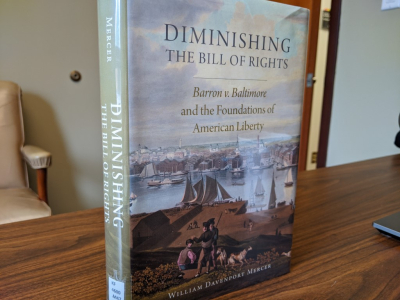
This Sunday, February 16, 2025, will be the day, 192 years ago, when — a mere 5 days after oral arguments — the U.S. Supreme Court issued its (in)famous opinion in Barron ex rel. Tiernan v. Mayor and City Council of Baltimore, 32 U.S. 243 (1833).

Generations of law students study this decision in their Con Law classes, and it is mostly known as the case in which the Court held that the Bill of Rights limits only the federal government and does not limit the power of states. For the latter, one must look to state constitutions. Barron, of course, was overruled or otherwise neutralized by the Fourteenth Amendment (privileges or immunities clause or the due process clause, take your pick). And it was formally abrogated in Chicago, Burlington and Quincy Railroad Co. v. City of Chicago, 166 U.S. 226 (1897) (states and their instrumentalities are bound

Continue Reading Feb. 16, 1833: Unhappy 192d Birthday To The First SCOTUS Takings Case, Barron v. Baltimore

You remember when in grade school you learned that your teacher was out for the day, and you were getting a substitute? It could be a very good day, or a very not-so-good day. Maybe the sub was cool, and you end up watching filmstrips. But if you drew the short straw, the sub acted like a real teacher and did real teacher stuff like give you homework.

That’s what it must’ve felt like when the advocates showed up for arguments in the First Circuit as it considered 29 Greenwood, LLC v. City of Newton, No. 24-1518 (Feb. 4, 2025), and there on the bench was none other than Justice (ret.) Breyer, sitting by designation. Was it going to be filmstrips, or homework?

The case was an appeal of the district court’s rejection of a federal takings claim on the grounds that “this case amounts to an

Continue Reading When The Substitute Teacher Gives You Homework: Justice Breyer Says Federal Court Needs State Court Decision Before Considering Takings Claim

A and B entered into a purchase and sale agreement for A to sell a commercial property (let’s call it “Blackacre”) to B, a commercial real estate developer.

A knew that the city planned to redevelop the area for a roundabout, “that would require the City to take over a portion of the property by eminent domain.” A did not disclose either the planned redevelopment or the likelihood of taking of Blackacre to B. Some time before the deal closed, B “learned of the redevelopment for the first time,” and soon issued notice of termination and requested return of the deposit under the terms of the sale agreement.

A refused and when mediation failed, B sued for breach of contract (the sale agreement provided that in the event of a taking by eminent domain, the deposit would be refunded). Count II alleged fraud for A’s failure to disclose knowledge of

Continue Reading Maine: Seller Of Land Has No Duty To Disclose Govt Plans To Condemn

Nothing to do with the case, beyond the owner’s name.
But c’mon, its ABBA.

Ms. Money and her spouse own a home in San Marcos, Texas. That home is in a historic district.

But it turns out that some of that history isn’t pretty: one of the previous owners was “notoriously associated with the Ku Klux Klan.” Yikes. And to make it worse, that owner, a certain Frank Zimmerman, branded the home by installing a Juliet balcony with a big ol’ wrought iron “Z” on the front of the house.

Very understandably, once they found out this detail (after they purchased the home), Ms. Money and her spouse wanted the Z gone. First the good news: although the home is in a historic district, the structure itself isn’t historic. So there’s that. But game not over, because even though it isn’t historic, the home nonetheless

Continue Reading Show Me The Money: Reg Takings Claim Ripe Because City Made Its Decision Even If Owner Could Have Administratively Appealed

We’ve long been fans of the Short Circuit podcast, a production of the Institute for Justice’s Judicial Engagement project. If you are not subscribed, you should be. It’s a great way to keep up on what is going on in the federal courts of appeals (ha, ha, now I get “short circuit”), with keen insight from the IJ team and others. Even us, from time-to-time.

The latest episode is no different. It covers a recent Fourth Circuit case we blogged about, in which the court rejected the property owner’s state-law inverse claims but also left some tantalizing crumbs about how to raise a claim that a taking lacks a public use or purpose. We score a mention!

As we wrote:

Now, here’s the useful dicta in the case. The court noted that it was not saying that these type of circumstances can never present a claim.

Continue Reading What Lingle Missed: Short Circuit Covers Eminent Domain Pretext

Check out In re Condemnation of Property in Rem (Appeal of Clemens), No. 1101CD23 (Feb. 4, 2025), one from the Pennsylvania Commonwealth Court.

The Town exercised eminent domain to take property, stating it was taking the land for public recreational purposes. That can’t be the Town’s true purpose, argued the landowner, because the Town doesn’t have a carefully developed recreation plan.” And you need a plan. Moreover, argued the owner, the Town has no authority to take property for open space.

First, the court held that “[n]othing in the Township Code or the Eminent Domain Code requires a ‘carefully developed plan’ for recreational purpose before a declaration of taking can be filed.” Slip op. at 18. What about that Pennsylvania case that seems to say you need a plan? Distinguishable. Having a plan helps to show the taking’s real purpose — but the absence of a plan doesn’t

Continue Reading No Plan? No Problem! Condemnation Statute Does Not Require A “Carefully Developed Plan”

Blevins

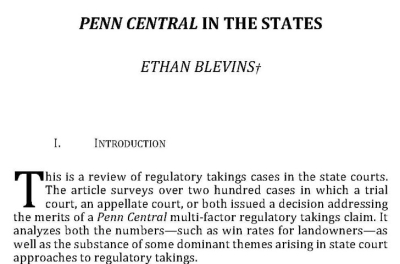
Our Pacific Legal Foundation colleague Ethan Blevins has published the lead article in the latest edition of the Wake Forest Journal of Law and Policy, and it is on a subject that makes it a must-read for you takings mavens.

The title says it all: “Penn Central in the States.” How do states treat the U.S. Supreme Court’s Penn Central test? Find out here, as Ethan surveys over 200 state court applications of that notorious test. Do they do better than federal courts? What court should you file in?

And if that doesn’t grab you enough, here’s his conclusion:

I conclude that most of these problems do not stem from unfaithful applications of the Supreme Court’s regulatory takings doctrine, but rather are a direct consequence of the Supreme Court’s failure to establish a clear, reliable test rooted in sound principles. I hope this article’s findings can assist

Continue Reading New Article: Ethan Blevins, “Penn Central in the States,” 15 Wake Forest J.L. & Policy 105 (2025)

1992 Aerial Photo Island2
Shands Key, with the City of Marathon in the background

This just in: in Shands v. City of Marathon, No. 3D21-1987 (Fed. 5, 2025), Florida’s Third District Court of Appeals sitting en banc held that the city’s downzoning of property (Shands Key, shown above in an exhibit from the Key West trial we participated in in June 2021) from General Use (density: one home per acre) to Conservation Offshore Island (one home per 10 acres; Shands Key is just under 8 acres) effected a Lucas taking because it deprived the owners of economically beneficial uses of their land. This, notwithstanding the possibility of the owners selling the property to a third party, who could have donated the property to city in return for a chit to move up in the city’s development queue.

We’re not going to go into too much detail or offer our opinion because this

Continue Reading Fla Ct App (en banc) In Takings Case: “failing to vindicate a right expressly stated in the Constitution is not judicial restraint but judicial abnegation. That we must not do.”

Screenshot 2025-01-23 at 17-00-09 Supreme Court of Canada - SCC Case Information - Webcast of the Hearing on 2025-01-16 - 40908

You know that from time to time — mostly thanks to our friend and colleague Shane Rayman and his firm — we cover property goings-on north of the border when a good property rights case comes before the Supreme Court of Canada (see here and here for past examples).

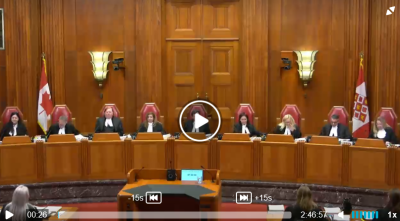
Well, here’s another one, this time involving the intriguing question of whether government-owned land is subject to adverse possession. Here’s where you can watch the arguments (in English or French, naturally!). As the summary of the case from the Supreme Court website notes:

The appellants are owners of a residential property in the City of Toronto. They sought an order for adverse possession of a parcel of City parkland that their predecessors in title had fenced off with a chain link fence and enclosed into their backyard. The City acknowledged that the appellants’ evidence satisfied the traditional test for adverse

Continue Reading Canada Supreme Court Hears Arguments: Is Govt Land Subject To Adverse Possession?

That was quick: no sooner are we all headed home from the just-wrapped 2025 ALI-CLE Eminent Domain & Land Valuation Litigation Conference in San Diego (report to follow soon), than Bobby Debelak posts up his report in the latest episode of the Eminent Domain Podcast –

Featuring Chris Clough, Angela Misch, Clint Schumacher, and Elizabeth Sockwell.

In this episode, we interview a handful of guests–presenters, first timers, and repeat attendees from the 2025 ALI-CLE Eminent Domain and Land Valuation Conference.

Note: Next Year’s conference will be in Savannah, GA.

Stream the episode above, or download it here.

And yes, we’re sporting our newly-acquired EDP pin:

PXL_20250203_162937553.MPContinue Reading Eminent Domain Podcast ep. 139: “Live From San Diego! ALI-CLE 2025 Conference Coverage”