July 2025

001q

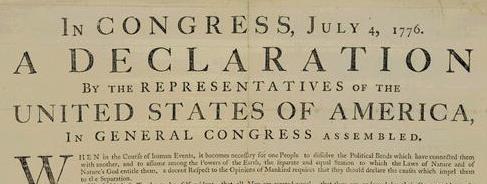
It’s not quite “Yes Virginia…” but here is our annual Independence Day missive on the legal angle on the Declaration. This may have special significance as the nation is in the process of reexamining many of our assumptions and history. But though the Founders may have been flawed individuals — as we all are — there’s really no question about the ideas they captured, and, thankfully, put down on for posterity.

—————————————————————————————

We know lawyers are easy targets (we enjoy lawyer jokes as much as the next person, i.e., What’s the difference between a good lawyer and a great lawyer? A good lawyer knows the law; a great lawyer knows the judge.).

Nonetheless, as we celebrate our independence, we note that author Thomas Jefferson and 23 other of the 56 signers of the Declaration of Independence were lawyers, and that the document was crafted and understood fundamentally


Continue Reading The Verified Complaint In Equity: The Declaration Of Independence, v.249
Here’s the latest in a case we’ve been following.

In Hudson Valley Property Owners Ass’n v. City of Kingston, No. 59 (June 18, 2025), the New York Court of Appeals held that after a municipality declares a housing emergency allowing it to regulate the amount of rent, it has the power to order lessors to refund to tenants rent which exceeded the maximum allowed amount, even if those rents had been collected prior to the declaration of the emergency. 

At least that is how we read the opinion. Due to its somewhat unusual procedural posture, the court did not actually allow the city to nail property owners for retroactive “overcharges,” it merely rejected the owners’ claims that because the statute may allow it in particular cases, it isn’t facially unconstitutional.

This was a facial challenge by property owners to Kingston, New York’s declaration of a housing emergency during

Continue Reading NY: In A Housing “Emergency,” City Can Retroactively Lower The Rent, Even Rent Collected Before The Emergency

Righttoretrievecover

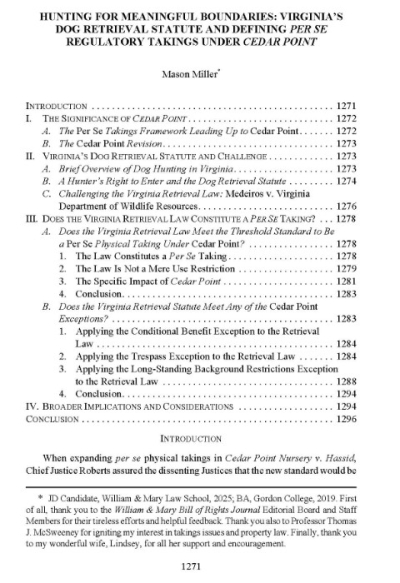
Be sure to read this recently-published piece in the William and Mary Bill of Rights Journal, Mason Miller, “Hunting for Meaningful Boundaries: Virginia’s Dog Retrieval Statute and Defining Per Se Regulatory Takings Under Cedar Point,” 33 Wm. & Mary Bill of Rights J. 1271 (2025). 

The article focuses on Virginia’s so-called “right to retrieve” law, Va. Code § 18.2-136 (“Fox hunters and coon hunters, when the chase begins on other lands, may follow their dogs on prohibited lands, and hunters of all other game, when the chase begins on other lands, may go upon prohibited lands to retrieve their dogs, falcons, hawks, or owls but may not carry firearms or bows and arrows on their persons or hunt any game while thereon.“).

Disclosure: our firm represented property owners in an earlier case challenging this statute, which is discussed in the piece. 

Here’s the Introduction

Continue Reading New Article: “Hunting for Meaningful Boundaries: Virginia’s Dog Retrieval Statute and Defining Per Se Regulatory Takings Under Cedar Point“

Screenshot 2025-06-30 201407

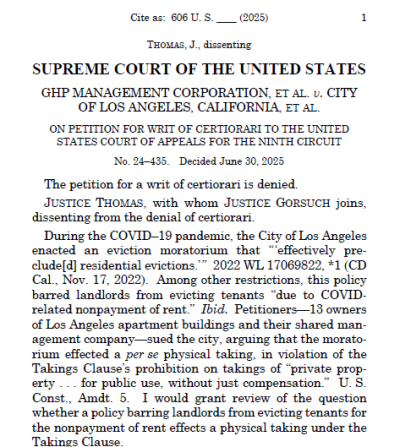
Yesterday, in this Order in a case we’ve been following, the U.S. Supreme Court declined to consider whether a municipal ordinance which allowed non-paying tenants to remain in the lessor’s property after the agreed-upon termination of a lease (nonpayment of rent) is a physical taking, or merely the regulation of the lessor/lessee relationship under the Yee theory.

You remember that theory? It goes like this: once an owner voluntarily rents property to a tenant, the government then allowing that tenant to remain rent-free when, under the rental agreement, the right to occupancy would otherwise be terminated (for failure to timely pay rent, for example) isn’t the government facilitating an unauthorized physical occupation (see, e.g., Kaiser Aetna), but rather is merely a regulation of the existing lessor/lessee relationship. The Ninth Circuit in this case, and other courts around the country have viewed Yee as compelling

Continue Reading The Other Shoe Drops: SCOTUS Declines Review Despite Acknowledged Split – Is Barring Owners From Evicting Nonpaying Tenants A Physical Taking?