2025

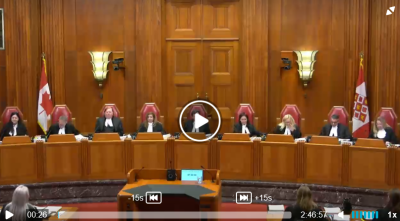
Screenshot 2025-01-23 at 17-00-09 Supreme Court of Canada - SCC Case Information - Webcast of the Hearing on 2025-01-16 - 40908

You know that from time to time — mostly thanks to our friend and colleague Shane Rayman and his firm — we cover property goings-on north of the border when a good property rights case comes before the Supreme Court of Canada (see here and here for past examples).

Well, here’s another one, this time involving the intriguing question of whether government-owned land is subject to adverse possession. Here’s where you can watch the arguments (in English or French, naturally!). As the summary of the case from the Supreme Court website notes:

The appellants are owners of a residential property in the City of Toronto. They sought an order for adverse possession of a parcel of City parkland that their predecessors in title had fenced off with a chain link fence and enclosed into their backyard. The City acknowledged that the appellants’ evidence satisfied the traditional test for adverse

Continue Reading Canada Supreme Court Hears Arguments: Is Govt Land Subject To Adverse Possession?

That was quick: no sooner are we all headed home from the just-wrapped 2025 ALI-CLE Eminent Domain & Land Valuation Litigation Conference in San Diego (report to follow soon), than Bobby Debelak posts up his report in the latest episode of the Eminent Domain Podcast –

Featuring Chris Clough, Angela Misch, Clint Schumacher, and Elizabeth Sockwell.

In this episode, we interview a handful of guests–presenters, first timers, and repeat attendees from the 2025 ALI-CLE Eminent Domain and Land Valuation Conference.

Note: Next Year’s conference will be in Savannah, GA.

Stream the episode above, or download it here.

And yes, we’re sporting our newly-acquired EDP pin:

PXL_20250203_162937553.MPContinue Reading Eminent Domain Podcast ep. 139: “Live From San Diego! ALI-CLE 2025 Conference Coverage”

Property_rights_and_the_roberts_court_Agenda_

Register now and plan on joining us on Thursday, February 27, 2025 at the U.C. Berkeley Law School for a one-day conference: “Property Rights and the Roberts Court: 2005-2025.”

Here’s the agenda. Here’s a description of the program:

For much of the past century, property rights were relegated to second-class status compared to the rest of the Bill of Rights. However, under the Supreme Court leadership of Chief Justice John Roberts, this trend has begun to shift.

In recognition of the 20th anniversary of the Chief Justice’s elevation to the Supreme Court, Pacific Legal Foundation is partnering with Berkeley Law’s Public Law and Policy Program to host a day-long conference exploring the major property rights developments and future of property rights law in the Roberts Court.

We’ll hear from two different panels of renowned legal scholars and accomplished litigators, as well as a keynote lunch discussion between

Continue Reading Join Us: “Property Rights and The Roberts Court: 2005-2025” (Feb. 27, 2025, UC Berkeley Law School)

With our tongues firmly planted in cheeks, the Planning Chairs for the upcoming 42d edition of this popular and venerable Conference bring you this “breaking news” report from San Diego!

As you know, in addition to being the best nationally-focused conference on the subjects that we love and a venue that is nearly certain to have some of the warmest winter weather in the continental United States, and we went on-location from some of the local highlights: the beaches, Torrey Pines, the Zoo, Balboa Park, the Gaslamp Quarter, and Coronado to name but a few.

More about the Conference here, including registration information.

Here are some of the highlights:

  • Property Rights at the Supreme Court: DeVillier and Sheetz and What’s Next
  • Slow Take: Possession, Rent, Relocation, and Offset
  • The Jury’s View: How Jurors See Your Case
  • From Penn Coal to Penn Central: How to


Continue Reading One Last Chance To Join Us For The 42d ALI-CLE Eminent Domain & Land Valuation Litigation Conference (San Diego & Webcast)

Hyatt

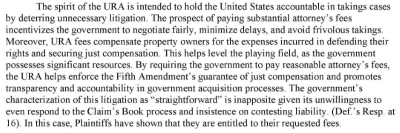
One from the U.S. Court of Federal Claims that is worth your time at least to skim. And the opinion is worth reading if only for the court’s conclusion which we’ve reproduced above.

Hyatt v. United States, No. 23-399 (Jan. 16, 2025) is, as the court described it, “a typical rails-to-trails action[.]” The issue resolved here was how much the property owners were entitled to recover in attorneys fees and expenses, now that they prevailed on the merits.

Under the Uniform Relocation Act, a property owner who obtains compensation for a regulatory taking may recover reasonable attorneys fees and costs. The opinion noted:

Specifically, in actions brought under the Tucker Act or the Little Tucker Act in which a plaintiff is compensated for the taking of property, the URA provides for the recovery of “such sum as will in the opinion of the court or the Attorney General reimburse

Continue Reading CFC: Attorneys Fee Shifting “incentivizes the government to negotiate fairly, minimize delays, and avoid frivolous takings”

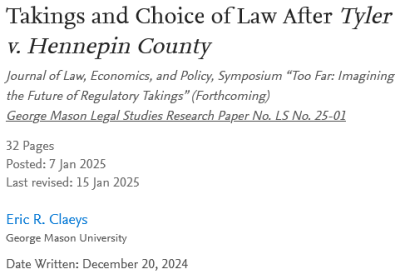
Screenshot 2025-01-23 at 15-10-58 Takings and Choice of Law After i Tyler v. Hennepin County _i by Eric R. Claeys SSRN

Check out this article, forthcoming in the George Mason Journal of Law, Economics, and Policy from lawprof Eric Claeys, “Takings and Choice of Law After Tyler v. Hennepin County.”

This is one of the pieces coming out of the recent symposium “Imaging the Future of Regulatory Takings” at George Mason Law School.

Here’s the Abstract:

This Essay contributes to a symposium on the future of regulatory takings. It focuses on choice of law in eminent domain disputes. When claimants bring eminent domain claims in federal courts, the courts must determine whether the claimants have constitutional “private property” in the entitlements allegedly taken. Should that determination be made with federal law, with the law of the state allegedly taking property, or law from some other source?

The 2023 Supreme Court decision Tyler v. Hennepin County addressed that issue. Under Tyler, it is a federal question whether an eminent domain claimant has constitutional private property. To answer the question, federal courts usually consult the law of the state where the alleged taking took place. But that presumption applies only if state law seems to secure and not to circumvent the federal right. And if that reservation is not satisfied, federal courts may consult a wider pattern of legal sources—Anglo-American history, the general law of the several United States, federal court precedents, and a broader cross-section of law from the state allegedly taking property. That approach resembles the approach taken generally for federal constitutional rights—especially in Indiana ex rel. Anderson v. Brand (1938)—but varies from the general approach in the sources it makes relevant to settle what counts as private property under the Fifth Amendment. This Essay interprets Tyler, and it offers a normative justification for Tyler’s approach to choice of law in eminent domain. 

Don’t miss this one.

Continue Reading New Article (Eric Claeys): “Takings and Choice of Law After Tyler v. Hennepin County”

What to say about the Colorado Supreme Court’s recent decision in Nonhuman Rights Project v. Cheyenne Mountain Zoo, No. 24SA21 (Jan. 21, 2025), wherein the court resolved the momentous and highly controversial question of whether an elephant is a person?

Our first temptation is to see this through the takings lens (surprise), and snark that courts seem be very willing to consider ridiculous cases like this one, determine whether a monkey owns a “selfie” that he snapped, and rule that bees qualify as “fish” in a statute because the legislature didn’t think to modify the term “invertebrate” in a list of marine invertebrates with the term “marine” — yet it is beneath the dignity of judges to consider cases where — oh, the humanity!they may be called on to be Super Zoning Boards of Appeals.

Our other snarky thought was the outcome of this case

Continue Reading Bees May Be Fish In California, But Here In Colorado, Elephants Ain’t Persons

Here’s what we’re reading this day:

Good weekend reading as well. Continue Reading Friday Dirt Law Round-Up

20180720_150853_HDR
The only courthouse we know where the Supreme Court
is
below the Court of Appeals (SJC on the second floor,
appellate court on the third)

A brief one from the Supreme Judicial Court of Massachusetts.

In Attorney General v. Town of Milton, No. SJC-13580 (Jan. 8, 2025), the court rejected a challenge to a state statue which allowed the Massachusetts Bay Transportation Authority, the public transit authority in the Boston area, to require municipalities which access the T loosen their zoning regimes to “provide for at least one district of multifamily housing ‘as of right’ near their local MTBA facilities.” Slip op. at 3. One town declined to do so, and the state AG sued to enforce the statute.

The town responded by challenging the statute’s validity and the AG’s authority to sue to enforce it. Yes on both counts held the SJC. But (and there’s a

Continue Reading Mass SJC: State Requiring Municipalities To Adopt Multi-Family Zoning Is Enforceable By AG…But