


2025

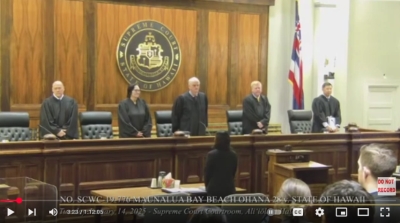
Screenshot 2025-01-18 at 14-58-03 No. SCWC-19-0000776 January 14 2025 10 30 a.m. Maunalua Bay v. State of Hawaiʻi - YouTube

Here’s the latest in a case we’ve been following for a long time.

As we previously noted, the Hawaii court of appeals affirmed a trial verdict that the just compensation owed to littoral property owners for the State’s regulatory taking of small portions of accreted beach is zero.

Last week, the Hawaii Supreme Court heard oral arguments. Here’s the video (sorry, can’t embed it here). Worth watching, if only because questions of just compensation and how it is calculated rarely are presented to this court (which is a frequent flyer in regulatory takings cases).

Here’s a description of the case and issues from the Hawaii Judiciary:

Petitioners Maunalua Bay Beach Ohana 28, Maunalua Bay Beach Ohana 29, and Maunalua Bay Beach Ohana 38 brought an inverse condemnation action against the State of Hawai‘i in 2005. At that time, they argued that the State effected a taking of accreted lands via Act 73 of 2005. In 2009, the Intermediate Court of Appeals (ICA) held that Act 73 “effectuated a permanent taking of littoral owners’ ownership rights to existing accretions to the owners’ oceanfront properties that had not been registered or recorded or made the subject of a then-pending quiet-title lawsuit or petition to register the accretions.” Maunalua Bay Beach Ohana 28 v. State, 122 Hawai‘i 34, 57, 222 P.3d 441, 464 (Ct. App. 2009).

On remand from the ICA, Petitioners sought just compensation for the alleged temporary taking of their accreted lands between 2005 and 2012. At trial, the circuit court concluded that $0 was just compensation for the alleged temporary taking of the accreted land and no nominal damages should be awarded to the petitioners. It also determined that the petitioners were not entitled to attorney’s fees.

The ICA affirmed the circuit court’s decision. With regard to attorney’s fees, the ICA held that the petitioners’ “claim for attorneys fees against the State for obtaining declaratory relief is barred by sovereign immunity.” The ICA further held that the Ohanas were not entitled to attorney’s fees under the private attorney general doctrine.

In their application for certiorari, the petitioners argue that the ICA erred in affirming the circuit court’s award of $0 in just compensation with no nominal or severance damages. Petitioners also contend that the ICA erred by concluding that sovereign immunity bars an award of attorney’s fees, and that they would not be entitled to fees under private attorney general doctrine. The State contends that the ICA did not err in affirming the circuit court’s award of $0 in just compensation or declining to award nominal damages to petitioners. It also argues that the ICA correctly held that sovereign immunity bars petitioners’ claim for attorney’s fees, and that even if it did not, petitioners would not be entitled to attorney’s fees under the private attorney general doctrine.

We watched live, and have a couple of thoughts:

  • Justice McKenna’s questions indicate she recalls that in an earlier regulatory takings case, the court concluded that even “speculation value” was enough to place a regulatory takings claim outside a Lucas wipeout analysis, an indicator that in this court’s view, property always has value, even if it has no use. Is that enough to say the owners here were entitled to, at the very least, nominal just compensation?
  • Does obtaining a decision holding the State to its constitutional obligation (after which the State repeals the unconstitutional statute) qualify the plaintiff for fee recovery from the State under the private attorney general doctrine, even where the adjudicated compensation is zero? We think so, because suing to keep the State in line when it has acted beyond its authority is exactly the kind of thing that the Attorney General should do (but didn’t here, because it has been too busy defending the State’s action). What about the advocate for the State who argued that there was no constitutional wrong here, because of the zero compensation verdict (the notion that the Takings Clause does not prohibit takings, only uncompensated takings)? The fact that the State withdrew the offending statute after the plaintiffs won the takings claim seems to contradict that argument because at the heart of it, the court ruled that the State should have used its eminent domain power to take future accreted land, and not the police power.

Stay tuned. We’ll continue to follow along and will post the court’s opinion when issued.

Continue Reading Hawaii Supreme Court Arguments: Is Just Compensation For Even A Small Slice Of A Primo Hawaii Beach Zero?
Here’s the latest in a case (and issue) we’ve been following.

In this latest iteration of what we call the “SWAT takings” issue, the Sixth Circuit, like every other federal appellate court, denied the owner of property severely damaged in the course of a police dislodging of a criminal suspect. But the court applied a different analysis. Instead of (incorrectly, we think) looking and whether the police were acting with the scope of their (ha!) police power, the court concluded that the police had a “privilege” to enter, so thus could destroy in the course of that entry, the petitioner’s property.

In short, your bundle of sticks never included the right to exclude the po-po.

Here’s the Question Presented:

A few weeks ago, this Court denied certiorari in Baker v. City of McKinney, 23-1363, a case about whether the Fifth Amendment’s Takings Clause re-quires compensation when a

Continue Reading New Cert Petition: SWAT Takings, Part X

You remember 1977, don’t you? No? Well surely you must know the soundtrack. Sublime and deeply resonant music, accompanied by complex-yet-meaningful lyrics like these:

I’m your boogie man, that’s what I am.
I’m here to do whatever I can.
Be it early morning, late afternoon.
Or at midnight, it’s never too soon.

To wanna please you, to wanna keep you.
To wanna do it all, all for you.
I wanna be your, be your rubber ball.
I wanna be the one you love most of all, oh, yeah.

I’m your boogie man
I’m your boogie man, turn me on.

We dig it. After all, we there, tuning in on AM radio at a time when disco dominated, before it fell from grace and then became hip again.

Well dust off your 1977 vibes. The year Elvis left the building for good, when Star Wars was just “Star Wars” and

Continue Reading Cal SCt Petition: Does “Existing Structures” Protected By The California Coastal Act Mean Only Those Existing In 1977?

The facts in D.A. Realestate Inv., LLC v. City of Norfolk, No. 23-1863 (Jan. 16, 2025), a recent decision from the U.S. Court of Appeals for the Fourth Circuit, are fairly sympathetic. And the opinion starts off with a tantalizing quote:

In 1761, Massachusetts lawyer James Otis exclaimed “one of the most essential branches of English liberty is the freedom of one’s house. A man’s house is his castle.” John Adams’s Reconstruction of Otis’s Speech in the Writs of Assistance Case, in Collected Political Writings of James Otis 12–13 (Richard Samuelson, ed. 2015). American law has embraced that principle since our nation’s founding. U.S. Const. amend. V. But we have also long recognized that “all property in this country is held under the implied obligation that the owner’s use of it shall not be injurious to the community.” Mugler v. Kansas, 123 U.S. 623, 665 (1887).

Slip op.

Continue Reading CA4: Challenge Public Use/Pretext Under Due Process And § 1983, Not Inverse

Here’s a recently-filed cert petition to watch. We won’t go into the background, because the Questions Presented pretty much lay the foundation:

Respondent County of San Diego, et al. (County), a California land use agency, denied the land use permits for Village Communities et al. (Village) to develop a much-needed residential and mixed-use community in North San Diego County, California. The County denied the Project solely because Village “failed” to satisfy the County’s condition requiring Village to pay money to acquire offsite easements from 100 percent of the 50 property owners along a public road near Village’s property site in spite of the fact that the County made no individualized determination that the monetary exaction, a sum of approximately $2.5 million, bore an “essential nexus” and “rough proportionality” to the purported impacts associated with Village’s project as required by Nollan v. California Coastal Comm’n, 483 U.S. 825 (1987)

Continue Reading New Cert Petition: To Have A Nollan-Dolan-Koontz Claim, Must You Be Forced To Give Up Land And Money?

Two — count ’em two! — cert petitions from our shop, filed today. Both call for “clarifying or overruling” Penn Central.

Oh, have I got your attention now?

Both arise out of the Michigan governor’s orders shuttering some, but not all, businesses during Co-19. These had devastating consequences, and owners sued for, inter alia, a taking, asserting a Penn Central theory. As we noted here, the Gym 24/7 case went up through the Michigan court system, with the Supreme Court eventually denying discretionary review over an extensive dissent. The Mount Clemens Recreational Bowl case took pretty much the same path. 

We’re not going to say much more because

Continue Reading Two New Cert Petitions (Ours) – 50 Years Of Fruitless Trying Is Enough: Overrule Or Clarify Penn Central!

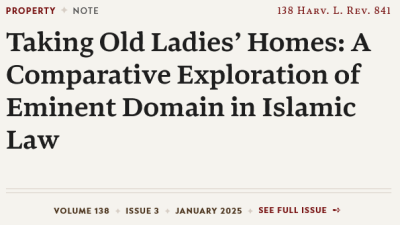
Screenshot 2025-01-12 at 09-35-14 Taking Old Ladies’ Homes A Comparative Exploration of Eminent Domain in

Check this out, a just-published unsigned student piece: Note, “Taking Old Ladies’ Homes: A Comparative Exploration of Eminent Domain in Islamic Law,” 138 Harv. L. Rev. 841 (2025).

Not that we have any background to be able to evaluate the author’s assertions, but at the very least, the piece is very interesting (you learn stuff!), and does reach the conclusion that forced acquisitions are not absolutely necessary to “develop[] advanced built environments and economic systems[.]” See id. at 862 (“It is not enough to assume that any society, or indeed any modern society, requires a particular form of eminent domain or the eminent domain power itself.”).

Here’s a summary.

This Note is therefore likely the first exploration of premodern Islamic discourses and practices of “eminent domain.” It will argue three things about forced appropriation of property for public purposes in premodern Islamic law: First, that unlike in Anglo-American

Continue Reading New Article (Note): “Taking Old Ladies’ Homes: A Comparative Exploration of Eminent Domain in Islamic Law,” 138 Harv. L. Rev. 841 (2025)

If you thought the issue of whether it is a Fifth Amendment taking for a state or local government to “keep the change” after satisfying a tax debt was settled by the U.S. Supreme Court in Tyler v. Hennepin County, 598 U.S. 631 (2023), you’d be right.

Then what was there left for the New Jersey Supreme Court to decide in 257-261 20th Avenue Realty, LLC v. Roberto, No. A-29-23 (Jan. 9, 2025)? Some interesting stuff, it turns out.

And before you conclude that this is just piling-on, remember — they wanted this: after Tyler, instead of reading the U.S. Supreme Court’s decision and the writing on the wall, some state and local governments, unhappy with being cut off from a source of easy money, tried to figure ways to avoid or negate the rule that if there’s money left over after you satisfy a tax debt

Continue Reading NJ’s Forfeiture Statute Is A Taking Of Surplus Home Equity

At first glance, it might seem like there’s a lot there in the U.S. Court of Appeals’ opinion in Becker v. City of Hillsboro, No. 23-3367 (Jan. 7, 2025).

After all, the city’s prohibition on new private wells and another requirement that newly built homes connect to the city’s water system seems a bit arbitrary (at least the opinion doesn’t give a lot of detail why, other than “the city said so”). And the opinion evaluates a Lucas wipeout, a physical invasion, a Penn Central ad hoc taking, and a Nollan/Dolan claim. Even a Murr denominator issue. This case could have been a good vehicle to examine those questions in more detail that many courts do.

But after taking a dive in, our initial impression that this case would provide a lot of insight — or even food for deeper thought — didn’t pan out. Take a

Continue Reading CA8 Misses An Opportunity For Penn Central Clarity: No Taking When City Bans New Private Wells, Requires City Water

With our tongues firmly planted in cheeks, the Planning Chairs for the upcoming 42d edition of this popular and venerable Conference bring you this “breaking news” report from San Diego!

As you know, in addition to being the best nationally-focused conference on the subjects that we love and a venue that is nearly certain to have some of the warmest winter weather in the continental United States, and we went on-location from some of the local highlights: the beaches, Torrey Pines, the Zoo, Balboa Park, the Gaslamp Quarter, and Coronado to name but a few.

More about the Conference here, including registration information.

Here are some of the highlights:

  • Property Rights at the Supreme Court: DeVillier and Sheetz and What’s Next
  • Slow Take: Possession, Rent, Relocation, and Offset
  • The Jury’s View: How Jurors See Your Case
  • From Penn Coal to Penn Central: How to


Continue Reading Breaking News: Come Join Us For The 42d ALI-CLE Eminent Domain & Land Valuation Litigation Conference, San Diego, Jan 30-Feb 1