


2025

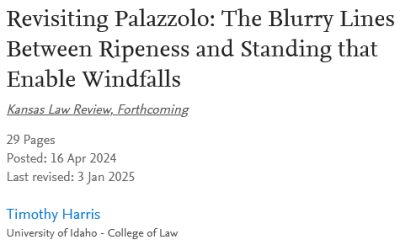
Screenshot 2025-01-04 at 08-42-51 Revisiting Palazzolo The Blurry Lines Between Ripeness and Standing that Enable Windfalls by Timothy Harris SSRN

Check out, the latest from Professor Timothy Harris, “Revisiting Palazzolo: The Blurry Lines Between Ripeness and Standing that Enable Windfalls,” 73 Kan. L. Rev. 289 (2024). He dives into the question of whether an owner who acquires property already subject to regulations that allegedly work a taking may assert a claim, or does that claim belong only to the prior owner?

Here’s the Abstract:

When property changes hands, the pre-existing right of the seller to bring an inverse condemnation claim against the government does not always pass to a subsequent owner. Sometimes it does. If valid takings claims expire on sale, the government may experience a windfall. But if a buyer gets a deal on burdened property and then sues under a prior owners’ takings claim, the new property owner gets a windfall. Established Supreme Court rules draw distinctions between the character of various “takings” to determine whether
Continue Reading New Article: Timothy Harris, “Revisiting Palazzolo: The Blurry Lines Between Ripeness and Standing that Enable Windfalls,” 73 Kan. L. Rev. 289 (2024)

It’s been a couple of weeks, but we’re still trying to wrap our head around the Iowa Supreme Court’s opinion in Singer v. City of Orange City, No. 23-1600 (Dec. 20, 2024).

The court rejected a facial challenge under the Iowa Constitution’s search-and-seizure clause to a city ordinance requiring the owner of rental units to have a rental permit and to submit to “regular inspections” of those properties. The ordinance purports to create a “right of entry” for a “code official,” and if the owner refuses to voluntarily allow inspection, the inspector may obtain an “administrative search warrant” to enter and search. An owner can exempt itself from inspection by a city inspector if a unit is “inspected by a certified third-party inspection organization[.]” And the ordinance says nothing about probable cause.

Several owners sued, and after discovery, the court granted the plaintiff-owners summary judgment. It declared the ordinance

Continue Reading Iowa: Mandatory Inspection Of Rental Units Without A Warrant Is Not Facially Unconstitutional, Because Private Inspectors Might Barge In

Heads up law students and young lawyers: the American Bar Association’s Section of State & Local Government Law has called for submissions for its annual writing competition.

Topics which the Urban Lawyer publish pieces about include land use, takings, eminent domain, housing, RLUIPA, exactions … and more. 

Here’s the announcement: 

The State and Local Government Law Section of the ABA is holding its annual Writing Competition, with the winner to be published in the Section’s Law Review, The Urban Lawyer.

The Section invites all those who qualify as young lawyers (less than 36 years old or in practice for less than 10 years) and law students to submit articles of 25-50 pages in length, and properly footnoted, on any topic of state or local government law of their choice.

Membership in the ABA as a Law Student or in the ABA Young Lawyer Division is encouraged but is not

Continue Reading Announcement: State & Local Govt Law Writing Competition

The owner’s land is a peninsula most of the time, but when Flathead Lake, Montana, rises a few months each year, it needed a bridge to access. So it asked the County “How about a bridge? We will only use it when the water rises.” County said yes, issued a permit.

NIMBY neighbors, however, had another idea, They sued the County to void the permit: “What about the Montana Lakeshore Protection Act?” they asked. Trial court agreed, declared the permit void, and ordered the owner to restore the area to its natural state. Montana Supreme Court affirmed.

Next up: the owner’s inverse claim against the County. We got a vested property interest, and “removal of the bridge by court order amounted to a taking[.]” Slip op. at 3. Trial court agreed with the County that the permit was void ab initio, and thus no vested property right. Moreover, the owner

Continue Reading Montana: It Doesn’t Take Much To Allege An Inverse/Takings Claim (Nor Should It)

Sandefur

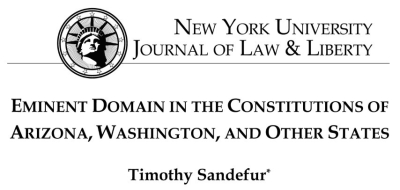
We’re starting off the new year with some eminent domain goodness. Tim Sandefur has published “Eminent Domain in the Constitutions of Arizona, Washington, and Other States,” 18 N.Y.U. J.L. & Liberty 167 (2024).

There’s a lot in the piece that will keep you reading, but what we found particularly insightful was how public use/purpose limitations “should operate in practice.” In our opinion, it’s fairly easy to say that the Fifth Amendment (and state constitutions) operate as a robust check on the sovereign power to take property for public use, but a lot more difficult to apply that broad notion to particular circumstances in a way that is both uniform and predictable. Right now, we seem to be operating on a know-it-when-I-see-it basis, but that doesn’t get us to a general rule. This piece goes a long way to getting us to a general rule.

Highly recommended.

Here’s the Abstract:

The nineteenth century was an extraordinarily prolific age of constitution-making. One of the greatest concerns of constitution-makers during this period—particularly in the western states—was the protection of private property against threats such as the use of eminent domain and the damage to property resulting from public works projects. This Article takes the eminent domain provisions of the Arizona and Washington constitutions as a point of departure to examine the innovative ways in which constitution-makers sought to limit government’s power to deprive people of their property. These constitutions—which until the admission of Alaska and Hawaii were the most up-to-date constitutions in America—contain four such innovations: (1) an explicit ban on takings for “private use,” reinforced by prohibitions on judicial deference regarding the definition of “public use”; (2) a compensation requirement for the “damaging” of property; (3) a requirement that payment precede a taking, and (4) a ban on deducting from just compensation awards the amount of purported “benefit” resulting from a taking. The Article traces the origins of these four protections, with reflections on how they should operate in practice.

Check it out

.
Continue Reading New Article: Timothy Sandefur, “Eminent Domain in the Constitutions of Arizona, Washington, and Other States,” 18 N.Y.U. J.L. & Liberty 167 (2024)