Anyone who reads this blog regularly knows Tiburon, California, even if you’ve never stepped foot there. Yes, that Tiburon. Well, the beat goes on: the Agins litigation wasn’t the only time that the town and its residents combined forces to try and draw up the drawbridge and prevent the building of more homes in this very exclusive and chichi Marin County waterfront and hilltop community with commanding multi-million dollar views of San Francisco and the Bay. 

For the latest example, read the California Court of Appeal’s opinion in Tiburon Open Space Committee v. County of Marin, No. A159860 (May 12, 2022). It’s 110 pages, but don’t let that discourage you (it’s not necessary to dig into the details, unless you are a true California Environmental Quality Act nerd). The facts alone are hair-raising. But on the other hand, the story may be an old story to
Continue Reading “Something is very wrong with this picture.” Cal Ct App Calls Out CEQA (“fearsome weapon”), Tiburon’s “official hostility,” And “combined animus of two levels of local government”

Screenshot 2022-05-02 at 11-51-57 Display event - 2022 Hawaii Land Use Law Conference (LIVE)

It’s back! After a hiatus on the in-person program, the bi-annual Hawaii Land Use Conference is back in-person (see here for a sample of one of our prior presentations at this conference).

May 25 and 26, 2022, downtown Honolulu.

The full agenda and speaker list has not yet been published, but here’s a summary of the program:

Sponsored by the Hawaii State Bar Association and the Real Property and Financial Services Section. Coordinated by David Callies and Benjamin Kudo, his 2-day conference is a must attend for any attorney or professional whose practice involves land use and development. Distinguished land-use practitioners, scholars, planners, and regulators from Hawaii and the Mainland will discuss timely and relevant issues, including:

• Takings 

• Transit Oriented Development (TOD) 

• Seawalls and Shoreline Access 

• Climate Change 

• Affordable/Workforce Housing 

• Ethical Considerations for Real Property Practitioners and Other Professionals

We’ll be speaking during

Continue Reading Hawaii Land Use Law Conference, May 25-26, 2022, Honolulu – Join Us!

Bergerpage

A new article by lawprof Bethany Berger, “Property and the Right to Enter,” criticizing the Supreme Court’s ruling in Cedar Point Nursery. The article builds on the amicus brief in the case, also authored by Prof Berger.

Here’s the Abstract:

On June 23, 2021, the Supreme Court decided Cedar Point Nursery v. Hassid, holding that laws that authorize entry to land are takings without regard to duration, impact, or the public interest. The decision runs roughshod over precedent, but it does something more. It undermines the important place of rights to enter in preserving the virtues of property itself. This Article examines rights to enter as a matter of theory, history, and constitutional law, arguing that the law has always recognized their essential role. Throughout history, moreover, expansions of legal exclusion have often reflected unjust domination antithetical to property norms. The legal advocacy that led to Cedar Point continues this trend, both undermining protections for vulnerable immigrant workers in this case, and succeeding in a decades long effort to use exclusion as a constitutional shield against regulation.

Definitely worth reading.
Continue Reading New Article (Bethany Berger): “Property and the Right to Enter”

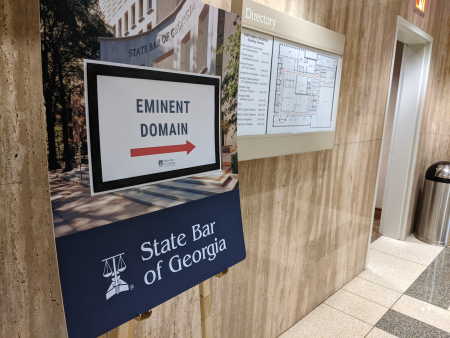
PXL_20220422_171653637

Here are the links to the cases and other materials that we talked about last Friday at the Georgia Bar Association’s annual Eminent Domain Conference. Our talk was entitled “It’s the Chief Justice’s Property World, We Just Live In It: National Trends in Takings, Property, & Eminent Domain,” and was part of the Eminent Domain Section’s (yes, the Georgia Bar has a Section entirely devoted to eminent domain!) annual conference on the topic. I was honored to have been asked to chat with this august and expert group of lawyers.


Continue Reading Links From Last Week’s Georgia Bar Association Eminent Domain Conference

FedCtsTakingsArticlepage1

A new article on takings from U. Virginia Law School profs Ann Woolhandler and Julia Mahoney in the Notre Dame Law Review, “Federal Courts and Takings Litigation.” Get the pdf here.

Rather than try and summarize the piece, we’re just going to cut-and-paste the highlights from the article’s Introduction:

While Knick clearly expands the lower federal court role in takings claims, many questions remain. We do not know how federal courts will respond to the increase in claims—whether they will embrace a robust federal role in land use cases, or use various abstention doctrines to rein them in. While pro-regulatory and pro-property rights scholars have predictably taken sharply contrasting positions as to the appropriate federal court role post-Knick, this Article will recommend a middle-of-the-road approach, based partly on history and partly on an assessment of where the lower federal courts may most usefully contribute to the

Continue Reading New Article: Woolhandler & Mahoney, Federal Courts and Takings Litigation, 97 Notre Dame L. Rev. 679 (2022)

Not too long ago, we posted the Fifth Circuit’s panel opinion in a case where the court held that there’s nothing a federal court can do if a local government does not pay a state-court just compensation judgment. We filed an amicus brief in that case arguing “[t]he Takings Clause does not permit the Sewerage Board to take property and hand the owner an IOU the Board might pay sometime in the future if and when it feels like it. Instead, it requires the Sewerage Board to pay the court ordered just compensation without ‘unreasonable delay.'”

Well, in the interim we’ve traded in our amicus hat for a co-counsel hat, and last week asked the Fifth Circuit to rehear the case en banc, via this en banc petition.

Since we’re now co-counsel in the case, we won’t go into further detail, but will leave it there for you to

Continue Reading Are The Federal Courts Powerless When A Condemnor Doesn’t Pay Just Compensation?

Here’s the latest case challenging a pandemic-related eviction moratorium, this one from Minnesota and the U.S. Court of Appeals for the Eighth Circuit.

In Heights Apts, LLC v. Walz, No. 21-1278 (Apr. 5, 2022), the court reversed the district court’s dismissal of a property owner’s takings claims. The owner challenged the Minnesota governor’s residential eviction moratorium and later extensions. Like a lot of these things, the Minnesota version was not a rent “holiday” (tenants were still, technically speaking, on the hook for the rent, and there were several limited exceptions under which the property owner could evict). But for the most part, the Minnesota measure, like a lot of these things, effectively left property owners holding the economic bag (good luck collecting thousands in back rent), and turned their units into public pandemic housing. 

The owner’s complaint raised Contract Clause, Petition Clause, and Takings claims.

Before we get to

Continue Reading CA8: Yee v. Escondido Doesn’t Save Eviction Moratorium From Takings Review

Here’s an issue that we’ve been following for a while. What will a court do when a condemnor is ordered to pay (the property owner has a judgment in hand), but the condemnor says “no thanks”?

The latest incarnation is the U.S. Court of Appeals’ opinion in Ariyan, Inc. v. Sewerage & Water Board of New Orleans, No. 21-30335 (Mar. 21, 2022). There, a group of property owners successfully brought Louisiana law takings claims against the Board after its flood control project caused “property damage and economic loss.” In the various cases, verdicts were rendered, and judgments were issued from 2018 through 2020.

Well, you know what is supposed to happen next. Judgment debtors are supposed to pay up, or else the judgment creditor may satisfy the judgment by other means.

But when the government is the judgment debtor, the creditor can’t just put a lien on City

Continue Reading What Can A Property Owner Do When A Condemnor Doesn’t Pay? (Fifth Circuit: Nothing)

Here’s a really short one from the U.S. Court of Appeals for the Fourth Circuit. Not published, so even shorter than you might expect.

In Virginia Hospital & Healthcare Ass’n v. Kimsey, No. 20-2176 (Mar. 1, 2022), the court rejected the Commonwealth’s argument that the sole remedy for a takings claim is just compensation.

The plaintiff challenged a statute which limited their ability to obtain reimbursement for medical services rendered to Medicaid patients, which instead keys reimbursement to the patients’ diagnoses. According to the plaintiffs, this scheme leaves them holding the financial bag in situations were they render services that the statute deems avoidable because of the final diagnosis. 

The complaint alleges a regulatory taking, because the statute “denies just compensation for federally-mandated emergency services by predicating reimbursements on the final diagnosis only – and not on the services actually provided,” and for reimbursing at only 1/2 the usual

Continue Reading CA4: Just Comp Isn’t The Only Remedy For A Taking

CedarpointPRELcoverpage

Thank you to the editors over at The Practical Real Estate Lawyer for publishing my missive on Cedar Point Nursery v. Hassid, the U.S. Supreme Court’s recent blockbuster regulatory takings decision (and for letting me post a copy of the article here so it is available even if you are not a PREL subscriber). And you know this, but I’m going to disclose it again: my law firm represented the property owner in that case, so yes, I do have a viewpoint; take that into account while reading. 

By the way, you might consider becoming a subscriber. The journal publishes just what the title suggests it does – practice-oriented articles about dirt lawyering. Good stuff.

Thomas, Common Sense and Common Law: Defining “Property” in Cedar Point v. Hassid, 38 Prac. Real Estate Law…

Continue Reading New Article: Common Sense and Common Law: Defining “Property” in Cedar Point v. Hassid