PXL_20220127_144224442

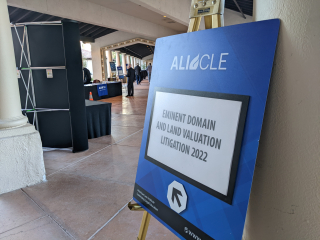
After a two-year absence in which we went remote, in the last week of last month (our usual spot on the calendar, between the playoffs and Super Bowl), we once again met in-person for the American Law Institute-CLE Eminent Domain and Land Valuation Litigation Conference.

Approximately 200 lawyers, judges, legal scholars, appraisers, law students, right-of-way agents, relocation experts, property owners, and other related professionals gathered in-person–yes, in-person–at the Scottsdale (Arizona) Resort at McCormick Ranch, to get reacquainted, learn stuff, and renew ties last made in-person in Nashville in 2020. In addition to the live attendance, we also welcomed about 50 remote colleagues, who joined the live webstream.

This was the 39th edition of the Conference, one of the most-established and successful conferences in the ALI-CLE stable of programs.

To those who joined us – thank you. This conference reminded us of why this program is so
Continue Reading 2022 ALI-CLE Eminent Domain And Land Valuation Litigation Conference, Scottsdale: You Should Have Been There!

Before we go further into the Ninth Circuit’s opinion in Ballinger v. City of Oakland, No. 19-16-550 (Feb. 2, 2022), this disclosure: this is a case in which our law firm represents the property owners. So take that into account as you read our take on the case.

The Ballingers own a home in Oakland, California, and were called away for a year while on active duty with the military. They rented their home with a one-year lease. Oakland makes property owners who want to move back into their own homes at the expiration of a lease to pay tenants a “relocation fee.” The Ballingers paid $6.5k to the tenant for the relocation fee, and sued the city for, inter alia, a physical taking of their money, and for an unconstitutional exaction of their home. The district court dismissed for failure to state a claim because the

Continue Reading CA9: We Reject Legislative/Administrative Distinction In Exactions, But City Requirement That Owners Pay Tenant To Move Back Into Their Home Isn’t A Taking

A developer alleged that the city didn’t live up to its contractual obligations.

The city thought it would be a good place for a new headquarters for something called “Perfect Game Incorporated.” The usual plans ensued, including agreements between the city, a non-profit redevelopment facilitator, and Preston Hollow, a “finance company that funds economic development projects for municipal governments and development corporations.” These agreements dealt with loans by Preston to the city and the facilitator; the loans were used by the facilitator to purchase two parcels in the city for the project, with some of the money remaining in escrow subject to disbursement when certain things happened.

That’s when things allegedly went awry. As the Fifth Circuit put it, “trouble ensued.” Preston claimed that the facilitator insisted on disbursement, even tough it has not yet complied with the conditions. Preston sent a notice of default, and requested that the escrow

Continue Reading When City Busts A Redevelopment Deal, It Might Face The Wheel (But Not For A Taking)

Screenshot 2021-12-12 at 09-10-29 Event Registration

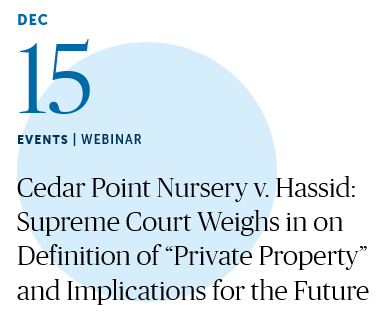
This Wednesday, December 15, 2021, at 1pm ET (10am PT) our PLF colleague Chris Kieser will be presenting an American Bar Association webinar, produced by the Real Property, Probate, and Trust Section, “Cedar Point Nursery v. Hassid: Supreme Court Weighs in on Definition of ‘Private Property’ and Implications for the Future.”

Register here. Here’s the details:

Chris Kieser, one of the attorneys representing Cedar Point Nursery in the recent Supreme Court case, will discuss the Court’s ruling as to what constitutes a physical taking of “Real Property” under the 5th Amendment and its potential applications in other contexts. He will be supported in the discussion by moderator, Nick Laurent, the chair of Land Use and Environmental Group – Condemnation Committee.

Chris is one of the lawyers representing the prevailing property owners in Cedar Point (our own look at the decision here), so he has a very

Continue Reading Wed, Dec. 15, 1pm ET: “Cedar Point Nursery v. Hassid: Supreme Court Weighs in on Definition of “Private Property” and Implications for the Future” ABA RPTE Webinar

The latest in a case we’ve been following, and this one is a double nerd whammy. The cert petition in RLR Investments, LLC v. City of Pigeon Forge, No. 21-703 (Nov. 15, 2021), seeks review of a Sixth Circuit decision in a takings case where the issue on appeal is whether the Rooker-Feldman doctrine applies only to final decisions, or also covers interlocutory rulings by a district court.

Here’s the story: Pigeon Forge wanted RLR’s property. Next stop – condemnation. RLR objected to the taking, asserting the condemnation was not supported by a public use. The Tennessee trial court considering the condemnation suit disagreed, and concluded twice (once at the hearing on immediate possession, the other on a motion for summary judgment) that the taking was supported by a public use or purpose. 

Instead of proceeding to a valuation trial, the owner pressed its argument the taking lacked

Continue Reading New Cert Petition: Rooker-Feldman Does Not Apply To Interlocutory State Court Orders

There’s not a lot of direct takings love in the U.S. Court of Appeals for the Second Circuit’s opinion in Melendez v. City of New York, No. 20-4238 (Oct. 28, 2021), but there’s enough there that you might want to read it anyway.

Because the opinion resurrected the plaintiffs’ Contracts Clause claim. You heard that right, their Contracts Clause claim. The plaintiffs asserted that New York City’s ordinance that prohibiting “threatening” a tenant due to their Co-19 status violated free speech and due process rights, and the city’s ordinance voiding personal guarantees for commercial leases impaired their lease contracts. The district court dismissed the case for failure to state a claim, concluding that the guaranty ordinance served a legitimate public purpose and did not favor any class.

The Second Circuit affirmed dismissal of the free speech and due process claims, but also concluded that the complaint alleged a plausible

Continue Reading CA2: NYC’s Eviction Moratorium May Have A Contracts Clause Problem

FrankLUI Co-Chair Prof. Frank Schnidman introducing the faculty
Here are the links to the cases and issues that we just finished speaking about at the 35th Annual Land Use Institute (more information on the LUI here). Today was day 1 of a multi-day remote program and the sessions are available ala carte, so there’s still time to join in and learn.

Supreme Court

  • Cedar Point Nursery: the Supreme Court affirms the “keep out” vibe in property law. Yes, there are three “exceptions” to the presumption that any physical intrusion into property is a taking (torts, entries allowed under “background principles,” and legal exactions), but overall a very strong affirmation of property rights.
  • Pakdel v. San Francisco: the “final decision” ripeness requirement in takings cases is “relatively modest” and turns on “de facto” readiness. Yes, it’s a technical requirement, but let’s not get too technical about it.
  • PennEast Pipeline


Continue Reading Links And Materials From Today’s Land Use Institute Takings/Eminent Domain Session

Here’s a new law journal article, just published, which we recommend everyone read.

Michael M. Berger, “Whither Regulatory Takings,” 51 Urban Lawyer 171 (2021). Available online here.

If you need encouragement to read it, here’s a sample:

The thrust of this article is severalfold. First, Holmes was right. His simple conclusion on behalf of eight Justices encapsulated the crux of modern government: while government needs to be able to regulate, zealous regulators can “go too far” and, when they do, regulation becomes a taking. The Constitution drew a line in the sand that may not be crossed without consequences. Second, a cautious Supreme Court thereafter left the Holmesian standard intact and nibbled around the edges, adding alternative descriptors that confused and confounded the situation. Third, the solution to the problem of how to define a regulatory taking lies in the simplicity of the common law. One of

Continue Reading New Article (Must-Read): Michael Berger, “Whither Regulatory Takings”

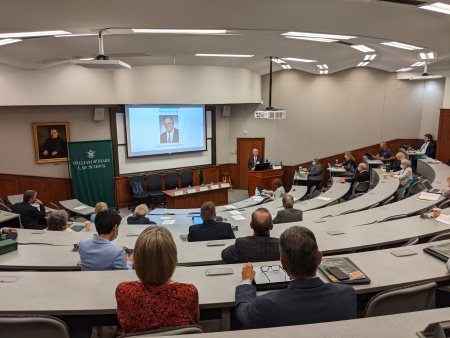
PXL_20211001_131054682Joe Waldo leading off the Conference with a remembrance of
Toby Prince Brigham, for the eminent property rights practitioner
for whom the Conference is named.

I was honored to speak today at the 2021 Brigham-Kanner Property Rights Conference, and here’s a rough transcript of my remarks.

Seeking Justice Through Just Compensation

Dean Spencer, Professor Been, Professor Butler, and colleagues.

The title of our session is “The Relationship between Eminent Domain and Social and Racial Injustice,” and my colleagues have ably covered the ways in which limitations on the power to take can move us towards justice. And there is little I might add to their contributions, except to note this, a quote from a commentator in a recent story about historical “slum clearance” in the Tampa, Florida, area:

“If you want to know where historic Black neighborhoods were once located, look for a sports arena or

Continue Reading Seeking Justice Through Just Compensation: 2021 Brigham-Kanner Property Rights Conference

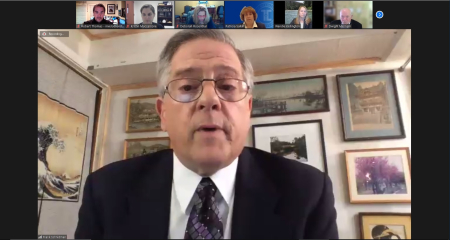
IS WM

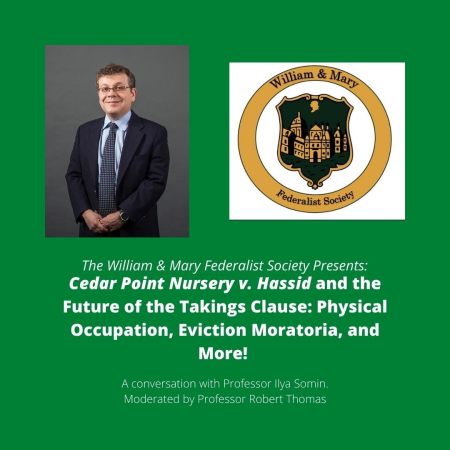
Next Tuesday, September 28, starting at 12:50pm ET, we’ll be moderating a talk sponsored by the William and Mary Law School chapter of the Federalist Society.

Professor Ilya Somin, a nationally-recognized expert in eminent domain, takings, and related topics, is zooming in to speak about “Cedar Point Nursery v. Hassid and the Future of the Takings Clause: Physical Occupation, Eviction Moratoria, and More.”

And guess what? You can Zoom in too. It’s open to the public, and it’s free.

So mark your calendars and join us for Prof Somin’s thoughts on the cutting-edge issues in property rights. Here’s the Zoom link: https://us02web.zoom.us/j/89365248145. See you on Tuesday!Continue Reading Join Us (For Free!): Lawprof Ilya Somin On “Cedar Point Nursery v. Hassid and the Future of the Takings Clause: Physical Occupation, Eviction Moratoria, and More” (Tues. Sep. 28, 2021, 12:50pm ET)