


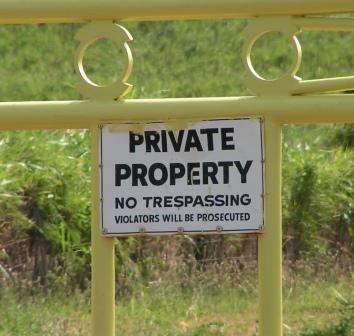
Keep out

In this post — the second in a series of deeper dives that we’re posting about last week’s U.S. Supreme Court opinion in Cedar Point Nursery v. Hassid, No. 20-107 (June 23, 2021) — we’ll be covering more on the “right to exclude,” how the Court treated our old frenemy Pruneyard, and how the majority dealt with that case’s holding that the California Supreme Court’s rule that shopping center owners must allow use of their properties as forums for public speech was not a judicial taking.

Here are all of the posts in our Cedar Point series:

And in case

Continue Reading Cedar Point Part II: Common Sense (Keep Out) And Common Law (The Right To Exclude)
More good takings news, hot off the press.

Before Cedar Point came down last week, we were all set to let you know about the Eleventh Circuit’s opinion in South Grande View Dev. Co., Inc. v City of Alabaster, No. 18-14044 (June 21, 2021), in which the court affirmed a jury verdict that the city’s reduction in the developable density on residential-zoned parcel (from R-7 and R-4) to R-2) was a Penn Central regulatory taking. 

The city appealed on an evidentiary issue, arguing that the jury should not have heard evidence of its reasons for downzoning the property, which were not relevant to the takings question and only went to whether the government acted arbitrarily and capriciously (a due process inquiry). The city also raised a ripeness question: the owner had not sought a variance from application of the new zoning, and indeed had never asked the city

Continue Reading 11th Circuit Affirms Penn Central Jury Verdict For Rezoning Resulting In 86% Loss Of Value

In this post — the first in a series of deeper dives that we’ll be posting about over the next few days about yesterday’s U.S. Supreme Court opinion in Cedar Point Nursery v. Hassid, No. 20-107 (June 23, 2021) — we’ll be covering the background of the case, and the heart of the majority opinion.

Here are all of the posts in our Cedar Point series:

And in case you missed the live webcast on Friday, July 16, 2021 that featured expert analysis of the case, please don’t miss listening to the recording of ALI-CLE’s “Takings and Eminent Domain After

Continue Reading Cedar Point Part I: SCOTUS’s Strawberry Letter 23 To Property Rights

Check out the U.S. Court of Appeals for the Sixth Circuit’s opinion in Harrison v. Montgomery County, No. 20-4-51 (May 11, 2021). It’s short, readable. And, most importantly, involves a subject that’s near and dear: takings, and the myriad potential traps that await an unsuspecting property owner making such a claim.

If you’ve ever asserted a takings claim, you know what we mean. The other side may argue you are too late (statute of limitations, for example), or too early (ripeness, in one form or another), or, remarkably, you are both too early and too late (yeah, that happens). Or simply that property questions are not worthy of the court (abstention). And these arguments are often not presented in a clear way — more like “here’s a bunch of reasons to throw this case out Judge, see which one you like” — and

Continue Reading Sixth Circuit Says No To Res Judicata As The Latest Williamson County Workaround

Order

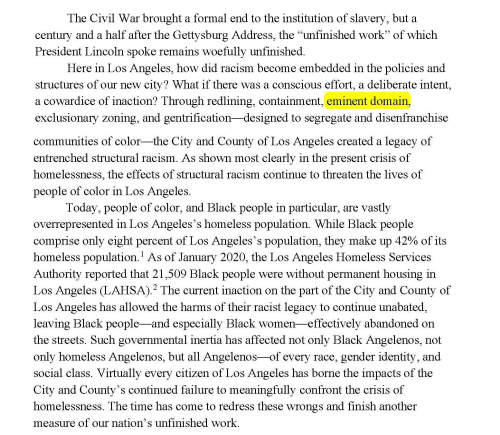
This In Chambers Order recently issued by a federal district judge may just be the most unusual, flat-out wild judicial opinion we have ever read.

Citing the Gettysburg Address, Brown v. Board of Education, systemic racism (including eminent domain) systemic sexism, and a slew of newspaper articles, the Central District of California (without even holding a hearing), issued a preliminary injunction ordering Los Angeles to immediately address the homeless problem, including ordering that “$1 billion, as represented by Mayor Garcetti, will be placed in escrow forthwith, with funding streams accounted for and reported to the Court within 7 days.” Order at 107.

The city is also ordered to halt any public land sales, figure out how to use said land for the homeless, and report to the court how to address “structural barriers (including but not limited to redlining, highway construction, eminent domain, and health exposure)[.]” Id. at 108.

Continue Reading A Federal Court’s Extraordinary Shot Across The Bow: LA’s Massive Homeless Problem Is Caused (In Part) By Eminent Domain

Here are links to the summaries and analysis of yesterday’s oral arguments in Cedar Point Nursery v. Hassid, No. 20-107, the case asking whether California’s forbidding of agricultural property owners from keeping out union organizers is a taking:

Neutral


Continue Reading Cedar Point Oral Arguments Round-Up

PICT1199

Here’s the recorded arguments.

  1. California will try and push the Court to seeing this as an “anti-union” lawsuit: this is not that big of an intrusion, we’ve been doing it for 50 years under both Cal and federal law, and a ruling for the property owners will upset this apple cart and prevent unions from organizing.
  1. The property owners will try and push the Court to seeing the case as one upholding the “keep out” nature of private property. There are other means of contacting the workers, so why need to do it on this private property? Convenience? [Disclosure: my law firm, Pacific Legal Foundation, represents the property owners.]
  1. Is this case different from Kaiser and Nollan in that California’s invitation to access the nursery property is not to the general public and only to union organizers?
  1. Is this case different from PruneYard in that the owner did not


Continue Reading In California, Can A Landowner Really Say “Keep Out?” Things To Look For In Today’s SCOTUS Cedar Point Nursery Arguments

You remember that Seventh Circuit case challenging (as, inter alia, a no-public-use taking) the location of the Obama Center in Chicago’s Jackson Park under the public trust (from the home of the American public trust doctrine, Chicago)? We wrote about it in “Friends Without Benefits: CA7 Rejects Takings Claim For Obama Center Because Citizen’s Group Lacks Property Interest In Public Park.”

This was then-Seventh Circuit Judge Amy Barrett’s first (and only) takings or property rights opinion she authored prior to her promotion to the Supreme Court.

A citizen’s group asserted it has a property interest in Jackson Park by virtue of being the beneficiary of the public trust, and that the handing over of the Park to the Obama Foundation was a private benefit regulatory taking. The plaintiff sought an injunction stopping the transfer, and did not seek just compensation.

The district court and the

Continue Reading New Cert Petition: Judge Barrett’s (Sole) CA7 Takings Opinion Is Wrong

We don’t usually post trial court rulings, but this one is very interesting, so we’re going to break our own rule.

New Orleans had a traffic camera program. Not popular, we’d suppose. People who were caught on camera brought a class action suit in Louisiana state court, arguing that the city didn’t have the legal authority to collect the fees and fines. They won, both in the trial court and in the court of appeals. The Louisiana Supreme Court declined to review the case. Meaning the judgment ordering the city to return the money illegally collected was final.

Apparently, the city didn’t do so.

So the judgment creditors sued for a taking in federal court under 42 U.S.C. § 1983. The predictable procedural arguments followed: Rooker/Feldman (nope), res judicata (nope), statute of limitations (nope).

But what about the takings claim itself? The city moved to dismiss for

Continue Reading Ipse Dixit: City’s Noncompliance With State Court Judgment Ordering Return Of Illegally-Collected Traffic Cam Fees Could Be A Taking

It’s Monday, so we’re just going to ease into the week by (inter alia) reading a couple of law review articles:

  • Federal Courts and Takings Litigation, by Prof. Ann Woolhandler & Prof. Julia D. Mahoney: “While Knick clearly expands the lower federal court role in takings claims, many questions remain, for it is not yet clear whether federal courts will embrace a robust federal judicial role in land use cases. This Article surveys the history of takings claims in the federal courts and recommends that going forward federal courts develop an abstention doctrine particular to takings cases in order to ensure prudent deployment of judicial resources. This Article also explains why § 1331 actions may be superior vehicles for takings cases than § 1983 actions.”
  • Swallowing its Own Tail: The Circular Grammar of Background Principles Under Lucas, by Prof Gregory M. Stein: the article “argues that


Continue Reading Today’s Readings: “Federal Courts and Takings Litigation” (Woolhandler & Mahoney), “Swallowing its Own Tail: The Circular Grammar of Background Principles Under Lucas” (Stein)