According to that trustworthy source Wikipedia, in drama, the term deus ex machina (“God from the machine”) “is a plot device whereby a seemingly unsolvable problem in a story is suddenly and abruptly resolved by an unexpected and unlikely occurrence. Its function is generally to resolve an otherwise irresolvable plot situation, to surprise the audience, to bring the tale to a happy ending, or act as a comedic device.” It is mostly considered a “lazy or cheap” trope.

And that takes us to the various federal, state, and local eviction moratoria that are (or were) in effect at various points in the covid epidemic. To us, those have mostly seemed like cases of kicking the can down the road (to use another overworn trope) because although couched as merely temporary withholding of the usual eviction remedy for nonpayment of rent, in a great number of cases the practical effect
Continue Reading What The Deus Ex Machina? – Federal Court Complaint: California’s Eviction Moratorium Is A Taking

Babe_ver1

We’re not entirely sure if this is “for real” or just an elaborate tongue-in-cheek spoof, but hey, there’s a website (“Give No Quarter!” and an invitation to “Become a Third Amendment lawyer”), a blog (“The Runt Piglet Squeals!”*), and the brief seems signed by an honest-to-goodness real lawyer and sure looks like it has a genuine CM/ECF stamp on the top, so we’re going to take it at face value.

[*The Third Amendment has been called the “runt piglet” of the Bill of Rights: short, overlooked, the butt of jokes.]

The Third Amendment Lawyers Association (ÞALA) [yes, that’s a thorn, not a “P” or a typo.] filed a short brief in the pending challenge by the Alabama Association of Realtors to the CDC’s eviction moratorium. Thanks to our colleague — a fellow Third Amendment admirer — for passing the brief along.

As you may (or more likely may

Continue Reading Third Amendment Lawyers Association (“ÞALA”): Eviction Moratorium Violates … The Third Amendment

All the topics you want to know about, presented by top-notch faculty from across the nation. Sessions include:

  • Property Rights as Civil Rights
  • Eminent Domain National Update
  • Just Relocation: Understanding the Law and Regulations to Ensure Fairness
  • Challenging Public Use: Lessons From a 67-Day Trial
  • COVID Takings
  • Federal Court and the Daubert Challenge: How to Prepare
  • Did the Supreme Court Signal a New Direction in Property Rights in Cedar Point Nursery?
  • How to Position Your Client for the Fallout When Projects Don’t Get Built
  • Rural Broadband and the Emerging Constitutional Challenges
  • Are Precondemnation Entry Statutes Still Valid After Cedar Point Nursery?
  • How Condemnor and Property Owners’ Counsel Prepare the Battlefield
  • How Will the Trillion Dollar Infrastructure Bill Impact Your Practice?
  • Ethics
  • …and more, including a full slate of networking and social events!

We’ve sold out the last few years, so don’t miss out. Room block now taking reservations. Continue Reading Join Us For The 39th Annual ALI-CLE Eminent Domain & Land Valuation Litigation Conference, Jan 26-29, 2022 (Scottsdale, AZ)


Talk amongst yourselves.

We’ve had our say, so in this post — the sixth and final post in a series of deeper dives about June’s U.S. Supreme Court opinion in Cedar Point Nursery v. Hassid , No. 20-107 (June 23, 2021) — we’re linking to what others are saying about the case.

Here are all of the posts in our Cedar Point series:

And in case you missed the live webcast on Friday, July 16, 2021 that featured expert analysis of the case, please don’t miss listening to the recording of ALI-CLE’s “Takings and Eminent Domain After Cedar Point: What Practitioners

Continue Reading Cedar Point Part VI: What Others Are Saying

In this post — the fifth and penultimate post in a series of deeper dives that we’re posting about June’s U.S. Supreme Court opinion in Cedar Point Nursery v. Hassid, No. 20-107 (June 23, 2021) — we’ll be trying to take some educated guesses about what the decision means for the future.

Here are all of the posts in our Cedar Point series:

And in case you missed the live webcast on Friday, July 16, 2021 that featured expert analysis of the case, please don’t miss listening to the recording of ALI-CLE’s “Takings and Eminent Domain After Cedar Point: What

Continue Reading Cedar Point Part V: Help Us Help You

What do you think about these facts in RLR Investments, LLC v. City of Pigeon Forge, No. 20-6375 (July 13, 2021), a decision by the U.S. Court of Appeals for the Sixth Circuit on what we might charitably call an obscure legal doctrine (RookerFeldman)?

City wanted some of RLR’s property to build a walkway and replacement parking for RLR’s parking that the walkway would displace. Eminent domain ensued. RLR objected to the take: no public use. The Tennessee trial court considering the condemnation suit disagreed, and concluded twice (once at the hearing on immediate possession, the other on a motion for summary judgment) that the taking was supported by a public use or purpose. 

Next step, valuation trial right?

Not in the view of the property owner, who, continuing to maintain that the taking was defective, filed its own civil rights lawsuit in federal

Continue Reading CA6: Rooker-Feldman Bars Federal Lawsuit Challenging State Court’s Public Use Determination

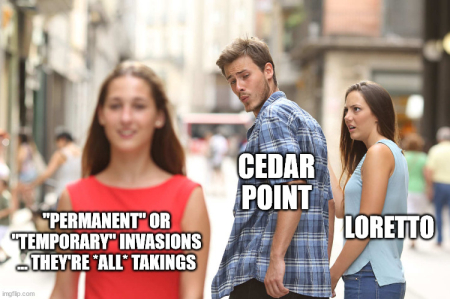
Permanentortemporary

In this post — the fourth in a series of deeper dives that we’re posting about June’s U.S. Supreme Court opinion in Cedar Point Nursery v. Hassid, No. 20-107 (June 23, 2021) — we’ll be discussing the two separate opinions, Justice Kavanaugh’s concurrence, and the Justice Breyer-authored dissent.

Here are all of the posts in our Cedar Point series:

And in case you missed the live webcast on Friday, July 16, 2021 that featured expert analysis of the case, please don’t miss listening to the recording of ALI-CLE’s “Takings and Eminent Domain After Cedar Point: What Practitioners Need to Know

Continue Reading Cedar Point Part IV: The Other Opinions

Our thanks to our friends and colleagues at the ABA Section of Real Property, Probate & Trust Section’s Land Use and Environmental Group for inviting us to a discussion of the latest and greatest decisions of interest.

We only had an hour together, so naturally could not cover everything of interest (indeed, we reserved a big discussion of the biggest item, the Supreme Court’s decision in Cedar Point, assuming that the Group will schedule a full session on that decision alone). So here is our curated list of what we think are the most interesting recent decisions in areas of interest to the Group:


Continue Reading Links From Today’s ABA RPTE Session

In this post — the third in a series of deeper dives that we’ll be posting about last week’s U.S. Supreme Court opinion in Cedar Point Nursery v. Hassid, No. 20-107 (June 23, 2021) — we’ll be discussing whether the “right to exclude” is absolute, what exceptions the Court laid out, and how it responded to the arguments that the ruling will bring the system crashing down.

Here are all of the posts in our Cedar Point series:

And in case you missed the live webcast on Friday, July 16, 2021 that featured expert analysis of the case, please don’t miss

Continue Reading Cedar Point Part III: No, Chicken Little, The Sky Isn’t Falling

License_20131009164108_63618

Another day, another property rights decision from SCOTUS. This time, the unanimous per curiam opinion in a case we’ve been following, Pakdel v. City & County of San Francisco, No. 20-1212 (June 28, 2021).

[Disclosure: our PLF colleague Jeff McCoy is lead counsel on this case, and we pitched in with help on the petition and related.]

Because we’re directly involved in this one, we’re not going to take a deep dive analysis. But the opinion is short, and the result clear: grant, vacate, remand, with instructions:

On remand, the Ninth Circuit may give further consideration to these claims in light of our recent decision in Cedar Point Nursery v. Hassid, ante, p. ___.

Slip op. at 3, n.*.

The Pakdels sued San Francisco for a regulatory taking because of the city’s requirement that as a condition of converting a tenancy-in-common to a condominium, the owners must

Continue Reading Another SCOTUS Property Rights Win, This Time On Williamson County’s “Final Decision” Requirement