Untitled Extract Pages

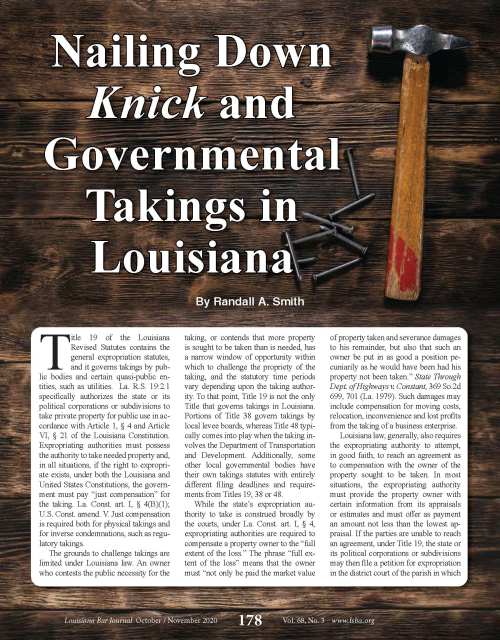
Check this out, a quick read from our New Orleans colleague Randy Smith, his article from the current edition of the Louisiana Bar Journal, “Nailing Down Knick and Governmental Takings in Louisiana.

Therein, he tells the story (inter alia) of Violet Dock Port (see here and here for two of our many posts on the case), and the efforts of the owner to secure compensation. The latest twist is that although the Louisiana courts adjudicated the amount of compensation owed (based on replacement cost), the condemnor (the Port of St. Bernard) didn’t pay up as ordered, and the U.S. District Court dismissed the owner’s § 1983 claim for a violation of the Fifth and Fourteenth Amendments.

Here’s how the article concludes:

Although Knick does not offer specific guidance regarding whether a property owners’ federal takings claim could take precedence over a previously-filed state court

Continue Reading Randy Smith: “Nailing Down Knick and Governmental Takings in Louisiana”
You are here

We have looked through the entire judicial and scholarly oeuvre of SCOTUS nominee Judge Amy Barrett, who today is continuing to run the gauntlet of the Senate Judiciary Committee. Naturally, our scanners were searching for any of her decisions or writings that might give us some clue how a “Justice Barrett” might treat takings and property cases, should she make the squad.

Frankly, however, there isn’t much to hold onto. As our colleagues Bryan Wenter (“What Might Supreme Court Nominee Amy Coney Barrett Mean to Property Rights?“) and Mike Ryan (“7th Circuit Rules Construction of the Obama Presidential Center Is Not A Taking Under The Fifth Amendment“) have covered, there’s just one opinion she authored or joined in which takings was on the docket: a recent decision about the challenge to the Obama Center being erected in a Chicago public park, Protect Our Parks, Inc v.

Continue Reading “Fidelity to the law means going where it leads, and sometimes it leads to the conclusion that a law is unconstitutional.” What Might A “Justice Barrett” Portend For Property Cases?

IMG_20190925_175845

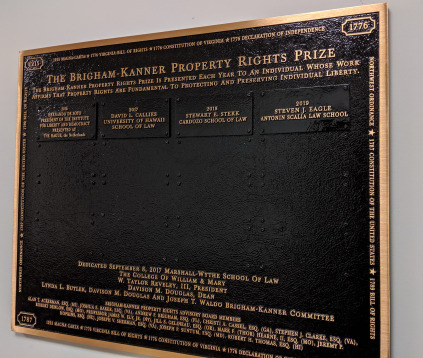
Although it is set to launch this Friday, October 2, 2020, there’s still more than enough time to register (and room at the inn) for you to join us for the 17th Annual Brigham-Kanner Property Rights Conference at the William and Mary Law School.

Like everything else this season, the Conference is online (register here), and although we would have preferred to gather in-person of course, the online format has some advantages: the number of attendees isn’t limited by the classroom size (this year’s registrations are at record levels), you don’t need to travel to Williamsburg, and the Conference is free if you don’t want Virginia CLE credit for attending. What a deal.

In our opinion, this is the best legal academy/practicing bar conference on property law. This year, the Conference honors the Brigham-Kanner Prizewinner, Harvard Law School Professor Henry Smith.

Here are the panel topics

Continue Reading There’s Still Room: Join Us For The 17th Annual Brigham-Kanner Property Rights Conference (Online, Free!)

We’ve been meaning to write up the U.S. Court of Appeals’ decision in a case we’ve been followingProtect Our Parks, Inc v. Chicago Park District, No. 19-2308 (Aug. 231, 2020), but our Illinois colleague Mike Ryan was quicker on the draw.

Rather than summarize Mike’s write up, we simply suggest you go to his firm’s blog and read “7th Circuit Rules Construction of the Obama Presidential Center Is Not A Taking Under The Fifth Amendment.”

Short story: the citizen’s group plaintiff doesn’t have a property interest in Grant Park, notwithstanding its argument that the public’s status as the beneficiary of the public trust (the real public trust, not, you know, the other things that get labeled “public trust” but really aren’t the thing you think about when you think “public trust”), is enough of a property interest to come under the Fifth Amendment’s protections (or

Continue Reading Friends Without Benefits: CA7 Rejects Takings Claim For Obama Center Because Citizen’s Group Lacks Property Interest In Public Park

As if to respond to a sibling federal court’s recent order upholding a covid-reaction shut down orders, the U.S. District Court for the Western District of Pennsylvania’s opinion in County of Butler v. Wolf, No.2:20-cv-00677 (Sep. 14, 2020) reaches an entirely different conclusion:

The fact is that the lockdowns imposed across the United States in early 2020 in response to the COVID-19 pandemic are unprecedented in the history of our Commonwealth and our Country. They have never been used in response to any other disease in our history. They were< not recommendations made by the CDC. They were unheard of by the people this nation until just this year. It appears as though the imposition of lockdowns in Wuhan and other areas of China-a nation unconstrained by concern for civil liberties and constitutional norms-started a domino effect where one country, and state, after another imposed draconian and hitherto untried

Continue Reading Fed Ct: “[T]he stay-at-home and business closure components of Defendants’ [COVID] orders violate the Due Process Clause” (Applying Rational Basis Review!)

Please join us and a panel of expert speakers including our friend and colleague Tony Della Pelle (see the flyer for the complete list), this Thursday, September 10, 2020 at 1pm Eastern Time for the ABA-produced webinar “Governmental Emergency Powers and the Constitutional Implications Arising from Pandemic Orders.”

Free to ABA members, a modest cost for those who are not. Register here.

Here’s the plan:

In the wake of the unprecedented global pandemic, every level of government has taken steps to address the public health crisis. These steps have manifested in orders which impact businesses and individuals alike including quarantine orders, travel restrictions, occupancy limitations, and restrictions on movement. This is the not the first pandemic, nor the first national crisis, faced by the United States. There have been several lawsuits filed challenging the constitutionality of the COVID-19 orders, including challenges based on the right to

Continue Reading This Thursday, Sept 10: “Governmental Emergency Powers and the Constitutional Implications Arising from Pandemic Orders” (Free to ABA Members)

News just in: we’ve just received confirmation that the Conference will not be in-person in Scottsdale in January 2021, and we’re going online.

Not a big surprise, but still a bit disappointing, and it’s a shame that the circumstances won’t allow us to meet in-person to talk shop and to renew our friendships like we do every year. 

But rest assured we’re making lemonade out of these lemons, and we’d appreciate everyone holding the dates on your calendars to join your colleagues from across the nation for the online Conference. And no, we’re not going to do two-and-a-half-days remotely, we’re paring down the agenda and will be focusing on hot topics, and great presenters. The remote format has some advantages, and we’re taking advantage of the circumstances to plan a conference more interactive and a bit different than usual.

This will also be a great program for first-time Conference participants.

Continue Reading Breaking: News About The 2021 ALI-CLE Eminent Domain & Land Valuation Litigation Conference (Jan. 28-29, 2021)

Can there be a more “Kentucky” thing than the Kentucky Derby? We can’t think of one. Today’s case from the U.S. Court of Appeals for the Sixth Circuit, West v. Kentucky Horse Racing Comm’n, No. 19-6333 (Aug. 28, 2020) is about the litigation stemming from the disqualification by the racing stewards of the “horse to cross the finish line first,” the storied “Maximum Security.”

As the opinion recounts, the owners of Maximum Security (we shall call him “MS” for short) thought they had a winner. He did indeed cross the line first. But the jockey of a different horse called “foul,” and after careful review of the tape, the stewards agreed. Don’t throw your stubs away yet, folks!

MS and his owners “were not awarded the Derby Trophy, an approximate $1.5 million purse, and potentially even far greater financial benefits form owning a stallion that won the Derby.” Slip

Continue Reading Kentucky Derby Umpires Did Not Violate Due Process By Calling Balls And Strikes And DQ’ing The “Winner”

Ainalea

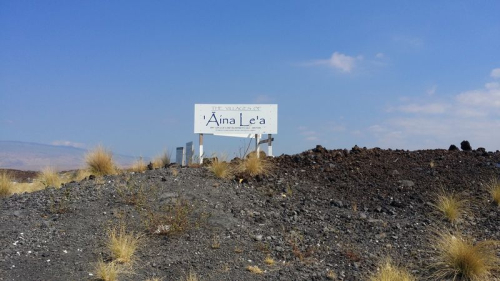
A short while ago, we featured the cert petition in a case from the Big Island that we’ve been following as various pieces of it went up and down through both the state and federal court systems. See “New (Mike Berger) Cert Petition: ‘This case is the proverbial ‘Exhibit A’ of much that is wrong [with takings law].

Now, after the State of Hawaii waived its right to file a BIO, five briefs of amici curiae (including one in which we played a small part) have been filed in support of the petition, urging the Court to review the Ninth Circuit’s opinion. We wrote about the case in a recent issue of the American Planning Association’s magazine. The short story is that a federal jury concluded that the State of Hawaii Land Use Commission took the owner’s property under both a Lucas and a

Continue Reading No Shortage Of Amicus Support For Takings Cert Petition (Lucas and Penn Central!)

Property owners sued the State of Ohio Department of Transportation’s Director (in his official capacity) in federal court after ODOT’s highway project resulted in flooding of their land. They raised two claims: the first, a taking under the Fifth (and Fourteenth) Amendments, and the second a claim under 42 U.S.C. § 1983. The relief sought: a declaration that this is a taking along with just compensation, and damages for the section 1983 violation.

If you are thinking “what about the Eleventh Amendment?,” you would be thinking like the U.S. Court of Appeals for the Sixth Circuit. In Ladd v. Marchbanks, No. 19-4136 (Aug. 20, 2020), the appeals court affirmed the district court’s dismissal of the complaint. No federal court lawsuits against a state is the general rule. There are exceptions, of course, most notably when Congress abrogates the states’ immunity, but the Supreme Court has held that section 1983

Continue Reading Sixth Circuit: You Still Can’t Sue States In Federal Court For Takings, Even After Knick