Although the U.S. Court of Appeals for the Sixth Circuit declined to publish its opinion in Ostipow v. Federspiel, No. 18-2448 (Aug. 18, 2020), we wish it had for a couple of reasons.

First, the name: it just rolls off the tongue, melodiously. “Ostipow versus Federspiel.” We just like how that sounds. Second, the facts: the Ostipows’ son set up a weed growing operation in his mom and dad’s farmhouse, unknown to them (bad son!). the local county Five-O seized the farmhouse and other Ostipow property by civil asset forfeiture (including a 1965 Chevy Nova, the philistines!), and after eight years in state court, in 2016, they finally won a judgment as innocent owners.

Not content with waiting for enforcement of the judgment, “[t]he next day [after the court entered the judgment against the county sheriff], the Ostipows made a written demand to Saginaw County Sheriff William Federspied

Continue Reading CA6: A Wrongful Civil Asset Forfeiture Is Not A Taking
Title

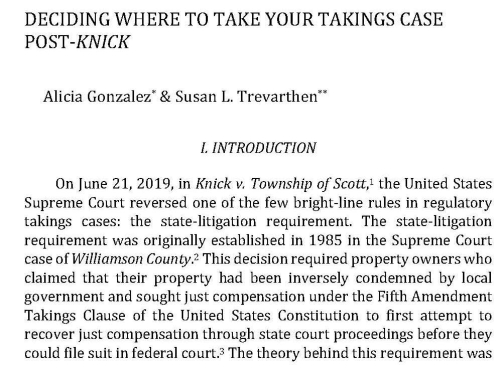
Check this out, a newly-published article on takings by two eminent Florida takings practitioners, Alicia Gonzalez & Susan L. Trevarthen, Deciding Where to Take Your Takings Case Post-Knick, 49 Stetson L. Rev. 539 (2020).

If the title isn’t enough to grab your interest, here’s the description in the Introduction,

Post-Knick,both plaintiffs and defendants have an option available to them that was previously unavailable. This Article will discuss the options that litigants on either side now have in federal takings cases and evaluate which options are desirable depending on the objectives of a particular litigant. Part II will discuss the history of the state-litigation requirement and the theoretical underpinnings of the Williamson County decision in which the state-litigation requirement was imposed. Part III will discuss Knick and the Supreme Court’s reasoning for reversing its own precedent in Williamson County. Part IV will discuss the new options

Continue Reading New Law Review Article: “Deciding Where to Take Your Takings Case Post-Knick

Here’s the cert petition that we’ve been waiting to drop in a case we’ve been following. Last we checked in, the Ninth Circuit (with concurral) had denied en banc review, over a dissental.

In Cedar Point Nursery v. Shiroma, 923 F.3d 524 (May 8, 2019), a 2-1 panel of the Ninth Circuit affirmed the dismissal of a complaint for failure to plausibly state a takings claim under Twombly/Iqbal.  At issue was a regulation adopted by California’s Agricultural Labor Relations Board which requires agricultural employees to open their land to labor union organizers. The regulation is framed as protecting the rights of ag employees to “access by union organizers to the premises of an agricultural employer for the purpose of meeting and talking with employees and soliciting their support.”

The panel majority viewed the complaint as alleging a Loretto physical invasion taking, and held the

Continue Reading New Cert Petition: Does A Physical Invasion Taking Require 24/7 Occupation?

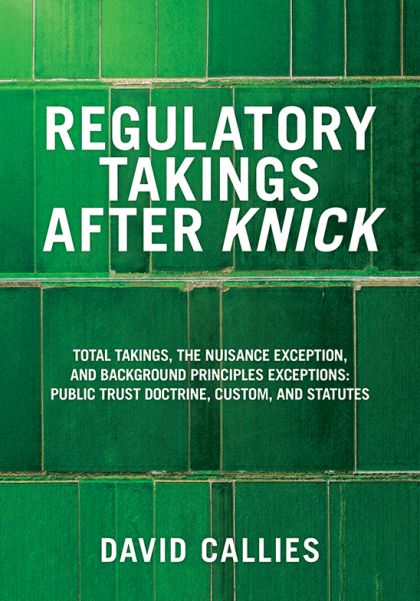
Callies_book
by David Lee Callies

Coming soon (August), a new book from lawprof David Callies on what might be our favorite subject, regulatory takings.

We had a chance to review the proofs, and we highly recommend this one for your bookshelf. We’ll bring you more once published. But for now, you can reserve your copy here.

Here’s the description:

Regulatory Takings after Knick summarizes the Supreme Court’s recent decision in Knick v. Township of Scott which does away with the state action prong of the Court’s former ripeness test and what it means for the law of regulatory taking of property. It emphasizes total takings after Lucas v. South Carolina Coastal Commission and the exceptions which permit government to so strictly regulate property as to permit no economically beneficial use of it.

The Supreme Court’s recent decision in Knick v. Township of Scott has been aptly described by some commentators


Continue Reading New Book Coming In August: Regulatory Takings After Knick by David Callies

20160114_125445

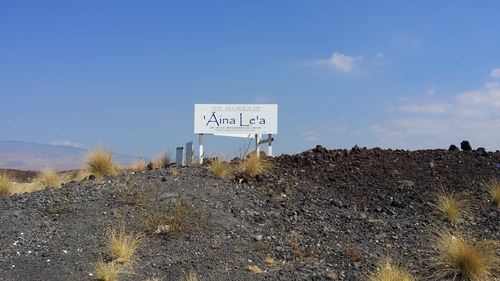
Here’s the latest in a case we’ve been following for what seems like forever. This is also a fact situation that has resulted in litigation in a variety of different fora, and at times has seemed like the final exam question in a Federal Courts law school class. We wrote about this latest phase — the issues raised by the Ninth Circuit’s opinion — in this article, even.

We won’t go into the background of the case, but if you are interested, you can find out more at this post (“What Constitutes a Loss“). The property owner has also summarized the situation thusly:

The State of Hawaii zoned for agricultural use land that it knew was not viable or appropriate for such use. At the property owner’s request, it rezoned it for urban use but, after Plaintiff Bridge Aina Le‘a began developing it, the State

Continue Reading New (Mike Berger) Cert Petition: “This case is the proverbial ‘Exhibit A’ of much that is wrong [with takings law].”

Here’s the latest order in one of the various challenges to coronavirus-related shut down orders. (See here, here, here, here and here, for example.)

In Xponential Fitness v. Arizona, No. CV-20-01310 (July 14, 2020) (unpub.), the U.S. District Court for the District of Arizona denied preliminary relief in a case which sought an injunction against the Arizona governor’s orders. The complaint including a takings claim among others (contracts clause, due process, equal protection, as well as state law claims). The only relief sought for the taking was an injunction, not just compensation. 

[Sidebar: interestingly, there’s no mention of the Eleventh Amendment, despite the State of Arizona being the lead defendant in the case; we haven’t taken a dive into the docket to see if the State consented, or objected elsewhere to being haled into federal court.]

To the court, that was fatal to the likelihood of the plaintiffs’ success on the merits. Here’s the entirety of the court’s takings analysis:

Plaintiffs’ Fifth Amendment takings claim cannot support their request for injunction relief. See Knick v. Twp. of Scott, Pennsylvania, 139 S. Ct. 2162, 2176 (2019) (“As long as an adequate provision for obtaining just compensation exists, there is no basis to enjoin the government’s action effecting a taking.”). “The Fifth Amendment does not proscribe the taking of property; it proscribes taking without just compensation.” Williamson Cty. Reg’l Planning Comm’n v. Hamilton Bank of Johnson City, 473 U.S. 172, 194 (1985), overruled on other grounds by Knick, 139 S. Ct. 2162. Thus, even if the June 29, 2020 Executive Order did violate Plaintiffs’ Fifth Amendment rights, Plaintiffs would not be entitled to injunctive relief because damages are the proper remedy for a taking. See Bridge Aina Le’a, LLC v. State of Hawaii Land Use Comm’n, 125 F. Supp. 3d 1051, 1066 (D. Haw. 2015), aff’d sub nom. Bridge Aina Le’a, LLC v. Land Use Comm’n, 950 F.3d 610 (9th Cir. 2020).

Slip op. at 16.

Before we move on, a comment. We’re not sure that just compensation should be considered the only remedy for a taking. First, we’ve seen cases in which the Supreme Court has recognized that an award of just compensation is not the sole way to raise a takings claim. You can raise it as a defense to some government action (“you can’t do X, government, because to do X without compensation would be an unconstitutional taking” – this is more like a rule that government cannot act except in conformity with the constitution than an actual “takings” claim for compensation). The raisin case (Horne v. USDA) is a good example. Another is Kaiser Aetna v. United States, 444 U.S. 164 (1970), where the property owner raised a similar argument in response to the Corps of Engineers’ district court lawsuit under the Rivers and Harbors Act.

Or, you might raise a takings argument affirmatively by declaratory judgment:

MR. JUSTICE REHNQUIST suggests that appellees’ “taking” claim will not support jurisdiction under § 1331(a), but instead that such a claim can be adjudicated only in the Court of Claims under the Tucker Act, 28 U.S.C. § 1491 (1976 ed.). We disagree. Appellees are not seeking compensation for a taking, a claim properly brought in the Court of Claims, but are now requesting a declaratory judgment that, since the Price-Anderson Act does not provide advance assurance of adequate compensation in the event of a taking, it is unconstitutional. As such, appellees’ claim tracks quite closely that of the petitioners in the Regional Rail Reorganization Act Cases, 419 U. S. 102 (1974), which were brought under § 1331 as well as the Declaratory Judgment Act. See App. in Regional Rail Reorganization Act Cases, O.T. 1974, Nos. 74-165, 74-166, 74-167, 74-168, p. 161. While the Declaratory Judgment Act does not expand our jurisdiction, it expands the scope of available remedies. Here, it allows individuals threatened with a taking to seek a declaration of the constitutionality of the disputed governmental action before potentially uncompensable damages are sustained.

Duke Power Co v. Carolina Env. Study Group, Inc., 438 U.S. 60, 71 n.15 (1979). We get that just compensation is the usual remedy, and the most common. But the sole remedy? Jury’s still out on that one, in our opinion.

Want more on the theory and practice of challenging these type of emergency orders? Please plan on joining us next week, Wednesday, July 22, 2020, at 1pm ET (10am PT) for a long-form program on “Emergency and Police Power: Property Claims in Times of Crisis,” sponsored by the ABA Section of State and Local Government Law. Our speakers are Professors Craig Konnoth (Colorado) and John Nolon (Pace), and one of the lawyers on the forefront of the nationwide legal challenges, Harmeet Dhillon (San Francisco). I’ll be moderating, along with Professor Sarah Adams-Schoen (Oregon).

Would you like a deeper dive into takings and these type of emergency orders? Check out our soon-to-be-published article, “Evaluating Emergency Takings: Flattening the Economic Curve” (forthcoming 2020).

Xponential Fitness v. Arizona, No. CV-20-01310 (D. Ariz. July 14, 2020) (unpub.)

Continue Reading Federal Court: No Takings Claim To Enjoin COVID Shut-Down Order

Check this out. In Willowbrook Apts, LLC v. Mayor & City Council of Baltimore, No. 1:20-cv-01818 (July 6, 2020), the U.S. District Court for the District of Maryland denied the plaintiff/property owner’s motion for a temporary restraining order, in a case challenging the COVID orders that pretty dramatically alter the landlord/tenant relationship in Maryland:

Specifically, the Baltimore City Council passed the Rent Increase Protection Act on May 19, 2020 (“Baltimore City Act”). On May 23, 2020, the Howard County Council passed the Rental Protection & Stability Act (“Howard County Act”), and the city of Salisbury followed suit one week later (on June 1, 2020) with Ordinance No. 2599, which amended chapter 15.26 of the city’s Municipal Code (“Salisbury Act”).

These laws (the “Acts”), while enacted in different jurisdictions, have the same three fundamental components, which Plaintiffs contend are constitutionally infirm. First, the Acts prohibit housing providers from increasing a

Continue Reading Fed Ct: Property Owners Not Irreparably Harmed By COVID Rent Orders (Because They Might Be Able To Get Compensation Later)

As expected, a quick decision and opinion from the U.S. District Court for the District of Hawaii, after yesterday’s hearing on the plaintiff’s request for extraordinary preliminary relief (a TRO and PI) in the case challenging the Hawaii Governor’s imposition of a 14-day self-quarantine on all travelers inbound to Hawaii (and other emergency orders, although the TRO request was limited to the quarantine).

When the opinion starts this way, you know which way it is headed:

Claiming that there is no emergency in Hawai‘i or the United States, Plaintiffs seek temporary injunctive relief enjoining Defendant from enforcing the 14-day quarantine requirements of the Emergency Proclamations and an order to show cause why a preliminary injunction should not issue.

Op. at 1-2 (footnote omitted). I’m not sure that’s exactly what the plaintiffs were arguing (“no emergency” anywhere), but you get the drift.

The Governor challenged the plaintiffs’ standing (they have not

Continue Reading Federal Court Denies TRO: Hawaii Gov’s Coronavirus Travel Quarantine Doesn’t Stop Anyone From Coming To Hawaii

Last we checked in, the U.S. District Court for the District of Hawaii has granted the Hawaii Attorney General’s request to hold an in-person hearing on the plaintiffs’ motions for preliminary relief in the case challenging Governor Ige’s COVID-19 related orders (including travel quarantine). Unfortunately, that meant that those of us not able or willing to visit the courthouse in person would not be able to listen in.

Well thank you, Judge, for zagging back, and yesterday opening up the hearing to the public via telephone again. Here’s the latest court order, on how today’s hearing is going to go:

EO: The Court CONVERTS the hearing on Plaintiffs’ 12 Application for Temporary Restraining Order and for Order to Show Cause Why Preliminary Injunction Should Not Issue from an in-person/telephonic hearing to one by video conference.

The courtroom manager will provide participants with instructions and information to connect by video

Continue Reading Zigging And Zagging: Federal Court Hearing On Challenge To Hawaii Gov’s COVID Orders Is Back On-Line

Please plan on joining us on Wednesday, July 22, 2020, at 1pm ET (10am PT) for a long-form program on “Emergency and Police Power: Property Claims in Times of Crisis.”

Our speakers are Professors Craig Konnoth (Colorado) and John Nolon (Pace), and one of the lawyers on the forefront of the nationwide legal challenges, Harmeet Dhillon (San Francisco). I’ll be moderating, along with Professor Sarah Adams-Schoen (Oregon).

Here’s the program description:

On the eve of the centennial of Pennsylvania Coal Co. v. Mahon (US 1922), this panel will revisit the question: How far can the police power be stretched to protect the public against dangers? The panel will evaluate the scope of state and local authority to respond to emergencies and the implications for private property rights—asking, how far is too far? What is the scope of implied limitations on private property rights in times of crisis? When

Continue Reading July 22, 2020: “Emergency and Police Power: Property Claims in Times of Crisis” (ABA Webinar)