1126181629e_HDR

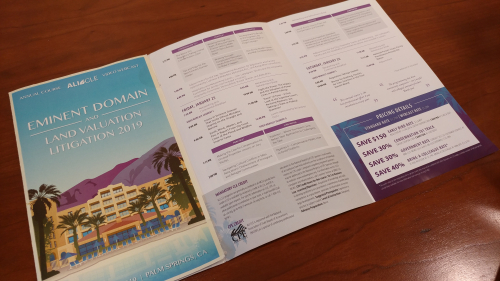
We’re almost there, but we still have room remaining. At the 2018 Conference in Charleston, we both sold out the registrations and the conference hotel, so we planned ahead for the upcoming 2019 Conference in Palm Springs at the Renaissance Palm Springs Resort

Register here. You will also be able to download the print brochure (above), or find out more details about the agenda and faculty on line. As always, we have assembled a great faculty — many of them new speakers — on the hottest topics in eminent domain and takings law: pipelines, jury presentations, challenging the take, an update on the most important decisions of 2018, pre-condemnation planning (from both the condemnor and property owner perspective), the border wall, and relocation. 

And of course, ethics and the “101” track for those new to the field, or experienced lawyers who would like a refresher on the
Continue Reading Space Remaining Is Limited – Register Now For ALI-CLE Eminent Domain And Land Valuation Litigation Conference (Palm Springs, Jan. 24-26, 2019)

Here’s the final brief for Ms. Knick, replying to the Township’s and the Solicitor General’s supplemental letter briefs.

It’s very short, so you should read it yourself. But here’s what we think is the highlight:

Williamson County is irreconcilable with the traditional view that a Takings Clause claim accrues (and is actionable in federal court) the moment government injures property without securing compensation. The Solicitor General ultimately concurs. SG Suppl. Brief at 6. Williamson County is also irreconcilable with the original understanding of Section 1983 as a law opening federal courts to unconstitutional takings suits, Monell v. Dep’t of Soc. Servs. of City of New York, 436 U.S. 658, 687, 687 n.47 (1978), and with exhaustion of remedies doctrine.

Br. at 4. 

Ms. Knick’s argument focuses — correctly, we think — on Kirby Forest Industries, Inc. v. United States, 467 U.S. 1 (1984), pointing out that “[s]ignificantly, a suit

Continue Reading Knick’s Supplemental Reply Brief: Injury To Property Triggers Right To Come To Federal Court

Here’s the third (and final) supplemental letter brief in Knick v. Township of Scott, No. 17-647 (which is set for reargument before the Supreme Court next month).

Of course, you should not be surprised that the Township disagrees with both Ms. Knick’s arguments, as well as the SG’s supplemental brief, and argues instead that all’s well in Williamson County, and that the Court should not disturb it one bit. 

Indeed, if there’s a fault here, it lies with Congress (according to the Township), which could have provided for federal jurisdiction to consider “questions” of federal law, not merely “violations.”

Finally, it is worth recalling that petitioner’s only quarrel with Williamson County is that it recognizes limits on the subject-matter jurisdiction of lower federal courts to hear claims for just compensation. But those limits are statutory, not constitutional, and Congress has discretion to lift them. See

Continue Reading Township’s Supplemental Brief In Knick: This Is A Statutory, Not Constitutional, Issue

As we wrote in this post, the federal government”s position in Knick v. Township of Scott, No. 17-647, which is set for reargument next month, has us a bit perplexed.

On one hand, the SG’s bottom line is good: property owners can bring their takings claims against local governments in federal as well as state courts. On the other, however, the SG’s supplemental letter brief disagrees with Ms. Knick’s supplemental brief, and argues that no, a “municipality does not violate the Takings Clause when it adopts a regulatory measure that may constitute a taking of property for a public use, even if it denies that such a taking has occurred[.]” SG letter at 3. The fact that state law provides a means for the owner to “still establish the existence of a taking and obtain just compensation through a reasonable, certain, and adequate state inverse-condemnation lawsuit,” means

Continue Reading SG’s Supplemental Knick Brief: No Fifth Amendment Violation If Govt Does Not Admit To A Taking, But Property Owners Should Still Be Able To Come To Federal Court Anyway To “Vindicate” The Right To Compensation

Earlier this week, we spoke to Howard Mansfield, author of the recently-published book “The Habit of Turning the World Upside Down – Our Belief in Property and the Cost of That Belief.”

His book is about property, property rights, and how these ideas are processed by the American psyche. But instead of the usual scholarly (and very often dry) treatment of these topics that we might expect – especially those of us in the legal and academic world – Mr. Mansfield takes a slightly different approach. He relates stories of how property fits in with the culture – the different and often competing narratives that are attached to the notion of property – and the often-contradictory way in which we in the United States view the idea of ownership and possession.

Listen to our interview above (Sound Cloud stream), or if that does not work for you

Continue Reading Audio: Our Interview With Author Howard Mansfield – “The Habit of Turning The World Upside Down – Our Belief in Property and the Cost of That Belief”

Retroactive continuity — or “retconning” — is, according to that authoritative source Wikipedia, a “literary device in which established facts in a fictional work are adjusted, ignored, or contradicted by a subsequently published work which breaks continuity.”

For example, compare the real-world explanation for why the 1960’s Star Trek show’s Klingons didn’t have butt heads, but the later-produced shows and movies did. The real-world reason was that the TV show had a bare-bones budget, so couldn’t afford the required intricate make-up. The later-produced stuff, having larger budgets, could. But to those concerned with an in-universe explanation that had to line up with the production realities, it turned out to be a big source of contention. Fandom as well as the later shows’ writers struggled to come up with a narrative that accounted for both Klingons with butt heads, and those without

Sorry for the impossibly nerdy

Continue Reading Knick And Klingon Foreheads: Retconning Williamson County

Knickrehearing

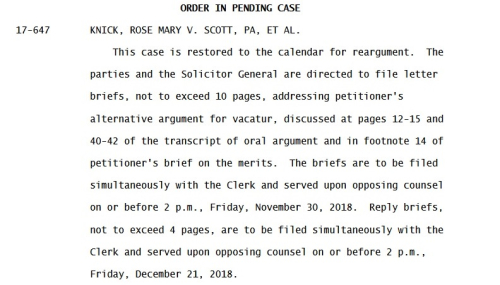
As we guessed immediately after arguments, today in this order the Supreme Court has set the Knick v. Township of Scott case for supplemental briefing, and reargument. 

Here’s the full text of the order:

This case is restored to the calendar for reargument. The parties and the Solicitor General are directed to file letter briefs, not to exceed 10 pages, addressing petitioner’s alternative argument for vacatur, discussed at pages 12-15 and 40-42 of the transcript of oral argument and in footnote 14 of petitioner’s brief on the merits. The briefs are to be filed simultaneously with the Clerk and served upon opposing counsel on or before 2 p.m., Friday, November 30, 2018. Reply briefs, not to exceed 4 pages, are to be filed simultaneously with the Clerk and served upon opposing counsel on or before 2 p.m., Friday, December 21, 2018.

This tells us that there was no clear

Continue Reading More Knick Briefing, Reargument

20181002_154246_HDR (1)

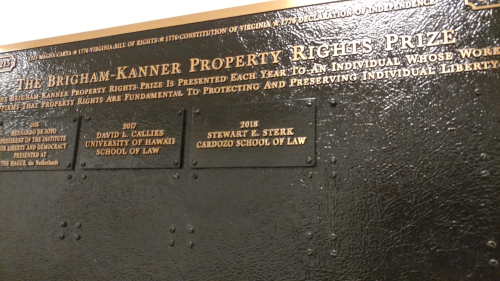
Last week, the 15th Annual Brigham-Kanner Property Rights Conference saw the gathering of legal scholars, judges, lawyers, and law students at the William and Mary Law School to award the B-K Property Rights Prize to Cardozo lawprof Stewart Sterk, followed by a day-long conference focusing on Professor Sterk’s work and the latest developments in property rights law.

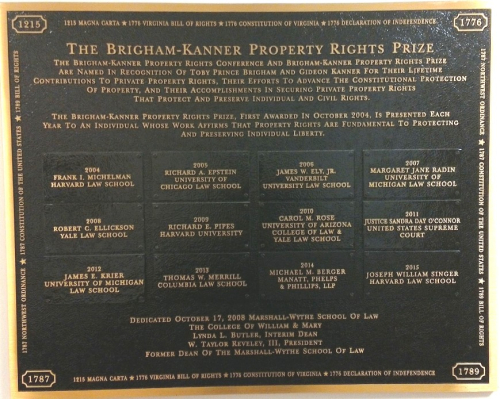
Professor Sterk joins the pantheon of property law scholars (and a judge and a practitioner) who have been awarded the Prize. Pretty impressive:

WIN_20151002_13_15_51_Pro

As always, the program starts off with a candlelight dinner and award presentation in the historic Wren Building, definitely a highlight of the Conference. More about the Conference here

And there’s nothing like spending the following day addressing some of the most pressing issues in our area, along with the brightest minds in the business (below is the final panel of the day, with Professor John Echeverria

Continue Reading 2018 Brigham-Kanner Property Rights Conference Report: Emerging Issues

6a00d83451707369e20223c85004e4200c-800wi

I’m not going to do an in-depth preview of tomorrow’s Supreme Court oral arguments in Knick v. Township of Scott, No. 17-647 for several reasons.

First, a lot of others have summarized the issues already, far better than I can. See the list below.

Second, I filed an amicus brief in the case in support of Ms. Knick, and that brief pretty much sums up my thinking about the case. Williamson County ripeness is something I’ve railed on for a while, and there’s no need for me to say it once again.

Finally, I’m attending the arguments tomorrow with my William and Mary Law class, (they get to see the sausage being made!) and am keeping my powder dry for a post-argument report from the scene. 

First, the previews, followed by some brief thoughts:

  • Read the merits and amici briefs (all 21 of them!) here 


Continue Reading Knick Preview: Reevaluating Williamson County Ripeness With An Eight-Justice Court – Just How Badly Can SCOTUS Screw Up Takings Law?