Our colleague and co-planning chair Joe Waldo was in town yesterday, so we walked through historic Williamsburg, Virginia (cradle of the Constitution and the Bill of Rights), to invite you to join us for the 36th Annual ALI-CLE Eminent Domain & Land Valuation Litigation Conference (January 24-26, 2019, in Palm Springs, California).

As we wrote in this post, the Conference will feature the nation’s best eminent domain faculty, presenting on the topics we love.

Register now here. Early registration and group discounts available. The 2018 Conference in Charleston sold out, so be sure to sign up now so you don’t miss out. Continue Reading Join Us For The 36th Annual ALI-CLE Eminent Domain & Land Valuation Litigation Conference In Palm Springs (Jan 24-26, 2019)
Before last week’s Judiciary Committee hearings on the nomination of Brent Kavanaugh to be an Associate Justice of the Supreme Court, we wrote that the issue of property rights and eminent domain may come up during the hearing, even though Judge Kavanaugh’s actual judicial record on that topic is pretty thin. 

We were busy during most of the hearings, and the portions we viewed did not focus on Kelo, but rather on a host of important other topics. But thanks to the efforts of our colleague Elaine Mittleman (the lawyer who argued and won the sole opinion in Judge Kavanaugh’s Public Use and Eminent Domain repertoire, Rumber v. District of Columbia, 487 F.2d 941 (D.C. Cir. 2007)), who sent us the video from the key portion of the hearings, we now have Judge Kavanaugh talking a bit about Kelo and property rights, and related (sort of) topics.  

Senator

Continue Reading Your Kelo Moments From The Kavanaugh Hearings

20180126_111558_HDR

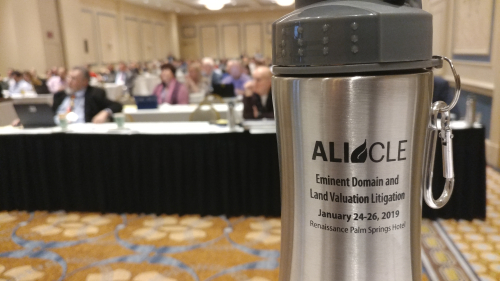
You’ve known for a while that Palm Springs, California, specifically the Renaissance Palm Springs Hotel (a resort facility, but right in town, so you will have many options for “off campus” activities like art museums, the aerial tram, golf, and whatever suits your fancy, and close-in to the Palm Springs Airport), is the venue for our 2019 ALI-CLE Eminent Domain and Land Valuation Litigation, January 24 through 26, 2019.

Of course, you also knew that the programming would be the usual spread of topical and cutting-edge topics, presented by some of the nation’s experts. But we didn’t give you the details. So here are some of the programs we’re having: 

  • Keynote Address: “Property Rights: Foundation for a Free Society” – Taylor Revley, most recently the past President of the College of William and Mary, and also former law school Dean (as well as a


Continue Reading ALI-CLE 2019 Eminent Domain And Land Valuation Litigation Conference, Palm Springs Agenda – Register Now!

A quick one today because we’re offline (more on that later). Pacific Legal Foundation (the folks who are representing the property owner in the pending case challenging the continuing viability of the Williamson County ripeness doctrine), has posted this entry on their blog, “This monkey got his day in court. Property owners still can’t.”

The post focuses on the brief we filed in the case on behalf of the Citizens’ Alliance for Property Rights Legal Fund, which notes the disparity between a monkey having standing to bring a suit in federal court to protect its (alleged) (intellectual) property rights, but human property owners like Ms. Knick having no right to do the same when asserting her plain old property rights. 

Our brief didn’t focus on the monkey background, so here it is:

In 2011, nature photographer David Slater set up camera equipment for a group of wild

Continue Reading Monkey Selfies And Takings Ripeness

Kearney had her property taken. The school district doing the taking said it wanted to put a septic system on the property, and so commissioned a percolation study. But then it decided that instead, it would connect to a sewer system. The state court jury believed neither side’s appraiser completely, rejecting both Kearney’s appraisal ($1.4 million), and the district’s ($850k), and instead settled on $953,000. 

After trial, Kearny learned about the percolation study. For whatever reason, the district hadn’t disclosed the results, something that Kearney apparently believes was critical to value. On that basis, she sought a new trial, and when the Superior Court denied it, sought and was denied relief in the Court of Appeal (that court essentially put the blame on her, noting “that Kearney should have more timely and thoroughly pursued discovering the test results before trial”).

Finding no relief in state court, she went across the street

Continue Reading Ninth Circuit: New Trial Motion, Not Federal Lawsuit, Is Condemnee’s Only Chance To Show Suppressed Evidence Affected Compensation Award

20180803_104034_HDR

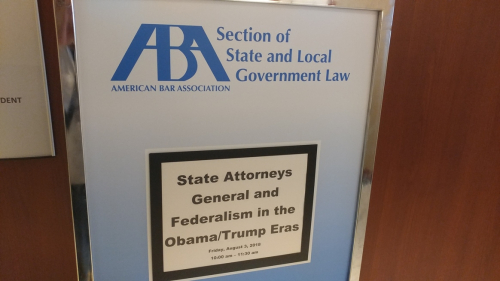
One of our last acts as Chair of the ABA’s Section of State and Local Government Law was to green light a CLE program at the recent Chicago annual meeting entitled “State Attorneys General and Federalism in the Obama and Trump Eras.”

The title kind of gives it away, but the main topic was the implications of the multitudinous lawsuits brought by states and their attorneys general against actions by the president’s administration, first grabbing headlines during President Obama’s tenure, and now during President Trump’s. And then switching playbooks after the election, it seems.  

20180803_104204_HDR

One of the good things about the CLE programming we do in our Section is that we try and get speakers from all sides of the ideological spectrum. We think we did a pretty good job here, with (left-to-right — geographically above, not ideologically) Wisconsin Solicitor General Misha Tseytlin (Madison, WI), William Hurd (past

Continue Reading Litigation As A Substitute For Legislation? Coverage Of Our ABA Section’s Federalism CLE

20180717_135234_HDR

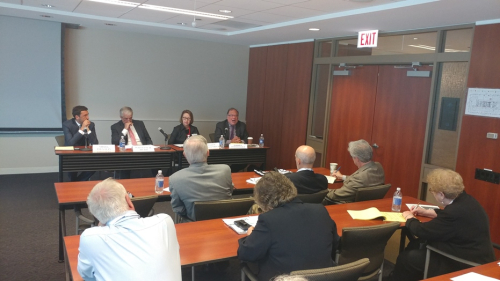
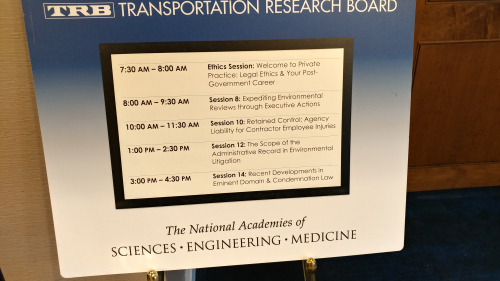
Here are the cases and other items I either spoke about or mentioned at today’s Transportation Research Board‘s 57th Annual Workshop on Transportation Law in Cambridge, Massachusetts:


Continue Reading Links And Materials From Today’s Transportation Research Board Session

A short, but published, opinion from the U.S. Court of Appeals for the Fifth Circuit.

In Archbold-Garrett v. New Orleans, No. 17-30692 (June 22, 2018), the court held that the plaintiffs’ Fourth Amendment, Fifth Amendment, and Fourteenth Amendment claims (search and seizure, compensation, and procedural due process) were ripe for federal court, even though the plaintiffs had not sought compensation in a Louisiana court under Louisiana law. 

Quick background: the city demolished a building the plaintiffs owned which they had purchased from the city at a lien sale. The prior owner had racked up a bunch of code enforcement fines, and the city claimed the building was dangerous and should come down. But after the sale to the plaintiffs and days before the demolition, the city cancelled the code enforcement lien. Predictably, the city sent the new owners a bill for the demolition. They sued in federal court, arguing

Continue Reading Fifth Circuit: Williamson County Doesn’t Require District Court Dismiss Due Process Or Takings Claim

This one is more for our muni law friends, but today’s post also has two eminent domain angles. 

Anyone who has been to a city council meeting knows at least one fellow like this, considered a pain-in-the-butt by officials. A gadfly, who testifies on seemingly every issue. This is Fane Lozman, eminent domain protester (among other things). Familiar to readers as the Houseboat Guy. Or, more accurately, the “Floating Home” Guy who took the City of Riviera Beach, Florida to the U.S. Supreme Court once before, on the arcane issue of whether his floating home was a houseboat subject to admiralty jurisdiction. The Court held it wasn’t, and wasn’t. 

The houseboat affair wasn’t the end of it for Mr. Lozman, who already was “an outspoken critic of the City’s plan to use its eminent domain power to seize homes along the waterfront for private development,” according to the latest

Continue Reading Arrested Eminent Domain Protester Still Can Sue City For First Amendment Violations

A quick check of the Supreme Court’s docket in the Knick v. Township of Scott case shows that no less than 18 amici briefs have been filed top side. Not all of them in support of the Petitioner mind you (two, the briefs of the United States and of the American Planning Association, are in support of neither party, or ask the Court to impose a specific remedy), but whoa, that’s still a lot. 

Shows us how much a case about a very technical aspect of takings law can generate huge participation, reflecting how important the issue of whether a property owner can file a federal takings claim in federal court truly is. 

So you don’t have to read each one (although we encourage you to do so), here’s our quick summary of each: 


Continue Reading Takings Ripeness Of Apparent Interest: Eighteen—18!—Amicus Briefs In Knick. Here’s Your Rundown.