Here’s one to add to the “unusual takings cases” category, at which we looked at last week

In  Young v. Larimer County Sheriff’s Office, No. 13CA1338 (Sep. 11, 2014), the sheriff raided Mr. Young’s (medical) marijuana grow and seized as evidence “forty-two mariijuana plants by cutting them off just above the roots.”

Now, we don’t know much of anything about the botany of the cannabis plant, medical or otherwise. And the court might not have any specialized knowledge either. But it doesn’t take Cheech and Chong to know that “[t]his action killed the plants.” Slip op. at 2. Bummer, man. 

The jury was more kind to Mr. Young than was the sheriff. It bought Young’s claim that his weed was not evidence, but medicine under the Colorado medical marijuana statute. The “jury acquitted him of all charges based on the affirmative defense of medical use of marijuana by

Continue Reading No Taking When Sheriff Took His (Medical) Weed
On the day we celebrate Constitution Day (or should we say Khaaaaan-stitution Day?) we have to admit that pretty much nothing beats One Named Kirk’s reading of the Preamble

He might be from Iowa, but that guy who plays him is from north of the border, so our kudos to a Canadian for the best dramatic rendition of our founding document.

And in that spirit, we explain the plural parenthetical in this post’s title, which we picked up from a talk last evening by Hawaii Supreme Court Justice Simeon Acoba and U. Hawaii Law School Dean Avi Soifer at the Judiciary History Center, “Who Trumps Whom: Exploring Federalism in Hawaii.” The talk focused on the ways that state constitutional protections can extend beyond what the U.S. Constitution requires (the “floor vs ceiling” theory), and Justice Acoba suggested that today really should be called “Constitutions Day”

Continue Reading Happy Constitution(s) Day

EM Hauulaeminent_domain_abuse

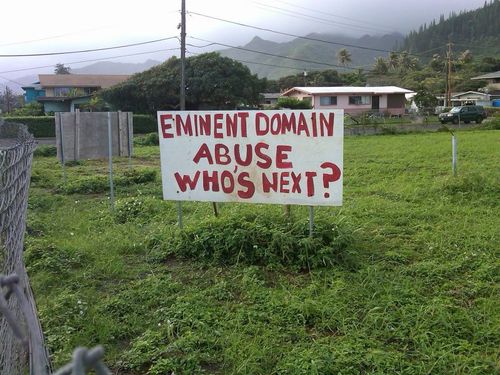
Remember that case which we posted about earlier, in which the City and County of Honolulu condemned an undeveloped lot in rural Oahu for a fire station, but has been met with staunch resistance by the property owners? Not only did we post on the case, but it made national waves, also.

The City filed an eminent domain action in state court, and obtained a writ of immediate possession. After that, the City removed the eminent domain protest signs the owners had maintained on the property. The owners objected, filing a complaint in U.S. District Court alleging that the City went on the property and posted a “removal notice” under the City’s newly-adopted “Bill 54,” an ordinance allowing the City to seize property “stored” on public property provided it “tags” it 24 hours in advance, and that the removal was retaliation for the signs’ content.

The complaint alleges that the

Continue Reading Hawaii Federal Court: “Quick-Take” In Eminent Domain May Not Give Condemnor Exclusive Possession

2010-03-24 15.24.40
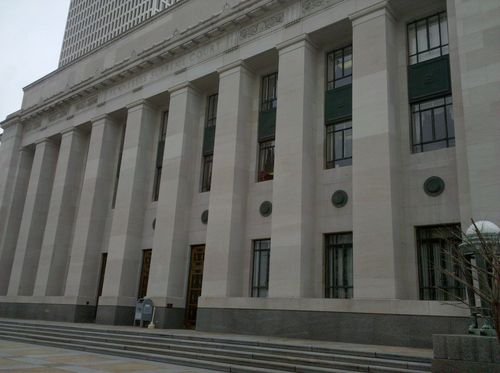
Tennessee Supreme Court, Nashville

In Phillips v. Montgomery County, No. M2012-00737-SC-R11-CV (Aug. 18, 2014), the Tennessee Supreme Court held that a property owner could recover under the state’s inverse condemnation statute, Tenn. Code Ann. § 29-16-123, for a regulatory taking:

We hold that, like the Takings Clause of the United States Constitution, article I, section 21 of the Tennessee Constitution encompasses regulatory takings and that the Property Owners’ complaint is sufficient to allege a state constitutional regulatory taking claim, for which they may seek compensation under Tennessee’s inverse condemnation statute, Tennessee Code Annotated section 29-16-123.

Slip op. at 12.

That’s all well and good, and we applaud the court for doing so. But wait a minute, you say, that statute and this issue sure sound familiar.

Indeed they do. This is the same statute which the U.S. Supreme Court, in Williamson County Regional Planning Comm’n v. Hamilton Bank

Continue Reading Tennessee Finally Recognizes Regulatory Takings Cause Of Action – A Quarter Century After The US Supreme Court Wrongly Assumed It Did

To follow up on our earlier post about issues to look for in the legal challenge to the Hawaii Chief Elections Officer’s choice to hold the delayed Democratic Party primary election on Friday, August 15, 2014, rather than keep the 21-day window open, here are the Complaint and Motion for Temporary Restraining Order filed this morning in the circuit (trial) court on the Big Island. As we suspected might be the case, the Hawaii Supreme Court’s original jurisdiction to hear election contests was not invoked, since the relief sought by the complaint is to stop Friday’s planned election, and delay it to some other time.

You can read the documents themselves (thank you, Honolulu Civil Beat, for posting them), but here is the short version:

  • The plaintiff is Democrat Colleen Hanabusa, a candidate for the Democratic Party’s nomination as U.S. Senator. There are two claims for relief:
  • The first is a


Continue Reading Too Soon? Lawsuit To Delay The Delayed Puna Precincts Primary Filed

Remember that decision by a U.S. District Court in Tampa, Florida last year that we crowed about? The court held that a county’s “Right of Way Preservation Ordinance” which allows it to land bank for future road corridors by means of an exaction is “both coercive and confiscatory in nature and constitutionally offensive in both content and operation.” 

A property owner brought a substantive due process claim, and the court first rejected the county’s argument that the substantive due process claim was not ripe under Williamson County because Hillcrest had not pursued a waiver or variance. It also concluded the Right of Way Preservation Ordinance violated the Takings Clause because it shifts the burden to disprove rough proportionality to the property owner and empowers the county to obtain land in excess of what it would otherwise get in the absence of the ordinance. The court enjoined enforcement of the

Continue Reading 11th Circuit: Facial Challenge To Ordinance Must Be Brought When Ordinance Adopted

Update: more on the issue from the New York Times: “Honolulu Shores Up Tourism With Crackdown on Homeless.”

—————————————-

Check out the headline story from today’s Honolulu Star-Advertiser, “Mayor’s sidealk strategy targets Waikiki homeless,” about two bills proposed by Honolulu’s mayor to address some difficult urban issues. 

The first bill is our iteration of the so-called “sit-lie” ordinance, which prohibits people from sitting or lying on sidewalks in the Waikiki Special District. A similar ordinance was upheld by the Ninth Circuit in Roulette v. City of Seattle, 97 F.3d 300 (9th Cir. 1996), in which Judge Alex Kozinski, in his inimitable fashion, wrote:

The first step to wisdom is calling a thing by its right name. Whoever named “parkways” and “driveways” never got to step two; whoever named “sidewalks” did.

. . . 

Plaintiffs claim it is unconstitutional for the city to

Continue Reading As Judge Kozinski Said, It’s A Sidewalk, Not A Sideseat Or A Sidebed

Here are the merits briefs in an important case set for argument later this month in the Hawaii Supreme Court.

The litigation is a series of two lawsuits that originated in state court in the Third Circuit (Big Island), one an original jurisdiction civil rights lawsuit, the other an administrative appeal. The essence of the plaintiff’s allegations is that the State Land Use Commission wrongfully amended the land use boundaries from urban to agriculture. Many years earlier, the LUC had amended the boundary to urban on the condition that the owner provide a certain number of affordable units by 2006. In 2008, the developer had not done so and the LUC ordered it to show cause why the land classification should not revert to agricultural.  

The State removed the civil rights lawsuit to U.S. District Court in Honolulu and promptly moved to dismiss, and this is the matter now

Continue Reading HAWSCT Briefs In Bridge Aina Lea: Takings, State Land Reclassification, And Orders To Show Cause

Here is the oral argument recording in Bridge Aina Lea, LLC v. Chock, Nos. 12-15971, 12-16076, case argued yesterday in the Ninth Circuit at its session in Honolulu. As we previewed, the issues involved Pullman abstention and immunity. As for Williamson County ripeness, an issue the court asked the parties to brief separately, one of the judges (it sounds to us like Judge William Fletcher) said he was “haunted by Williamson County” (click forward to the 12:25 mark). Aren’t we all, Your Honor, aren’t we all. 

Ninth Circuit Oral Argument No.12-15971

Next up, the oral arguments in the Hawaii Supreme Court in the state court case, scheduled for June 25, 2014, which may have an impact on the federal appeal (one judge asked counsel, “What if we wait until the Hawaii Supreme Court does whatever it’s about to do, will that illuminate these issues for us?”). More

Continue Reading 9th Circuit Orals In Bridge Aina Lea: Pullman Abstention, Qualified Immunity, And “Haunted By Williamson County”

It’s been our experience that when a court of appeals — particularly when it’s the Ninth Circuit, and it’s the eve of oral argument — raises an issue on its own after the briefs have been filed and requests supplemental briefing, then whatever that issue is must really be on the judges’ minds. They’re the cream of the crop (right?) and along with their cohort of law clerks (the next generation cream), they know the law (right?). And, as one Ninth Circuit judge candidly revealed at one of those bench/bar tip sessions last year, law clerks like nothing better than to catch the advocates in a misstatement or to find a missed argument, so they can present the issue to their judge like a cat bringing home a dead bird to its master (we’re paraphrasing that last bit, of course, but the judge did say that clerks groove on finding things

Continue Reading Ninth Circuit Sua Sponte Raises Williamson County Ripeness, Asks For Briefing, Gets Some