In all of today’s excitement about the Court’s opinions in Horne v. Dep’t of Agriculture, No. 14-275, the “raisin takings” case which we posted about earlier, we almost lost sight of the other property rights decision issued by the Court, City of Los Angeles v. Patel, No.13-1175 (June 22, 2015). 

The case did not present takings, land use, or eminent domain issues, but we’ve been following along with interest nonetheless, because at stake was the right of a Los Angeles hotel owner to require the police to obtain a warrant before he allowed inspection of the hotel’s guest register. The Court’s majority said yes, hotel owners really do need the opportunity to make the police get a warrant before the police can force the hotel to open up its records.

The opinion by Justice Sotomayor and joined by Justices Kennedy, Ginsburg, Breyer, and Kagan, didn’t talk about property

Continue Reading Today’s Other Supreme Court Property Rights Decision
Sorrentino v. Godinez, No. 13-3421 (Jan. 23, 2015) was a lawsuit by prisoners complaining that several items which they purchased from the prison commisary — a fan and a typewriter — were later declared by the warden to be prohibited contraband.

Under the new rules, their property was “removed,” and the prisoners given options for what they wanted done with the items: destroy them, store them, or send them to someone on the outside at the prison’s expense. They didn’t like these options and instead sued, claiming a taking, among other things. The District Court dismissed with prejudice.

The Seventh Circuit affirmed the result, concluding that the plaintiffs’ failure to avail themselves of the available remedy under Illinois law for obtaining compensation in the Illinois Court of Claims for a physical taking was fatal: “[t]he latter rule is what dooms Sorrentino’s claims. Illinois provides such a procedure, but he

Continue Reading 7th Circuit Tosses Prisoner’s Takings Claim Under Williamson County’s State Procedures Rule

Last we checked in with the Bridge Aina Lea case, the Ninth Circuit said it would hold off on a decision until the Hawaii Supreme Court ruled in the associated state court litigation (see 9th Cir Says “Let’s Wait” On Hawaii Supreme Court To Rule In Bridge Aina Lea).

This is the federal court side of a case in which a developer is suing the State Land Use Commission (and certain Commissioners in their individual capacities) after the LUC reclassified its land on the Big Island from urban to agricultural use. Aina Lea filed two actions in state court: an administrative appeal under the administrative procedures act, and an original jurisdiction civil rights complaint. The defendants removed the latter action to federal court. The District Court, however, abstained. After oral arguments in the Ninth Circuit, the panel withdrew the case from submission to allow the Hawaii Supreme Court

Continue Reading 9th Cir: No Need For Pullman Abstention In Aina Lea After Hawaii Supreme Court Ruling

Here’s the latest in a case we’ve been following, the property owner’s cert petition, filed last week, in which a U.S. District Court invalidated a Florida county’s “Right of Way Preservation Ordinance” which allows it to land bank for a future road corridors by means of an exaction. The court concluded the ordinance is “both coercive and confiscatory in nature and constitutionally offensive in both content and operation,” and struck it down under Nollan/Dolan

The transportation corridor protrudes into Hillcrest’s undeveloped commercially-zoned property. Hillcrest wanted to build a shopping center and it submitted a plan to the Review Committee, which rejected the application because it did not account for the corridor. Hillcrest submitted a second plan which was rejected, and a third plan which was eventually approved, which required Hillcrest to dedicate the right of way to the county. Hillcrest reserved its right to object

Continue Reading New Cert Petition: Must A Plaintiff Challenging An Ordinance For Facial Invalidity File Suit Before Her As-Applied Claim Has Ripened?

20150115_091355-1
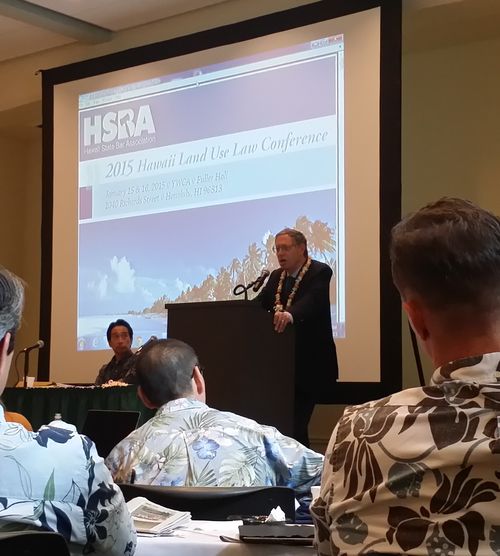
Ben Kudo and David Callies, leading off

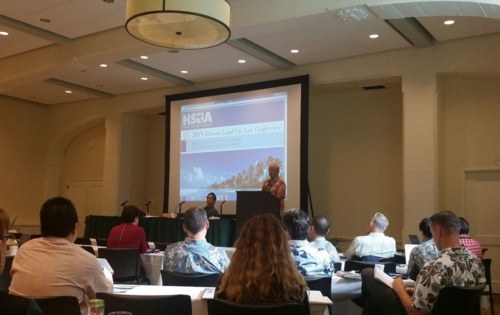
Professor Richard Epstein began the Hawaii Land Use Law Conference with the keynote presentation on “Stealth Takings: Exactions, Impact Fees, and More,” which was his usual comprehensive and non-stop takedown of takings law. 

20150115_100935

Our panel on Impact Fees and Exactions After Koontz followed, and here are the promised links and other materials which I mentioned:

Later today, I will also post up a recording of my short backgrounder on the exaction issue, to give you a flavor of the panel discussion (the Hawaii State Bar Assocation

Continue Reading 2015 Hawaii Land Use Law Conference

131996

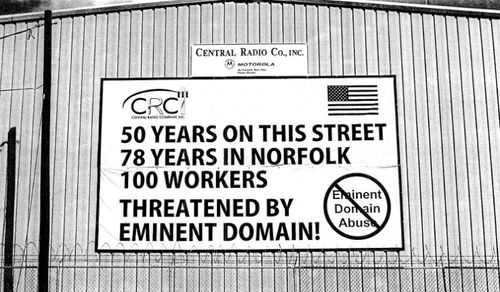
In a 2-1 decision, the U.S. Court of Appeals for the Fourth Circuit concluded that Norfolk, Virginia’s sign ordinance did not violate the First Amendment, when it was applied to bar the anti-eminent domain banner shown above.  

Central Radio Co. Inc. v. City of Norfolk, No. 13-1996 (4th Cir. Jan. 13, 2015), arose from a situation that also resulted in a property-owner favorable ruling from the Virginia Supreme Court in 2013. See PKO Ventures, LLC v. Norfolk Redevelopment and Housing Authority, 747 S.E.2d 826 (Va. Sep. 12, 2013) (a case won by our Owners’ Counsel colleagues at Waldo & Lyle). The city’s redevelopment authority planned on taking property to transfer it to Old Dominion University, but the Supreme Court shut it down, holding that the agency did not have the authority to take non-blighted property. See our write up of that decision here

While it was

Continue Reading 4th Cir OK’s City’s Sign Ordinance: You Can “Whisper” Your Anti-Eminent Domain Message, But You Can’t “Shout” It

Here’s that last case in our 2014 opinion queue, from way back in July. It’s also coincidentially the 2,500th post on the blog.

In Sawn Beach  Corolla, LLC v,.County of Currituck, No. COA13-1272 (July 1, 2014), the North Carolina Court of Appeals considered vested rights and takings claims in a fact pattern than streched back decades. 

In 1966, the owners purchased 1400 acres for residential development. In 1969, the owners recorded a subdivision plat, to make both residential and commerical uses. The county had no zoning ordinance in place at that time. The owners spent $425,000 on preliminary work and infrastructure, such as surveying, engineering and grading. Big bucks in 1960’s dollars.

The county adopted a zoning ordinance in 1971, zoning the property for “RO2,” which prohibits most businesses, including those contemplated by the owners. “Nevertheless, plaintiffs continued to believe that they would be allowed to commerically develop their

Continue Reading Our Final 2014 Opinion Post: Vested Rights In North Carolina

On one hand, the U.S. Court of Appeals’ opinion in Hutto v. South Carolina Retirement System, No. 13-1523 (Dec. 5, 2014) is old hat: the court concluded that a plaintiff alleging a federal takings claim could not bring that claim in federal court. But this case is different because it — unlike those where Williamson County ripeness is invoked to (in theory) merely delay federal court jurisdiction — resulted in a permanent bar.

The difference here is that the plaintiffs were suing the state retirement system and state officers in the their official capacities, claiming that a 2005 amendment to South Carolina’s state employee retirement system which required those who retire and then return to work to make the same contributions to state-created pension plans as pre-retirement employees but without receiving further pension benefits, was a taking. They filed their complaint in federal court, and the defendants raised the Eleventh

Continue Reading 4th Cir: Takings Claim Against State Can’t Be Brought In Federal Court – State Immune Under The 11th Amendment

The Hawaii Supreme Court has issued a lengthy opinion in a case we’ve been following, DW Aina Lea Development, LLC v. Bridge Aina Lea, LLC, No. SCAP-13-0000091 (Nov. 25, 2014). 

The litigation is a series of two lawsuits that originated in state court in the Third Circuit (Big Island), one an original jurisdiction civil rights lawsuit, the other an administrative appeal, the latter being the case in which the Supreme Court just ruled.

The essence of the plaintiff’s allegations is that the State Land Use Commission wrongfully amended the land use boundaries from “urban” back to to “agriculture.” Many years earlier, the LUC had amended the boundary to urban on the condition that the owner provide a certain number of affordable units by 2006. In 2008, the developer had not fully done so and the LUC ordered it to show cause why the land classification should not revert to

Continue Reading HAWSCT: Land Use Comm’n Can’t Rescind A Re-zoning Via Truncated Procedures

Today, on behalf of the National Federation of Independent Business Small Business Legal Center, we filed this amicus brief in Kurtz v. Verizon New York, Inc., No. 14-439 (cert. petition filed Oct. 14, 2014). The cert petition, filed on Kurtz’s behalf by the Institute for Justice, is posted here

That’s the case in which the Second Circuit threw out a complaint on Williamson County ripeness grounds. Odd thing was that the court held that a procedural due process claim was not ripe under Williamson County‘s exhaustion of state remedies prong. But wait, you say, Williamson County is based on a takings-specific rationale: a federal takings claim is not ripe for federal court review until just compensation has been denied by the state (inclulding a state court). That’s what our brief says, too: 

For nearly 30 years, Williamson County’s state remedies requirement has required federal courts to

Continue Reading New Amicus Brief: Overrule Williamson County! (At Least The State Exhaustion Requirement)