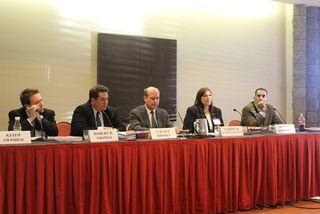
IMG_6999

“Yosemite,” according to California Place Names, Erwin Gudde’s seminal work on the origins of (surprise) California place names, means “they are killers.” It was “[e]vidently a name given to the Indians of the valley by those outside it.”

I raise this historical tidbit because I must admit to feeling a little like “those outside it” when I was invited to speak about regulatory takings at the California State Bar’s Environmental Law Conference at Yosemite. I figured as a conference devoted to environmental law, it was a going to be a decidedly skeptical audience, given my advocacy for property owners and property rights. I accepted the invitation nonetheless, heartened that this conference wasn’t going to be an echo chamber and that they were at least open to hearing competing ideas.

It turns out that my prediction about “they are killers” was not accurate — the audience, while not exactly

Continue Reading Yosemite Seminar Summary – Regulatory Takings: Looking Back And Looking Forward
Yosemite_conference Here are the links to the cases and other items discussed today at the session Regulatory Takings – Looking Back and Looking Forward at the Cal State Bar’s Environmental Law Section’s Environmental Law Conference at Yosemite.

These cases are also in your written materials.


Continue Reading Links From “Regulatory Takings: Looking Back And Looking Forward” (Cal. State Bar Yosemite Conference)

The Pacific Legal Foundation, the Cato Institute, Professor Paul M. Sullivan, The Grassroot Institute of Hawaii, and the Goldwater Institute have filed this amicus brief, supporting the cert petition filed last month in Corboy v. Louie, No. 11-336 (cert. petition filed Sep. 15, 2011).

That’s the case seeking SCOTUS review of the Hawaii Supreme Court’s opinion concluding that challengers to the property tax exemptions conferred on lessees of Hawaiian Homesteads lacked standing. Only “native Hawaiians” are eligible to lease homestead land, and thus only those possessing the appropriate blood quantum are entitled to the tax exemptions, and the Hawaii court dismissed the case for lack of jurisdiction, holding the petitioners lacked standing to challenge the exemption since they had not sought homestead leases (leases for which they were ineligible because they are not native Hawaiians).

The petition asks this question:

Whether the Hawaii courts erred in failing to recognize

Continue Reading Amicus Brief In Hawaii SCOTUS Case: Is Hawaiian Homes Property Tax Exemption Racial Discrimination?

IMG_3352

As part of the Fall Meeting of the ABA’s Section of State & Local Government Law in Tucson, on Thursday, September 22, I was on a panel discussing the Supreme Court’s recent decision in Nevada Commission on Ethics v. Carrigan, “Ethical Considerations for Municipal Attorneys: Caught in the Crosshairs Reconciling the Rules of Professional Conduct with Government Ethics Laws.”

Joining me in the discussion were Yvonne M. Nevarez-Goodson (Commission Counsel and one of the lawyers for the Nevada Commission on Ethics in the Supreme Court), J. Scott Rhodes (an expert in ethics and professional responsibility issues), and Professor Keith Swisher (Phoenix School of Law – his scholarship includes ethics and he produces the Judicial Ethics Forum blog). Michael Donaldson moderated.

I started us off by providing a short summary of the Carrigan case, touching on the Nevada Supreme Court’s conclusion that vote by a legislator is a

Continue Reading CLE Report: Government Ethics, Free Speech, And Voting Rights

In a cert petition filed yesterday, five Hawaii taxpayers argue that they have standing to challenge the constitutionality of property tax exemptions conferred on lessees of Hawaiian Homesteads. Only “native Hawaiians” are eligible to lease homestead land, and thus only those possessing the appropriate blood quantum are entitled to the tax exemptions.

The petitioners are not “native Hawaiians” and thus are not lessees, and paid their property taxes under protest. When they sought refunds in the Hawaii Tax Appeals Court and argued that they should also be exempt, that court concluded that “native Hawaiian” was not a racial classification and did not review the tax exemption with strict scrutiny. Instead, the court upheld the exemption under rational basis review.

The Hawaii Supreme Court vacated the Tax Court decision and dismissed for lack of jurisdiction, holding the petitioners lacked standing to challenge the exemption since they had not sought homestead

Continue Reading New Hawaii Cert Petition: Is Hawaiian Homes Property Tax Exemption Racial Discrimination?

No, it’s not a takings claim, so Williamson County ripeness isn’t a part of the opinion. In Potrero Hills Landfill, Inc. v. County of Solano, No. 10-15229 (Sep. 13, 2011), the Ninth Circuit held that the Younger abstention doctrine did not prevent the district court from considering a § 1983 claim for declaratory and injunctive relief in a land use case involving an initiative ordinance that regulated the amount of solid waste that could be imported into the county.

After the county concluded the ordinance was unconstitutional under the dormant Commerce Clause and refused to enforce it, one of the county landfills began to reach its limits and its owner sought an expansion permit. Environmental groups eventually brought suit in state court to require the county to enforce the ordinance. Shortly thereafter, the landfill and other waste and recycling businesses filed a federal court action to invalidate the ordinance

Continue Reading 9th Cir: Federal Court May Consider A Land Use Civil Rights Claim


This is not what we normally do. We do land use, real estate, development law. Heck, I can get you zoning to be an airport if that’s what you want. But I don’t represent inmates, I don’t represent people charged with crime, I don’t represent criminals.”

                                     — Land use lawyer Joshua Safran

“Crime” and “land use lawyers” are phrases not usually heard together; in most cases, the worlds of criminal law and land use never intersect, and lawyers for developers and property owners don’t have much occasion to visit the “Attorney’s Room” at the state pen. But in the documentary film Crime After Crime, two land use lawyers including our ABA State & Local Government Law Section colleague Nadia Costa (Vice-Chair of the Section’s Land Use Committee), plunge into that unfamiliar milieu:

In 1983, Deborah Peagler, a woman brutally abused by her boyfriend, was

Continue Reading Review: “Crime After Crime” – A Movie That Makes You Feel Right About Being A Lawyer

“Property rights” often are portrayed as belonging only to the rich and powerful and protecting only the politically connected. But as we recently were reminded, this is a very inaccurate picture because property rights — as the “guardian of every other right” — form the foundation on which all other rights rest, and are “civil rights” that benefit everyone.

If we needed any more reminding, the U.S. Department of Justice recently filed a complaint in the Northern District of Ilinois against the City of Joliet under the Fair Housing Act after the City condemned an apartment complex in which 96% of the residents are African-American. The City claims it needed to take the property for “redevelopment” to alleviate blight. According to the DOJ’s press release:

The complaint, filed today in the U.S. District Court for the Northern District of Illinois, alleges that the city of Joliet

Continue Reading The “Bad Old Days” – Feds Sue City For Eminent Domain Abuse