There’s been yet another cert petition asking the Suprme Court to revist and discard the ripeness rules of Williamson County Regional Planning Comm’n v. Hamilton Bank of Johnson City, 473 U.S. 172 (1985).

In Colony Cove Properties, LLC v. City of Carson, 640 F.3d 948 (9th Cir. 2011), the Ninth Circuit affirmed the dismissal of a property owner’s claim that the city’s mobilehome rent control ordinance is a taking. The district court dismissed the facial takings claim because it was filed outside the statute of limitations, and the as-applied takings challenge as unripe.

The property owners’ petition poses these Questions Presented:

This case involves a regulatory takings claim brought under the Fifth Amendment and 42 U.S.C. § 1983. The Ninth Circuit Court of Appeals upheld the district court’s dismissal of the claim, holding that Petitioner is required to seek a remedy for the taking through the California state

Continue Reading The Latest Cert Petition Seeking To Overrule Williamson County

cert petition has been filed by the property owners in a case we’ve been following about what the takings ripeness doctrine of Williamson County Regional Planning Comm’n v. Hamilton Bank of Johnson City, 473 U.S. 172 (1985) requires.

In Downing/Salt Pond Partners v. Rhode Island, 643 F.3d 16 (1st Cir. 2011), the U.S. Court of Appeals for the First Circuit concluded that because Rhode Island state law might allow an inverse condemnation remedy andthe burden is on the property owner to show that the remedy is unavailable, and thus the case was not ripe for review in federal court.

The petition poses these Questions Presented:

Does the ripeness doctrine of Williamson County Reg’l Planning Comm’n v. Hamilton Bank of Johnson City, 473 U.S. 172, 194 (1985), require a property owner to litigate in state court to show a taking of property is “without just compensation,” and

Continue Reading New Cert Petition: Why Can’t A Federal Court Determine The State Has Not Provided Compensation?

Here’s the latest in a case we’ve been following. In Bridge Aina Lea, LLC v. State of Hawaii Land Use Comm’n, the plaintiff filed its complaint in state circuit court alleging that the LUC violated state and federal law (due process, takings, vested rights, and more) when it reclassified “urban” land on the Big Island to “agriculture.” 

The defendants then removed the case to federal court, and have now filed a motion to dismiss that contains a host of defenses: immunity, the unavailability of prospective injunctive relief, whether certain defendants are “persons” under 42 U.S.C. § 1983, abstention on the federal takings claim, the lack of a state damage remedy for deprivation of constitutional rights, and zoning estoppel, among others.

Just the thing to give you flashbacks to your Federal Courts class.

Update: here‘s the errata filed just after the motion to dismiss.

Motion to Dismiss, Bridge at

Continue Reading Latest In Big Island Takings And Vested Rights Challenge To LUC Reclassification

In Edwards v. City of Jonesboro, No. 10-2405 (July 14, 2011), the U.S. Court of Appeals for the Eighth Circuit held that a takings claim brought in federal court after the property owner prevailed on the same claim in state court was not barred by the Rooker-Feldman doctrine, but that the state court judgment was final and precluded relitigation of the owner’s federal claims.

Methane gas, released by decomposing waste in the the city’s landfill, invaded adjacent land, rendering it undevelopable, so the owner sued the city. He filed an action in state court; alleging violations of his rights under state law (inverse condemnation, trespass, violations of the state constitution, and the like), and under federal law (takings, etc). With his third amended complaint, however, he filed an England reservation, withholding his federal claims from resolution in state court.

After a trial, the state court ordered the city

Continue Reading 8th Cir: No Rooker-Feldman, But San Remo Hotel Precludes Federal Takings Claim

We tend not to think of churches as “blighting” their neighborhoods. But what about a church in a downtown “entertainment” district, where the nearby businesses are bars, nightclubs, and liquor stores, and placing a church in the area might limit the availability of liquor licenses?

In a sort of reversal of the usual LULU (locally undersirable land uses) issue, in Centro Familiar Cristiano Buenas Nuevas v. City of Yuma, No. 09-15442 (July 12, 2011), the Ninth Circuit considered whether a municipality ran afoul of RLUIPA’s “equal terms” provision when it required a church to seek a conditional use permit before it could relocate to a downtown entertainment area, and then denied the permit because it might limit the liquor licenses that could be issued to nearby businesses.

Arizona law prohibits issuance of a liquor license to any new bar, nightclub, or liquor store within 300 feet of a church

Continue Reading 9th Circuit: Church’s Use Permit Requirement Violates RLUIPA Equal Terms

stlouis

Is this a “sign?” The city of St. Louis thought so. The city’s building inspection department issued a citation to the folks who commissioned the painting on a residential duplex, telling them they needed a permit. So they asked the city for one.

Denied. The zoning code does not allow for such signs. It’s too big. The building doesn’t have street frontage. Signs can only be incidental to the building’s use, and the building is a two-family home.

Appeal to the Board of Adjustment. No adjustment: it’s not exempt as a “work of art,” a “civil symbol,” or (get this) a “crest.” Those things are not subject to the sign code. Paint a big flag, a mural, (or your family crest?) and you don’t need a permit. But this is a sign. And signs need a permit.

Next stop, state court. The sign guys filed a lawsuit for

Continue Reading Eighth Circuit Sees The Sign – Eminent Domain Abuse Protest Mural Gets First Amendment OK

Civil Beat‘s recent report on the mayor’s plan to demolish the Waikiki Natatorium War Memorial, a salt-water swimming pool erected to honor those who served in “the Great War,” not only brought back some childhood memories (I swam there as a kid) but reminded us of the cost of preservation. When the thing or property sought to be preserved  — or, to use the bumper-sticker vernacular, “saved” — is public property like the Natatorium, the discussion usually involves the cost of doing so balanced against the desire to keep it.

But when the property involved is private property, you usually hear very little about the burdens placed on the owner, or the cost to the public of preservation. Which brings us to the tile of this post, which was inspired by a recent column by Howard Dicus “What do you want to save in Honolulu that’s old?

Continue Reading What Do You Want To Save In Honolulu (And How Much Will It Cost?)

Any regular reader of these pages knows about the Williamson County/San Remo Hotel “ripeness” Catch-22: try vindicating a property owner’s federal constitutional right in federal court in the first instance, and the federal court will tell you that you are too early — a regulatory taking is of no constitutional moment until the state regulators have made a final decision, and the state courts have denied compensation (even if this means the state hasn’t offered compensation and in state court denies it owes any). But bring a federal action after a state court inverse condemnation case, and the federal court will tell you that you are too late — you already litigated your federal claim, even if you expressly didn’t.

The Catch-22 nature of this prompted four Justices to note in San Remo Hotel that the Williamson County experiment may have run its course and is due

Continue Reading First Circuit: RI’s Inverse Condemnation Remedy Satisfies Williamson County

PICT0408
Last week, after we concluded the spring meeting of the ABA’s Section on State and Local Government Law in Portland, Oregon (more about that in a subsequent post), we could not resist paying a brief visit to the neighboring City of Tigard.

Yes, that City of Tigard.

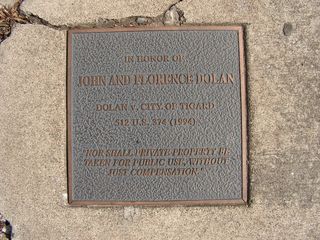
In the early 1990s, the city was home to John and Florence Dolan, who owned A-Boy Plumbing & Electrical Supply. They asked the city for a permit to expand their store and pave their parking lot. The city saw this as an opportunity to expand its network of bike paths, and conditioned its approvals on the Dolans “dedicating” (giving) the city land for a public “greenway” along the adjacent Fanno Creek, totaling approximately 10% of the parcel.

PICT0407

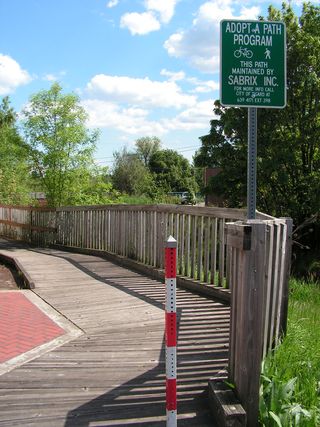
            The entrance to the “greenway” from the street.

The Dolans objected, arguing that requiring them to donate land as a condition of land use

Continue Reading Regulatory Takings Pilgrimage, Part II

Here’s Bettendorf v. St. Croix County, No. 10-1359 (Jan. 20, 2011) a 2-1 decision from the U.S. Court of Appeals for the Seventh Circuit, another regulatory takings opinion we’ve been meaning to post for a while. The case involves a property owner’s claim that the county’s changing the zoning on his land from commercial to agricultural-residential was a taking and a violation of due process. The county changed the zoning in response to a state court judgment holding that the commercial zoning was void because it contained a provision that it would revert to agricultural-residential upon the property owner’s death or a sale to a new owner. The owner sued to invalidate the condition, but the state court invalidated the entire zoning ordinance. Put that one in the “be careful what you ask for” department.

But before you get to the majority’s treatment of the merits (no taking, no

Continue Reading 7th Circuit Rejects Takings Claim On The Merits. But How?