


According to this City Room blog post at the New York Times, Daniel Goldstein, the “last Atlantic Yards holdout” and the driving force behind Develop Don’t Destroy Brooklyn, has agreed to cease his objections to the taking of his family home in return for $3 million. For a statement from Mr. Goldstein, see here.

We say good for him.

Browse through some of the comments on the post, however, and you will note that others view this through more jaded lenses: “We knew it was all about the money in the end,” “I guess it was about money all along, eh?,” “Moral of the story: He who holds out longest, gets the biggest check. No good guys in this one.” Similar charges were leveled against Susette Kelo when she eventually settled her case.

These comments are unfair, and reflect a gross lack of understanding of what
Continue Reading Was It “All About The Money?” Hardly.

To paraphrase comedian Jeff Foxworthy, if you understand the title of this post…you might be a regulatory takings lawyer.

And when you hear the terms “RookerFeldman” and “San Remo,” you know you are knee deep in the often-bizarre procedural maze where a regulatory takings claim in federal court may be too early (ripeness), too late (preclusion and full faith and credit), or completely barred (RookerFeldman).

The RookerFeldman doctrine posits that federal district courts do not have jurisdiction to review the decisions of state supreme courts, where it is alleged that the state court’s judgment itself violates the plaintiff’s federal rights. San Remo Hotel, L.P. v. City and County of San Francisco, 545 U.S. 323 (2005) is the Supreme Court’s most recent “ripeness” decision, affirming that property owners do not have to bring their federal takings claims

Continue Reading 8th Circuit: Rooker-Feldman Not Applicable, But Federal Claims Precluded Under San Remo

In granting a special zoning exemption to Shelter House, Iowa City allowed it to build a homeless shelter on land next to Mr. and Mrs. Dahlen’s mobile home park. After losing their challenge to the zoning exemption, the Dahlens filed suit in federal court alleging the exemption violated their due process rights.

That claim was abandoned when the Dahlens amended their complaint to allege that they owned a portion of the Shelter House property by adverse possession, and the city’s approval of a site plan for the homeless shelter was an uncompensated taking of their property. The District Court dismissed the amended complaint because it was not ripe under Williamson County Regional Planning Comm’n v. Hamilton Bank of Johnson City, 473 U.S. 172 (1985).

In Dahlen v. Shelter House, No. 09-1909 (8th Cir. Mar. 24, 2010), the U.S. Court of Appeals for the Eighth Circuit agreed. The Dahlens

Continue Reading 8th Circuit: Federal Takings Lawsuit Not Ripe

This just in: the U.S. Court of Appeals for the Ninth Circuit will be hearing Guggenheim v. City of Goleta, No. 06-56306 (Sep. 28, 2009) en banc.

The panel opinion in Guggenheim held that the city’s mobile home rent control ordinance was a regulatory taking, an issue the court had never considered before:

Daniel Guggenheim and others bring a facial challenge the the City of Goleta’s mobile home rent control ordinance. Guggenheim argues that the ordinance, which effects a transfer of nearly 90 percent of the property value from the mobile home park owners to mobile home tenants, constitutes a regulatory taking under Penn Central Transportation Co. v. New York City, 438 U.S. 104 (1978). We have fielded such challenges before, but have never reached the merits of the takings claim.

Slip op. at 13808-09. What review by the full Ninth Circuit probably portends is that whatever

Continue Reading Ninth Circuit To Hear Rent Control Takings Case En Banc

Contradicting Chris Rock’s dictum (caution, may be very offensive), Fulton County, Georgia concluded there might be something untoward going on in the Champagne Room, at least in those serving alcohol. In Flanigan’s Enterprises, Inc. of Ga. v. Fulton County, No. 08-17035 (Feb. 16, 2010), the U.S. Court of Appeals for the Eleventh Circuit held the County’s conclusion was not irrational.

The county commissioners believed that strip clubs featuring nude dancing might have a relationship to crime and lowered property values, so they commissioned local studies of the issue and gathered studies from other areas. The local studies revealed no relationship between strip clubs and crime or property values. But relying on the “foreign studies” which showed otherwise, the commissioners barred alcohol in strip clubs and other “adult entertainment establishments.”

For its troubles, the County was sued by the owner of a strip club for First Amendment violations, and the

Continue Reading 11th Circuit: County Reasonably Concluded Something Might Be Going On In The Champagne Room

The Connecticut Supreme Court has issued opinions in a trio of closely-watched eminent domain cases. The first two opinions deal with technicalities of eminent domain law, but the third overturns a $12 million jury verdict that the Town of Branford, Connecticut abused its eminent domain power.

In
Town of Branford v. Santa Barbara, SC 18091 (officially released Feb. 16, 2010), the court affirmed that the highest and best use of the property taken was for residential development.

In Town of Branford v. Santa Barbara, SC 18090 (officially released Feb. 16, 2010), the court held that Connecticut’s offer of judgment statute is not applicable to condemnation appeals.

In New England Estates v. Town of Branford, SC 18132 (officially released Feb. 16, 2010), the court overturned the jury’s $12,435,914 jury verdict, because an “unrecorded, unexercised option to purchase the property…is not considered a property interest under Connecticut state law

Continue Reading Connecticut Supreme Court: An Option To Purchase Is Not “Property,” So Optionee Can Be Abused

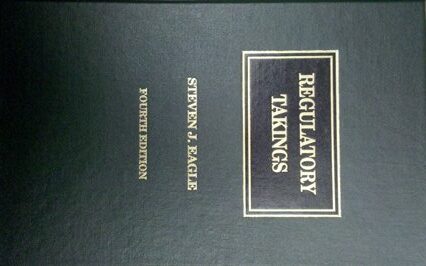
Eagle_reg_takings_cover I just received my copy of the latest edition of Professor Steven J. Eagle‘s definitive treatise Regulatory Takings (Lexis/Nexis, 4th ed. Dec. 2009).

Like the earlier editions, this is a must-have for every land use and property law attorney’s back bookshelf.

Chapters include “Property Rights and Their Sources,” “The Ascendancyof Land Use Regulation,” “Analytical Issues in Regulatory TakingsLitigation,” and “Regulatory Takings Remedies.”

The book is available here (oddly, the Lexis-Nexis web site only has the 3d edition for purchase, but I expect that to be remedied shortly).

From the preface to the fourth edition:

Thisbook is about “regulatory takings,” which is a relatively new term, but not an entirely new idea. The underlying concept is stated simply — government may “regulate” private property, but not to the extent that it constitutes a “taking,” under the United States Constitution, or a state constitution. Owners need not be compensated for losses

Continue Reading Eagle On Regulatory Takings (4th ed. 2009)

Both parties have asked the Hawaii Intermediate Court of Appeals to take another look at its opinion in Maunalua Bay Beach Ohana 28 v. State of Hawaii, No. 28175 (Dec. 30, 2009).

In that case, the court held (1) the Hawaii Legislature took existing littoral accretion when it assigned ownership of the accretion from beachfront owners to the State; and (2) the Legislature did not take “future accretion.” We summarized the opinion here. [Disclosure: we filed an amicus briefsupporting the property owners, available here.]

The State of Hawaii asserts the opinion should not have addressed the claim that land which had accreted prior to 1985 was taken. The State’s Motion for Clarification is here.

The property owners assert the ICA’s conclusion that “future accretion” is not a property interest should be reexamined. The ICA relied on three federal cases from the Ninth Circuit, Western Pac. Ry.

Continue Reading Motions For Reconsideration In ICA Accretion Taking Appeal

The County of Maui has filed its Answering Brief in Leone v. County of Maui, No. 29696, an appeal in the HawaiiIntermediate Court of Appeals which is considering, among other issues,the question of when a regulatory takings claim is ripe for reviewunder Williamson County Regional Planning Comm’n v. Hamilton Bank of Johnson City, 473 U.S. 172 (1985). The brief responds to the property owners’ Opening Brief (here).

Thetrial court determined the plaintiffs’ federal regulatory takings claim — which they brought in state court, as required by Williamson County — werenot ripe because they should have sought a legislative change to theoffending land use regulations which allegedly deprive their propertyof all economically beneficial uses. The trial court’s decision isavailable here.

The County’s brief argues the takings claims are not ripe for review because they “have not alleged nor can they demonstrate they have attempted to obtain

Continue Reading Government Brief: Landowner Must Seek To Change Land Use Designations To Ripen Federal Takings Claim