


In Colony Cove Properties, LLC v. City of Carson, No. 09-57039 (Mar. 28, 2011), the U.S. Court of Appeals for the Ninth Circuit affirmed the District Court’s dismissal of a property owner’s claim that the City of Carson’s mobilehome rent control ordinance is a taking. The District Court dismissed the facial takings claim because it was filed outside the statute of limitations, and the as-applied takings challenge as unripe.

We’ll review the opinion in detail to see if there is anything more worth posting about, or whether this is another one in the long series of Williamson County ripeness cases.

Colony Cove Properties, LLC v. City of Carson, No 09-57039 (9th Cir 3/28/2011)Continue Reading 9th Circuit: Mobilehome Rent Control Takings Claim Too Early Or Too Late, Take Your Pick
In Alto Eldorado Partnership v. County of Santa Fe, No. 09-2214 (Mar. 16, 2011), the U.S. Court of Appeals for the Tenth Circuit held that a regulatory takings challenge to an affordable housing exaction was not ripe under the second prong of the   Williamson County test.The “final decision” prong was not at issue in this case, where the plaintiffs challenged the County’s up-to-30% affordable housing exaction on subdivisions, where the subdivision is for resale.  Continue Reading 10th Circuit: Affordable Housing Exaction Claim Not Ripe Under Williamson County

Sometimes, you have to wonder. In an otherwise well-written opinion, in Johnson v. Manitowoc County, No. 10-2409 (Mar. 19, 2011), the U.S. Court of Appeals for the Seventh Circuit concluded that a Wisconsin property owner who suffered damage to his rental property when the authorities executed a search warrant against his tenant did not have a Fourth Amendment or takings claim.

Mr. Johnson had the bad fortune to rent his property to a guy who was accused and eventually convicted of murder, and in the course of their investigation, the police seized several of Mr. Johnson’s items, and damaged his property by “removing carpet sections and wall paneling, cutting up a couch in the trailer, and jackhammering the concrete floor of the garage.” Slip op. at 3. Mr. Johnson had yet to pursue Wisconsin procedures to get his property back and to address the damage to his property, but he filed a complaint in federal court, seeking damages under civil rights law for violation of his constitutional rights. The district court granted the County’s motion for summary judgment, and the Seventh Circuit affirmed. The search and seizure was not “unreasonable” under the Fourth Amendment, and the owner has no takings claim under the Fifth Amendment.

There’s nothing obviously outlandish about the court’s takings conclusion — it’s a result that other circuits have reached in similar circumstances. See, e.g., Amerisource Corp. v. United States, 525 F.3d 1139 (Fed. Cir. 2008) (a drug company’s product that was seized but never used in a government investigation, and which was rendered worthless in the interim, did not have a Tucker Act claim for compensation). It might be an incident of ownership that all property is subject to reasonable searches in furtherance of the state’s need to enforce the criminal law. Or, under Williamson County, a federal court could validly ask what a federal takings claim was doing in federal court while there apparently remain avenues for obtaining compensation under state law. But that’s not how the court analyzed the case.

Instead, it addressed it this way:

The Takings Clause provides, “nor shall private property be taken for public use, without just compensation.” It is made applicable to the States by the Fourteenth Amendment. Kelo v. City of New London, Conn., 545 U.S. 469, 472 n.1 (2005). But the Takings Clause does not apply when property is retained or damaged as the result of the government’s exercise of its authority pursuant to some power other than the power of eminent domain. See AmeriSource Corp. v. United States, 525 F.3d 1149, 1154 (citing Bennis v. Michigan, 516 U.S. 442, 452 (1996)). Here, the actions were taken under the state’s police power. The Takings Clause claim is a non-starter.

Slip op. at 10.

The court’s conclusion that a takings claim is a “non-starter” because the government has not invoked its power of eminent domain is utter nonsense. Indeed, the doctrine of regulatory takings is premised on the idea that the government’s exercise of power other than the eminent domain power is a taking if it “goes too far.” See, e.g., Pennsylvania Coal Co. v. Mahon, 260 U.S. 393 (1922) (state’s exercise of its police power was a taking).

We actually like the way this opinion is written, in plain, easy-to-understand language. See, e.g., slip op. at 1 (“A landlord is lucky when he rents a dwelling he owns to a tenant who turns out to be pretty good. When he rents to a tenant who turns out to be fairly bad, he’s unlucky.”); slip op. at 8 (“Johnson argues that the officers’ use of the jackhammer violates the reasonableness standard of the Fourth Amendment. He contends that the officers should have used a diamond or carbide-bladed saw, which would have resulted in less damage to the garage floor. Perhaps Johnson is correct, but the use of the jackhammer looks to be reasonable under the circumstances.”). So it’s a shame that an opinion that is such a pleasure to read could get its reasoning so wrong on the takings claim.

It’s not like the regulatory takings doctrine is a recent concept, or a wholly undeveloped area of law, so we fail to see how the court’s analysis was so off the mark, especially since there were, as noted above, other ways of disposing of this case without perpetuating bad law.

Continue Reading Say What? 7th Circuit: “Takings Clause does not apply when property … is damaged as the result of the government’s exercise of its authority pursuant to some power other than the power of eminent domain.”

This just in: the en banc Ninth Circuit, in an opinion by Judge Kleinfeld (the dissenter from the panel opinion) has concluded that the City of Goleta’s mobile home rent control ordinance is not a regulatory taking. In Guggenheim v. City of Goleta, No. 06-56306 (Dec. 22, 2010), the majority “assumed without deciding” that the case was ripe under Williamson County, but that the property owners did not establish a regulatory taking under Penn Central. We covered the en banc oral arguments here, and our resource page on the case is here.

There’s a lot of opinion to churn through, but the core of the majority opinion is based on the notion that the Guggenheims did not have “investment-backed expectations.” Imposing what can only be called a bizarre economic and appraisal theory, the majority concluded:

Whatever unfairness to the mobile home park owner might have

Continue Reading En Banc 9th Circuit Decides Guggenheim: Mobile Home Rent Control Ordinance Is Not A Regulatory Taking

At 10:00 a.m. HST (3 p.m. EST, noon PST), the Hawaii Intermediate Court of Appeals will hear oral arguments in a case we’ve been following that involves federal regulatory takings claims, Williamson County ripeness, the practical effect of the Hawaii Supreme Court’s decision in GATRI v. Blane, 88 Haw. 108, 962 P.2d 367 (1998) regarding zoning and planning for land in the Special Management Area.

Leone v. County of Maui, No. 2969 is a case that has U.S. Supreme Court potential if the Hawaii courts don’t get it right and is definitely one to watch.

We will be live blogging the arguments starting at about 9:55 a.m. Joining me will be my Damon Key colleague Mark Murakami. We will post a full summary of the case and a set of the briefs before then.

Disclosure: we filed an amicus brief supporting the property owners in this case, available

Continue Reading 12/8/2010 Oral Argument Live Blog: Must A Property Owner Seek To Change The Law To Ripen A Federal Regulatory Takings Claim?

In a case that could write the next chapter in the Kelo saga, the property owner recently filed this cert petition asking the U.S. Supreme Court to review the decision of the New York Court of Appeals in the Columbia “blight” case, Kaur v. New York State Urban Development Corp., No. 125 (June 24, 2010).

This is the case in which the Court of Appeals held that de novo judicial review of the factual record leading to an exercise of the eminent domain power was improper, and whether property can be taken because it allegedly is “substandard or insanitary” is a question for taking agencies, not courts. As we noted in several posts criticizing the decision (see here and here) and in a post lauding the Appellate Division’s decision (which struck down the taking as pretextual), “in other words, ‘blight’ is whatever the agency says it is. Just

Continue Reading Cert Petition In Columbia “Blight” Case: Are There Any Limits To Eminent Domain In New York?

In Kauai Springs struggling, The Garden Island (the Kauai daily newspaper) writes about

The Kauai Planning Commission (Planning Commission) asks this Court to validate a remarkable theory: that in the course of reviewing whether Kauai Springs, Inc. (Kauai Springs) was entitled to three simple zoning permits for its agriculturally-zoned land, the public trust doctrine required the Planning Commission to determine water rights and water usage – issues acknowledged as beyond the Planning Commission’s competence, and beyond its jurisdiction.

The Planning Commission’s consideration of the zoning permits required it to determine whether Kauai Springs’ use of its land was “compatible with the neighborhood” and whether it was “reasonable use of land situated within the Agricultural or Rural District.” Further, Haw. Rev. Stat. § 91-13.5 (1998) and Kauai’s “deemed approved” ordinances mandate that if the Planning Commission did not process the applications within certain times, they were automatically approved.

The Planning

Continue Reading Justice Delayed Is Justice Denied: Zoning Permits

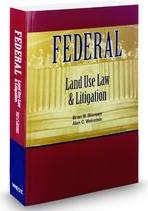
P13513986-160025L I’ve just received my copy of the 2010 revision of Federal Land Use Law & Litigation by Brian W. Blaesser and Alan C. Weinstein (West, $225).

Here’s the description of the book from West’s site:

Examines all federal, constitutional, and statutory limitations on local land use controls, discussing cases, regulations, liability, defense strategies, doctrines, and antitrust restrictions. Comprehensively reviews Supreme Court and lower federal court decisions that consider the constitutionality of land use regulations. Discusses complicated free speech issues affected by federal land use law, and municipalities exercising home rule powers. Examines issues such as: constitutional and statutory limits, First Amendment limitations on land use controls, federal remedies and attorney’s fees, liability and immunity issues, litigation guidelines, zoning, subdivision controls, growth management, model complaints, and selected constitutional and statutory decisions.

Federal Land Use Law & Litigation is an eminently useful single-volume research and reference guide. It’s well-organized, and although it

Continue Reading Book Review: Federal Land Use Law and Litigation, 2010 edition

The Ninth Circuit’s en banc rent control takings case, set for oral argument in Pasadena tomorrow, has generated big interest.

In Guggenheim v. City of Goleta, 582 F.3d 996 (9th Cir., Sep. 28, 2009), a three-judge panel of the U.S. Court of Appeals for the Ninth Circuit held that the city’s mobile home rent control ordinance was a regulatory taking. The court found the case ripe under Williamson County, and addressed the merits of the takings claim. On March 12, 2010, the court ordered en banc review.

Twelve amici have filed briefs (10 supporting the property owners, and 2 supporting the City; available here on our resource page), and the court will be beaming the June 22, 2010 oral arguments live to the San Francisco, Portland, and Seattle courthouses at 2:00 p.m. if you can’t make it to Pasadena.

We will be in the Pasadena courtroom tomorrow, and

Continue Reading Ninth Circuit Rent Control Takings Case (Guggenheim) Preview

Yesterday, I had the pleasure of speaking to members of the Western Manufactured Housing Communities Association about some of the legal issues facing their businesses, and property owners in general. Here are the links I mentioned:

  • Guggenheim v. City of Goleta, 582 F.3d 996 (9th Cir. 2009) (en banc review ordered Mar. 12, 2010). This is the very important case regarding the city’s mobile home rent control ordinance, which the Ninth Circuit panel concluded worked a facial taking of property under Penn Central. We have the briefs which have been filed for en banc review, and will be posting them in the upcoming days. Most definitely a case to watch.
  • A recent opinion from the California Court of Appeal in another rent control


Continue Reading Links From WMA Presentation – Regulatory Takings, Rent Control, And Guggenheim