The Supreme Court of Montana’s opinion in Tai Tam, LLC v. Missoula County, No. DA21-0660 (Nov. 15, 2022) starts off like a somewhat typical land use dispute turned into a constitutional fight. The property owner sought subdivision approvals for a 28-acre parcel to allow residential development, and the County denied the applications because “the proposal failure to adequately mitigate the loss of agricultural soils.” Slip op. at 2.(Oh, and “bird habitat.” Slip op. at 3.)

Next, the complaint, alleging some of the usual claims: due process, equal protection, and takings, and a statutory claim under Montana law. The trial court dismissed all claims: the statutory claims for failure to get in before the 30-day limitations period, and the constitutional property claims based on the court’s conclusion that the plaintiff lacked a “property” interest.

We’ll let you read the part of the opinion in which the court reversed the dismissal
Continue Reading Montana: Owning The Land Is Enough To Plead A Property Interest: Property Means “Rights Inherent In Ownership,” Not Extent Of Govt Discretion

Syllabus

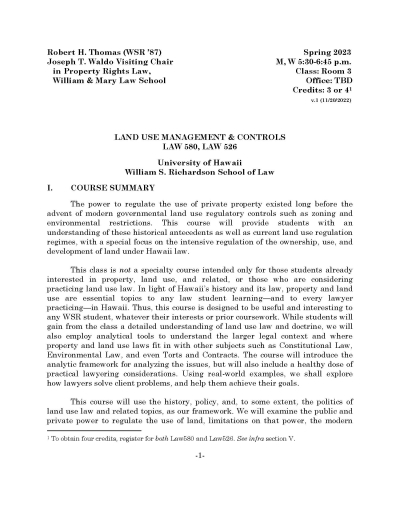
Starting in January, we’ll be teaching the venerated, and oh-so-important Land Use course (Law 580) at the University of Hawaii’s Law School.

We’re at least temporarily stepping into some mighty big slippers (this is Hawaii, so we don’t always wear shoes), as this is the course that our mentor Professor David Callies taught for decades. And is there a better venue in which to teach and study land use law and regulation, and its limits? After all, Hawaii may be the most heavily-regulated land on the planet, and is a focal point for every issue you can think of, from zoning to environmental restrictions to takings to public trust to subdivision to admin law to … well, you get the drift.

We’ll cover those topics, as well as the fundamentals. And we have a few surprises up our sleeve – some impressive guest lecturers, explorations of dirt law careers

Continue Reading Hawaii 5-80: Land Use Law At The University Of Hawaii

Here’s a short one you might have overlooked because it’s an unpublished memorandum opinion.

In Kagan v. City of Los Angeles, No. 21-55233 (Nov. 10, 2022), a Ninth Circuit panel summarily affirmed the dismissal of property owners’ challenge to a city ordinance prohibiting eviction of “protected status” tenants from a duplex in order to regain the unit for family use. 

The takings claim was rejected for the now-familiar Yee rationale: there’s no physical invasion or a taking of the right to exclude, because the owner wasn’t forced to let the tenant on the premises in the first place. In other words, once you let someone in your property, you lose the right to exclude:

Here, as in Yee, the Owners “voluntarily rented their land,” and were not required to submit to physical occupation by another. Id. at 527. Moreover, the RSO allows at-fault evictions, such as evictions for creating

Continue Reading Ninth Circuit: Property Owners Don’t Have A Fundamental Right To Use And Occupy Their Own Property

Here it is, the official agenda and program for the 40th ALI-CLE Eminent Domain & Land Valuation Litigation Conference, February 2-4, 2023 (with a special event the evening of Wednesday, February 1, 2023 to entice you to arrive early).

Screenshot 2022-11-18 at 13-35-13 ALI CLE PA NY VA TX FL Continuing Legal Education

Here’s the brochure with the complete agenda, schedule, and faculty listing. But to tempt you, here are some of the highlights of the program:

  • Everything Old is New Again: Why Today’s Practitioners Need to Understand the Original Meaning of the Takings and Just Compensation Clauses
  • Private Utility Takeovers – Lessons From a 67 Day Trial

  • Valuation Issues When Billboards and Signs are Condemned

  • Setting Client Expectations and Identifying Red Flags

  • Developing Property Right Issues in Texas – Questions and Answers from the Bench: A View From the Bench (with Texas Supreme Court Justice Jimmy Blacklock)

  • Eminent Domain and Regulatory Takings Updates: Important Decisions You Need to Know

  • Ethics:


Continue Reading Here’s The Program For The 40th ALI-CLE Eminent Domain & Land Valuation Litigation Conference, Feb 1-4, 2023, Austin

Well, that was quick. As we noted here, we recently argued a case in the Ninth Circuit (October 20, 2022) about whether a regulatory takings claim is ripe

Not long after we posted the argument recording, the Ninth Circuit panel issued a short memorandum opinion rejecting our arguments wholesale (November 1, 2022).

So earlier this week, we asked the entire Ninth Circuit to take a look. Here’s our en banc petition.

We’ll leave it to you to read it and see why we think this one is ripe.

Appellants’ Petition for Rehearing En Banc, Ralston v. San Mateo Cnty., No 21-16489 (9th Cir. Nov. 15, 2022…

Continue Reading Let’s Take A Deeper Look At Takings Ripeness, Ninth Circuit

Earlier this month, the U.S. District Court invalidated Honolulu’s stretching of the minimum term for a residential rental from 30 days to three months, concluding that the ordinance likely violates the state Zoning Enabling Act, and also would be a taking if implemented. The court issued a preliminary injunction.

The lawyers repping the plaintiffs in that case — our former law partner Greg Kugle — appeared on Kelii Akina’s Hawaii Together (Think Tech) program to talk about it more. Check it out.Continue Reading More On Federal Court Invalidating Honolulu’s 3-Month Minimum Rental Term

October 20, 2022 was what one advocate noted was “land use day at the Ninth Circuit,” because three out of the four cases being argued in Courtroom 3 of the San Francisco courthouse were indeed land use — or perhaps more accurately, regulatory takings — cases.

Ours was one of those cases, Ralston v. San Mateo County.

Without going into too much detail, this is an appeal from the district court’s 12(b)(6) dismissal of our regulatory takings complaint. The crux of the claim is that Ralston’s R-1 zoned property is subject to an “overlay” district called the Montecito Riparian Corridor, a highly-restricted zone that allows only 5 environmental uses of land within the zone (none of which are consistent with the R-1 zoning). (Ralston’s property is labeled “076-19” on the County’s MRC map.)

Montecito Riparian Corridor

Absent some kind of special dispensation — what the County calls an “override” —

Continue Reading CA9 Takings Ripeness Oral Arguments: Must Property Owners Secure Govt’s Agreement That Property Is Subject To Challenged Regulations Before A Court Can Review?

Been meaning to post this one for a while.

The plaintiff in Northwest Landowners Ass’n v. North Dakota, No. 20210148 (Aug. 4, 2022), challenged North Dakota’s adoption of a statute about “pore space,” which is “a cavity or void, whether natural or artificially created, in a subsurface sedimentary stratum.” Whoa.

The problematic part of the statute “allows an oil and gas operator to use subsurface port space and denies the surface owner the right to exclude others or to demand compensation for this subsurface use.” Slip op. at 2. The statute also amended the definition of “land” to exclude pore space, and barred tort claims for injection or migration of substances into pore space. Frack!

The Association sued, asserting that the statute effected a facial taking because “it strips landowner of their right to possess and use the pore space within their lands and allows the State

Continue Reading Shades Of Mahon From North Dakota: Fracking Statute “constitutes a per se taking”

We won’t be providing our detailed thoughts on last week’s U.S. Court of Appeals for the Sixth Circuit’s opinion in Hall v. Meisner, No. 21-1700 (Oct. 13, 2022), because we’re obviously biased: our law firm colleagues Christina Martin and Kady Valois represent the prevailing property owners, so we naturally agree with the court. Thus, you should really read the opinion in its entirety yourself. But we shall offer some commentary:

  • This is another one of those “home equity theft” cases where, after foreclosing property in order to satisfy a tax or other debt, the government doesn’t remit the excess equity to the property owner, but keeps it or allows a private third-party to do so.
  • This case is a takings challenge to a Michigan county doing just that under the authority of state law. Hall owed a tax debt of $22k, and her home was worth close to $300k.


Continue Reading CA6: Home Equity Is Property Even If State Law Says Otherwise: Govt Can’t Foreclose To Satisfy A Tax Debt, Then Keep The Change

PXL_20220927_164202969

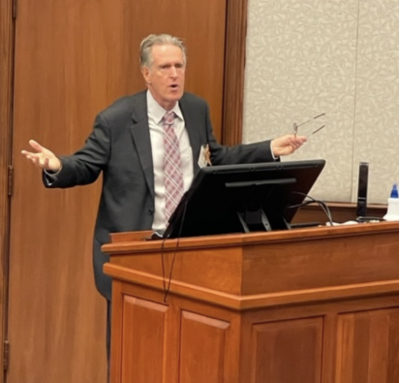
We spoke on the second panel of the day at the 2022 Brigham-Kanner Property Rights Conference at the William and Mary Law School. The subject of our panel — which included Professors David Callies, Tim Mulvaney, and Dave Owen — was “Reshaping the Framework Protecting Property Under the Roberts Court.

Here’s a rough transcript of my remarks.

————————————–

President Reveley, Professor Butler, distinguished Brigham-Kanner Prizewinners (present and future), mentors, colleagues, family and friends: thank you for the opportunity to speak today.

The story goes that when asked what it was like to be a part of the “Rat Pack,*” that Dean Martin responded “It’s Frank’s world, we just live in it.”

Fd5_62PUoAEo-y8

When I first heard the title of this portion of the program and the discussion of how and if the Roberts Court is reshaping property, my first reaction was a paraphrase of Dean

Continue Reading Brigham-Kanner Property Rights Conference 2022 Report: It’s Chief Justice Roberts’ Property World, We Just Live In It