Check this out, a recently-filed cert petition in a case we’ve been following, filed by our friends and colleagues at the Institute for Justice. This one involves an issue we’ve been on top of also, most recently in these two cases (see here and here).

That is, what does the Supreme Court’s description of the Takings Clause as “self-executing” actually mean? Do you need statutory authorization in order to bring a takings or just compensation claim, or can you sue directly under the Constitution?

In Devillier v. Texas, No. 21-40750 (Nov. 12, 2022), the Fifth Circuit’s cryptic opinion concluded that “the Fifth Amendment Takings Clause as applied to the states through the Fourteenth Amendment does not provide a right to action for takings against a state[.]” Slip op. at 1-2. Here’s the entirety of the decision (minus footnotes):

The State of Texas appeals the district court’s decision

Continue Reading New Cert Petition: Do You Need Statutory Authorization To Sue For A Taking?
Screenshot 2023-03-03 at 08-06-54 Robert Thomas inversecondemnation.com on Twitter

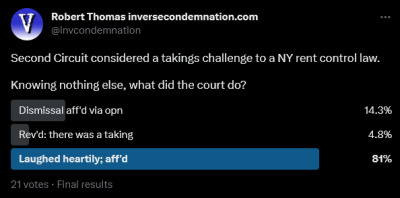
Let’s say you know nothing else about an appeal except it is being decided by the U.S. Court of Appeals for the Second Circuit, and the case is a constitutional challenge to rent control. What’s your best guess about the outcome (the district court dismissed for failure to state a claim)?

When the Second Circuit issued its summary order in just such a case last week — a challenge to the “Housing Stability and Tenant Protection Act of 2019” — we decided to undertake a little unscientific poll to see whether others out in the Twitterverse predicted as we did.

Looks like so. Yes, the sampling size was small, and the respondents were only those who voluntarily offered their thoughts. But 95% accurately predicted that the property owners would lose, as the Second Circuit indeed held in an appellate court’s version of “laughing heartily” at an appellant’s arguments:

Continue Reading One Guess What The Second Circuit Did With A Takings Challenge To Rent Control

Screenshot 2023-02-23 at 11-13-54 Toward Principled Background Principles in Takings Law

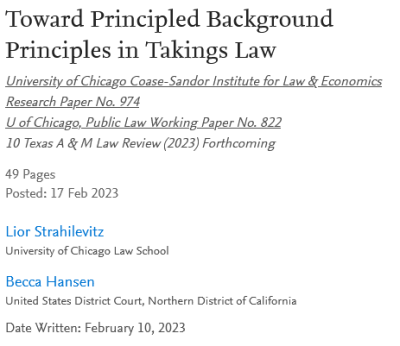
Check this out, a new article co-authored by a federal judge’s law clerk and lawprof Lior Strahilevitz (Chicago). With the title, “Toward Principled Background Principles in Takings Law” are we going to read it? You bet. (Unlike a lot of new scholarship that we post here, we read this one immediately.)

Here’s the Abstract:

Blunders made by lawyers, judges, and scholars have caused the Supreme Court’s recent opinion in Cedar Point Nursery v. Hassid to be deeply misunderstood. In Cedar Point, the Court re-wrote takings law by treating temporary and part-time entries onto private property as per se takings. Prior to Cedar Point these sorts of government-authorized physical entries would have been evaluated under a balancing framework that almost invariably enabled the government to prevail. As it happens, there were two well-established rules of black letter law that California’s lawyers and amici mistakenly failed to invoke in defending

Continue Reading New Article: “Toward Principled Background Principles in Takings Law” (Strahilevitz & Hansen)

ThomasMitchell

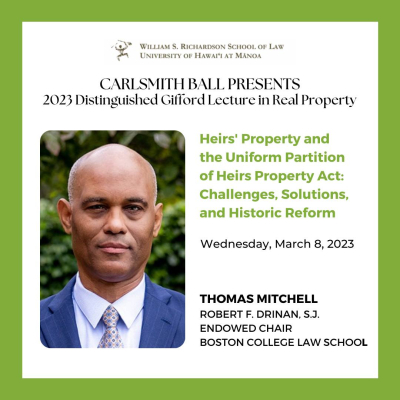
If you are in Honolulu, please join us on Wednesday, March 8, 2023, 4:30-5:30 p.m. at the University of Hawaii Law School for Professor Thomas Mitchell on “Heirs’ Property and the Uniform Partition of Heirs Property Act: Challenges, Solutions, and Historic Reform.”

Our U.H. Land Use class is attending to learn more about “heirs’ property” (described as “the biggest problem you’ve never heard of“), and so should you. Yes, Hawaii has adopted the Uniform Partition of Heirs’ Property Act and we have followed this issue for some time, but if you didn’t know about this, now is your chance to catch up.

Here are the details from the U.H. newsletter:

Carlsmith Ball presents the 2023 Distinguished Gifford Lecturer in Real Property, Thomas W. Mitchell. Mitchell is a professor at Boston College Law School, where he holds the Robert F. Drinan, S.J. Endowed Chair and serves as the Director of the Initiative on Land, Housing & Property Rights. He is a national expert on property issues facing disadvantaged families and communities and has published leading scholarly works addressing these matters.

In 2020, Professor Mitchell was named one of 21 recipients of the MacArthur Fellowship in recognition of the substantial impact his professional work has had in assisting disadvantaged farmers and property owners, people who are disproportionately but not exclusively African American and other people of color. He is the only lawyer in his MacArthur Fellowship class. Please join us for this Distinguished Gifford Lecture; a light reception is to follow from 5:30 – 6:30 p.m.

Come, join us for this compelling session.
Continue Reading Join Us On Wed March 8 at 4:30pm For 2023 Distinguished Gifford Lecture In Real Property – Prof Thomas Mitchell On “Heirs’ Property & the Uniform Partition of Heirs’ Property Act: Challenges, Solutions, & Historic Reform”

40th ALI-CLE

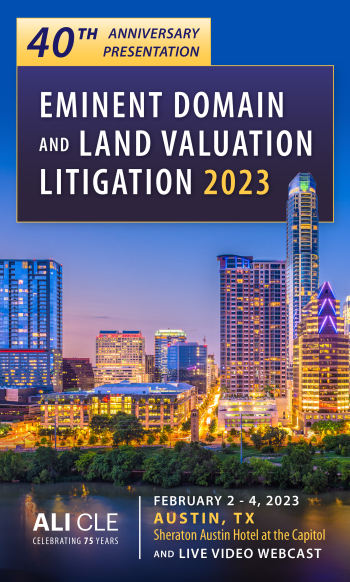
We were eagerly anticipating 40th American Law Institute-CLE Eminent Domain and Land Valuation Litigation Conference. The 2022 Conference in Scottsdale was one of the first meetings where everyone was back in-person (and was a smashing success), but that conference was early in the game so not everyone could or would attend. But in the past year most of us got back to some semblance of “normal,” and the turnout promised to be good.

We had record registrations: with over 300 attendees, faculty, and staff signed up, things were shaping up.

Plus, we were headed to Austin, Texas. The last time we held the Conference there in 2016, we loved it so much it has been in-demand for a return visit. And this year is the debut Conference for some new planning co-chairs for both the main tracks as well as the “Condemnation 101” tracks, so the buzz for the

Continue Reading Ice Ice Baby: A Report From The 40th ALI-CLE Eminent Domain & Land Valuation Litigation Conference, Feb 1-4, 2023, Austin

Here’s the latest in a case we’ve been following since its inception.

The U.S. Court of Appeals for the Second Circuit has affirmed the Eastern District of New York’s 12(b)(6) dismissal of a complaint alleging that New York (state)’s sweeping amendments to its Rent Stabilization (rent control) statute effected physical and regulatory takings.

First, this can’t be a surprise to anyone who has been paying attention to how courts treat rent control. Putting aside for a moment the legal theories and the various challenges, rent control has become so ossified — such a political third-rail and sacred cow — that courts are very reluctant to do anything to upset the system, and will approve most any ratcheting-up of the restrictions. Any challenger, whatever the logic of their legal theory, has to recognize that they start off in a very deep hole.

That said, let’s take a look at

Continue Reading CA2, Pellucidly:* You Let ‘Em In, Property Owners, So New York Can Tell You To Keep ‘Em (Part I)

Screenshot 2023-02-07 at 09-17-30 Emerging Issues in Property Rights

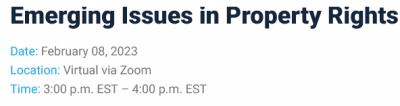
Join our Pacific Legal Foundation colleagues Jon Houghton, Daniel Woislaw, Kady Valois, and Sam Spiegelman (moderating) tomorrow, Wednesday, February 8, 2023, at 3:00 – 4:00 p.m. ET for a free webinar, “Emerging Issues in Property Rights.”

Here’s the agenda:

Protecting private property rights has been at the heart of PLF’s work since our founding in 1973. Our view, and that of the American Founders, is that property rights are foundational to all other constitutional rights.

Our relentless defense of property rights has secured many precedented victories, including 12 property rights wins at the U.S. Supreme Court—and counting.

Unfortunately, even today, the need for property rights champions remains critical.

Government officials too often relegate property rights to second-class status among Americans’ constitutional rights—cloaking their assaults in erroneous assertions of environmental protection or cleverly constructed land use restrictions.

To learn more about property rights’ legal landscape in

Continue Reading “Emerging Issues In Property Rights” – Wednesday, February 8, 2023, 3-4pm ET (Free!)

We really want you there…

One (nearly) last reminder that there’s still time to register for your space at the 40th ALI-CLE Eminent Domain & Land Valuation Litigation Conference, February 1-4, 2023, in Austin. In the past several years, we have sold out due to the conference room capacity and the conference hotel block. But there’s still space, although we are nearly full. So register now – don’t delay any further! 

Here’s the brochure with the complete agenda, schedule, and faculty listing. But to tempt you, here are some of the highlights of the program:

  • Everything Old is New Again: Why Today’s Practitioners Need to Understand the Original Meaning of the Takings and Just Compensation Clauses
  • When the SWAT Team Comes (No) Knocking: Police Power Takings
  • Private Utility Takeovers – Lessons From a 67 Day Trial

  • “Contraband”: How Property Rights Helped Pave the Way for Civil Rights

  • Valuation


Continue Reading (Nearly) Last Call: There’s Still Time To Join Us For The 40th ALI-CLE Eminent Domain & Land Valuation Litigation Conference, Feb 1-4, Austin

We’ve had the North Dakota Supreme Court’s opinion in Wilkinson v. Bd. of Univ. & School Lands, No. 20220037 (Nov. 10, 2022), in our queue for a while because it isn’t exactly the clearest opinion we’ve come across. It is relatively short, so that’s not the issue. But it is cryptic and poorly written, and each time we steeled ourselves to understand and digest it, we got distracted by some bright shiny object and put the opinion aside. But we’ve always meant to post it, and now that 2022 is winding down, we figured we better get on with it.

So let’s see if we get this right (we’re still not entirely sure we did, so feel free to comment if your read of the facts and the court’s analysis differs from ours). Here goes.

Wilkinson’s predecessors-in-title owned land in the Missouri River, and conveyed most of their interests

Continue Reading North Dakota: State May Lease Out Property It Doesn’t Own As Long As It Calls It “Overinclusive Leasing Activity”

Here’s another one from the Ninth Circuit, argued on what one advocate called “land use day at the Ninth Circuit” (except, unlike the other two cases argued that day, the decision in this one gets published). 

In Gearing v. City of Half Moon Bay, No. 21-16688 (Dec. 8, 2022), the panel upheld the dismissal of a takings case, holding that federal courts should abstain from considering regulatory takings cases in favor of pending state court eminent domain actions, even when the condemnor instituted the state court action in response to the federal takings claim (and even though, unlike the other two cases argued that day, the federal takings claim is ripe).

This one started in federal court, where the property owner asserted the city’s rejection of its development application worked a taking. In response, the city ran to state court and filed an eminent domain action

Continue Reading CA9: Land Use Is A “Sensitive Area Of Social Policy” So We’re Gonna Let A Local Govt Bleed The Property Owner Out