


Here’s a few reports worth reading:

  • Lt Gov. Gavin Newsom alleges ‘threats’ against mortgage plan – the LA Times reports on California’s Lieutenant Governor (who just happens to have “some ties to Mortgage Resolution Partners” — the private investment group that promulgated the idea of using eminent domain to seize underwater mortgages), who is calling for an investigation of whether those objecting to the plan are “threatening” local governments. “Newsom’s complaint comes after several groups, including the influential Securities Industry and Financial Markets Assn., objected to the eminent domain plan and warned that mortgages could become more expensive for future homeowners living in regions that adopt the plan. The Federal Housing Finance
Continue Reading Thursday’s Worth Reading List

We are at the ABA Annual meeting this week, so don’t have a lot of time to keep up a long-distance practice and write up comprehensive blog posts, so we’re going to keep it short.

Here’s the latest takings decision from the Federal Circuit in a case we’ve been following, Estate of Hage v. United States, No. 2011-5001 (Fed. Cir. July 26, 2012). The property owners filed their case in 1991 in the Court of Federal Claims seeking compensation for the federal government’s taking of water rights in Nevada. In 2008, the CFC ruled in favor of the property owners, but the Federal Circuit reversed on Williamson County grounds because the case wasn’t administratively ripe. The federal agency, you see, has not reached a final decision on what the property owners might do with the land, and just might issue a permit (even if other similar permit applications

Continue Reading Federal Circuit: 22-Year Old Takings Case In Which The Landowner Is Already Dead Is Not Ripe

There’s a feature story in today’s Honolulu Star-Advertiser, “Red tape ties up groups’ fishpond restorations,” about a local caretaker group’s frustration with “government rules” they claim are thwarting their efforts to fix up a traditional littoral fishpond.

For those of you not familiar with these centuries-old aquacultural structures designed to catch and raise fish that once dotted the shores of most every Hawaiian island, check out Kaiser Aetna v. United States, 444 U.S. 164 (1979), the U.S. Supreme Court’s decision upholding the private nature of these structures. For a slightly more recent case protecting the private status of a  fishpond on Molokai see Boone v. United States, 944 F.2d 1489 (9th Cir. 1991). Disclosure: we represented the property owners in both cases.

The S-A story is mostly behind a paywall, so for those without subscriptions or access to the hard copy, here’s the short

Continue Reading Trickle-Down Regulation: Environmental Maze Becomes “Stumbling Block” For The Little Guys

AFBF-annual
On Monday, January 9, 2012, I’ll be speaking to my American Farm Bureau Federation colleagues, who are in town for the AFBF annual meeting.

The title of my presentation is “Agriculture and Property Rights: Why Hawaii Matters.” I’ll be talking water rights, GMO, right-to-farm, eminent domain, and other issues to the lawyers who represent farmers and ranchers. I’ll record it and post it here on Monday.

Check out the AFBF’s annual meeting blog here.Continue Reading Agriculture And Property Rights: Why Hawaii Matters

12.WATHIWe’ve just finalized the agenda and faculty for the Hawaii Water Law conference, to be held in Honolulu on January 11, 2012. I am the planning co-chair along with Jesse Souki, Director of the State of Hawaii Office of Planning.

In addition to Jesse and me, we’ve assembled a diverse and talented faculty: UH lawprof David Callies will speak with Elijah Yip (Cades) on the latest developments in water law and public trust litigation. State Water Commissioner Lawrence Miike will update us on the latest goings-on at the Commission. My Damon Key partner Greg Kugle is speaking with Leo Asuncion, the Manager of the Coastal Zone Management Program at the State Office of Planning on coastal issues.

After lunch, we have a special guest, Ed Thomas (a lawyer and President of the National Hazard Mitigation Association, and a nationaly known expert in floodplain management and disaster

Continue Reading Mark Your Calendars: Hawaii Water Law Conference (Jan. 11, 2012)

Last week, the petitioners filed their merits brief in Sackett v. EPA, No. 10-1062, the case in which Idaho property owners are asserting their right to challenge the EPA’s assertion that a portion of their land are “wetlands.”

A multitude of amicus briefs have been filed to support the Sackett’s arguments. We haven’t had the time to review each brief yet, but here they are for your review:


Continue Reading Amicus Briefs In Sackett v. EPA: Judicial Review Of A Claim Of Regulatory Jurisdiction

One of the very first things we addressed in the first year Property class (wonderfully taught by Allen Smith, visiting from Michigan Law) was the ownership of animals: when do wild animals become someone’s “property?” And the very first Latin phrase we incorporated into our new legal lexicon was ferae naturae, the law of wild animals.

In that vein, we introduce you to Ferae Naturae, a new law blog (to us, at least) on the law of animals, wild and otherwise. The blog is authored by our ABA State and Local Government Law colleague Amy Lavine, and although she posts on a wider scope of issues than the property law aspects of wild animals, it’s still an informative and worthwhile read.

Recent posts include “How to fight criminal charges when you get caught with a crocodile in your bathtub,” “Raccoons are not ‘cuddly

Continue Reading New Law Blog To Follow: Ferae Naturae

California, if you weren’t already aware, produces raisins. Lots of raisins. It accounts for 99.5% of the U.S. crop and 40% of the world crop.

Since the 1920’s, supply has exceeded demand by 30 to 50 percent. Since the 1940’s, the USDA has regulated the raisin industry to even out the fluctuation in supplies and prices by creating “annual reserve pools” that remove extra raisins from the market. Those regulations, in the form of “marketing orders,” require raisin “handlers” (those who process and pack agricultural goods for distribution) to set aside a certain percentage of raisins from the domestic open market, upon pain of civil and criminal penalties if they do not. The reserve raisins can only be sold for resale in export or secondary markets, with the proceeds used to pay for administration of the regulatory program (naturally), and any balance being distributed among raisin “producers.”

In Horne

Continue Reading 9th Cir: California Raisins Were Not Taken

Honolulu attorney Jay Fidell (who also produces Think Tech Hawaii) writes a regular column in the Honolulu Star-Advertiser. This week, he focuses on eminent domain in “Governor must insure wind farm moves forward,” where he writes about the proposed wind farm on Molokai, and urges the state to use eminent domain aggressively to take the needed land:

When Abercrombie threatened eminent domain against Molokai Ranch, he unleashed the genie, and the possibility of condemnation is now in play. He gave us a glimpse of a powerful solution to our energy security predicament, and we can’t let it pass.

In our state of islands, land is scarce, and NIMBY is in every back yard. Large landowners want to hold on to their land in hopes of appreciation and because it’s so difficult to find other parcels. So they refuse to sell.

Hawaii has traditionally been reluctant to

Continue Reading “Make Eminent Domain Imminent” – Fidell On Wind Power

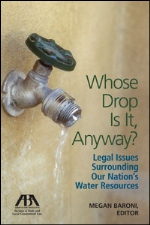
5330213_big The ABA State & Local Government Law Section has just published a new book, Whose Drop Is It Anyway? Legal Issues Surrounding Our Nation’s Water Resources, edited by Megan Baroni. I just received my copy.

Skimming through the chapters, it looks worthy of a place on the bookshelf as a practical guide to a very wide range of issues related to water.

Here are the details:

Whose Drop Is It, Anyway? Legal Issues Surrounding Our Nation’s Water Resources, is a valuable resource and practical tool discussing the legal issues surrounding water resources and the current issues and trends that are influencing the legal regimes. Practical in use, this book can be used as a tool for developing effective water management strategies in your own jurisdictions.

As scarcity issues become more common and threats like global climate change loom with uncertainty over our water resources, water only stands to

Continue Reading New Book On Water Law And Water Resources