With the 2019 edition of the Brigham-Kanner Property Rights Conference (and award of the B-K Prize to Professor Steven Eagle) to get underway later this week, it is also publication time for the latest issue of the Brigham-Kanner Property Rights Journal

This edition focuses on the “Federalism Dimension of Constitutional Property,” and we contributed a short essay, “Emerging Issues in Property Law.”  (And yes, this essay was part of my talk at an academic conference, so used the word “normative.”)

Thomas, Emerging Issues in Property Law, 8 Brigham-Kanner Prop. Rts. J. 113 (2019) 
Continue Reading New Article: Emerging Issues in Property Law (Brigham-Kanner Property Rights Journal)

Klingonsnippet

Takings mavens know lawprof Ilya Somin. Among other things, he’s authored some of the more interesting and useful scholarship in our field.

Here’s his latest, published in the 2019 Cato Supreme Court Review, about the Supreme Court’s latest takings case, Knick v. Township of Scott

We naturally recommend you read the entirety of his article, Knick v. Township of Scott: Ending a Catch-22 that Barred Takings Cases from Federal Court, which he has posted on SSRN here

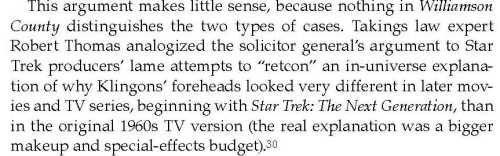
And for those of you wondering about the snippet above, Prof. Somin was brave enough (or geeky enough) to include a reference to our commentary on the SG’s amicus arguments in Knick, comparing it to the weak-sauce Klingon forehead “retcon” in Star Trek. How could we resist highlighting the inclusion of an impossibly nerdy Trek reference in a published scholarly work? 

Thank you, and bravo, Sir. 

Continue Reading New Article: “Knick v. Township of Scott: Ending a Catch-22 that Barred Takings Cases from Federal Court”

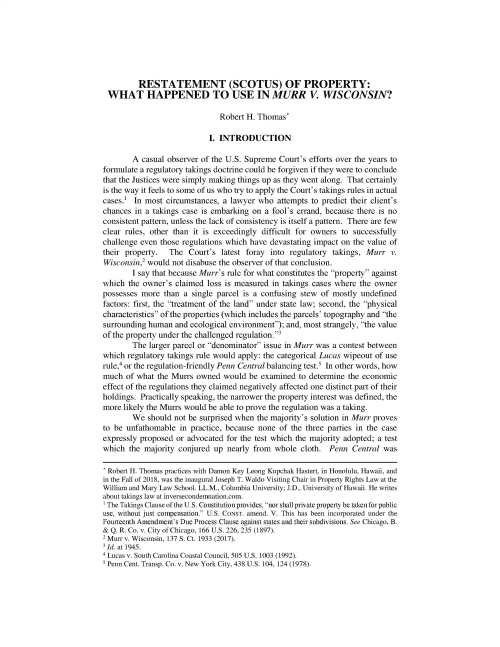
Restatement cover page

Here’s the article, recently published in the UMKC Law Review with thoughts on Murr v. Wisconsin, the case about the “denominator” issue in regulatory takings cases.

We won’t get into it in detail (if you are interested, you can read the article yourself), except to say that therein we offer views of what test the Court should have adopted to analyze whether the Murr family’s two parcels should be considered as one parcel for purposes of whether they were denied productive use of their property by Wisconsin’s environmental regulations. As you recall the Justice Kennedy authored Murr majority adopted a test with a mishmash of factors (what we waggishly labeled his “social justice warrior” test). The article argues that the Court should have instead applied the old “three unities” test from larger parcel questions in eminent domain. That test focuses on the owner’s joint use of the property. 

Continue Reading New Article: Restatement (SCOTUS) of Property – What Happened to Use in Murr v. Wisconsin?

A must-read for takings mavens. Property rights gurus Professor Gideon Kanner and Michael Berger have published a new article, The Nasty, Brutish, and Short Life of Agins v. Tiburon, 50 Urb. Lawyer 1 (2019). It’s the lead article in the latest volume of The Urban Lawyer, the law journal of our Section of the ABA, the Section of State and Local Government Law.

Barista’s note: since TUL ended its long-time editorial relationship with UMKC Law School last year, the journal has been published in-house, and we’ve taken on the role of Editor-in-Chief, in-between our lawyering and teaching day jobs. We recognize the efforts of our ABA editor, as well as our team of volunteer Associate Editors (our fellow lawyers who took on the responsibility of tech editing the pieces) in producing the journal. 

Kanner and Berger have written an informative (and entertaining) tour-de-force of modern regulatory takings law.

Continue Reading New Must-Read Article: Kanner & Berger, “The Nasty, Brutish, and Short Life of Agins v. City of Tiburon”

Short answer: no.

But the longer answer which lawprof Ilya Somin discusses in this short podcast is worth listening to. Check it out. 

Here’s the summary:

Over the last few years, taxi companies in several cities have brought lawsuits claiming that legalizing ride-share services such as Uber and Lyft violates the Takings Clause of the Fifth Amendment, because it expropriates their supposed property right to a monopoly of the taxi business. Courts have so far rejected these arguments. But they raise broader issues about the nature of property rights, and what kinds of government actions qualify as a taking. Confusion about these matters goes well beyond this specific set of cases. Could treating government-created monopoly privileges as property rights imperil valuable innovations and reforms in many parts of the economy?

We follow the issue, mostly from an academic standpoint (we’ve yet to take on one of these cases, but find

Continue Reading Lawprof: “Does Legalizing Uber and Lyft ‘Take’ The Property Of Taxi Companies?”

Here’s what’s on the reading list for today:


Continue Reading Tuesday Takings And Property Round-Up

A law journal article worth reading (short, not too many distracting footnotes) on takings theory.

In Imperfect Takings, 46 Fordham Urban Law Journal 130 (2019), Professor Shai Stern writes about what he calls the “three safeguards” in eminent domain (due process, public use, and mandatory compensation), and how to evaluate the legality of takings when all three are not accomplished perfectly. He argues that his balancing model “allows the government to exercise its expropriation power properly even in imperfect circumstances, while still sufficiently protecting property owners and society from abuse of that power.”

Our thinking: in our experience, none of the bars for the three safeguards are all that high, so we are not convinced this model is new. Because this is what courts already do, no? In Kelo for example, the majority mostly shrugged its shoulders at a stricter reading of the public use requirement because it was

Continue Reading New Article: Imperfect Takings

Kansas colleague Chris Burger has published an article in the Kansas Bar Journal with the intriguing title, “Sanguine Doves in the Hands of the State or How the Power of Eminent Domain has Few Practical Restraints.” We dare you to resist downloading it and reading.

Thanks to Chris for allowing us to repost it (since most of us are not members of the Kansas Bar). It’s a short article and won’t take too much of your time, but there’s some valuable information there, even if you are not barred in Kansas. We especially appreciated the section on “drafting gamesmanship” and the quotes from the Kansas Supreme Court Justices on pages 31-32, this one in particular:

Left unchecked by flood walls erected either by the people’s representatives or by the people’s constitution, the power of the state will flow like an encroaching ocean into and through every available chink

Continue Reading New Article: Sanguine Doves in the Hands of the State; or How the Power of Eminent Domain has Few Practical Restraints

20181004_152311_HDR

Every year, at the Brigham-Kanner Property Rights Conference, the conference publishes a law journal with the articles, essays, and remarks presented at last year’s conference. So it was this year, and Volume 7, with the theme of “The Future of Regulatory Takings,” is now available

We contributed an essay, “Back to the Future of Land Use Regulation,” which focuses on the rational basis test in land use law — where it came from and where it might be going — as well as some other current issues in property law such as the recent trend of raising general environmental concerns as property claims. Check it out if you are so inclined. 

Here’s the Introduction:

As always, I bring you greetings from the land of Midkiff, the land of Kaiser Aetna. The jurisdiction in which the legislature thought it was a good idea to try and

Continue Reading New Article: Back to the Future of Land Use Regulation – From Hadacheck To “New” Property