An interesting and thought-provoking new article from Professor Donald Kochan that is definitely worth your time: The [Takings] Keepings Clause: An Analysis of Framing Effects from Labeling Constitutional Rights, 45 Fla. State U. L. Rev. ___ (forthcoming 2018). 

As the title suggests, Professor Kochan doesn’t quite care for the phrase the “Takings Clause” when it comes to that part of the Fifth Amendment we like so much. Instead, he prefers “Keepings Clause” because that term better embodies the right protected, and does not focus on the governmental power being exercised. 

Best tidbit: the phrase “takings clause” isn’t of ancient origin. Indeed, it is pretty modern. (Count us among those who didn’t know that.) From the article’s Introduction:

It will probably surprise most people that the label “takings clause” is a moniker of modern invention. In fact, the provisions in the U.S. Constitution’s Fifth Amendment that identify the rights and obligations
Continue Reading New Article: The [Takings] Keepings Clause: An Analysis of Framing Effects from Labeling Constitutional Rights

Clare Trapasso has a Realtor.com piece on what a Justice Kavanaugh could mean for real estate, property, and land use issues, “What Supreme Court Nominee Brett Kavanaugh Could Mean for Real Estate,” where she correctly notes that “while commentators have been scrutinizing Kavanaugh’s record on hot-button topics like abortion and immigration, there’s been little discussion of what a more conservative court could mean for home buyers, sellers, and owners.”

She asked us for input, and here’s what we said:

“The Supreme Court has done some very interesting things on land use law that affect homeowners,” says Robert Thomas, a real estate attorney specializing in land use and eminent domain at the Honolulu-based law firm of Damon Key Leong Kupchak Hastert.

Thomas expects more property-related cases will make their way to the Supreme Court, brought by people hoping that the new bench will increase their odds of a

Continue Reading What Might A Justice Kavanaugh Mean For Takings, Land Use, And Other Issues?

20180717_135234_HDR

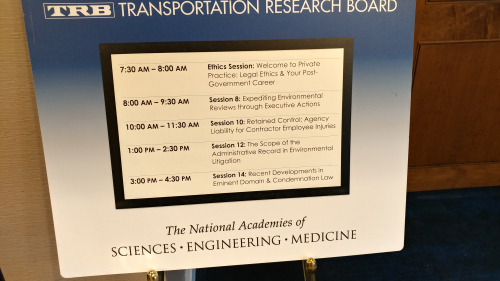
Here are the cases and other items I either spoke about or mentioned at today’s Transportation Research Board‘s 57th Annual Workshop on Transportation Law in Cambridge, Massachusetts:


Continue Reading Links And Materials From Today’s Transportation Research Board Session

IMG_20180322_100645

Here’s some of the things we’re reading or reviewing today, focused on the legal scholars and takings (with the last one being of general interest):

  • Michael Pollack, Taking Data, 86 U. Chi. L. Rev. ___ (2018) (“This Article proposes a new approach to regulating government investigations of data that has been shared with ISPs — one that is inspired by a legal tool that is designed to achieve the very balance between public benefits and private burdens that has thus far proven elusive. This tool is the Takings Clause.”). 
  • Meron Werkneh, Retaking Mecca: Healing Harlem through Restorative Just Compensation, 51 Colum. J. L. & Soc. Probs, 225 (2018) (just compensation does not account for “the loss of the community as a unit, or the dignitary harm suffered due to forcible displacements in the name of ‘revitalization.'”). 
  • Katrina M. Wyman, Limiting the National Right to Exclude, 72 U.


Continue Reading Thursday Reading, Law Review Edition

Check out this recent article by lawprof Timothy Mulvaney, “Non-Enforcement Takings.” We’re used to situations in which government regulation results in a takings claim, but Professor Mulvaney asks about cases in which the government’s inaction is argued to result in a taking.

Here’s the abstract:

The non-enforcement of existing property laws is not logically separable from the issue of unfair and unjust state deprivations of property rights at which the Constitution’s Takings Clause takes aim. This Article suggests, therefore, that takings law should police allocations resulting from non-enforcement decisions on the same “fairness and justice” grounds that it polices allocations resulting from decisions to enact and enforce new regulations. Rejecting the extant majority position that state decisions not to enforce existing property laws are categorically immune from takings liability is not to advocate that persons impacted by such decisions should be automatically or even regularly entitled to

Continue Reading Takings By Government Inaction?

Emotionheader

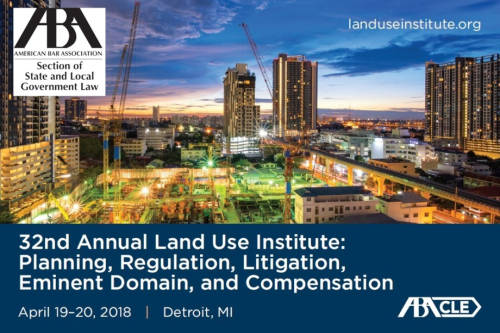
Here’s the printable brochure with the details on the 32nd Annual Land Use Institute in Detroit, April 19-20, 2018. We’ve plugged the program before so we won’t do so again, except to say that you really should attend because (1) it’s a very good program that won’t take much of your time (fly in for the Thursday afternoon program, stay a night, fly home on Friday evening); (2) Detroit is the place to be these days; and (3) it’s one of the best deals in CLE credits, with tuition as low as $400.

2018 Land Use Institute Brochure Detroit 5 2018

Continue Reading April 19-20, 2018: Land Use Institute, Detroit (Printable Brochure)

ZPLR front page

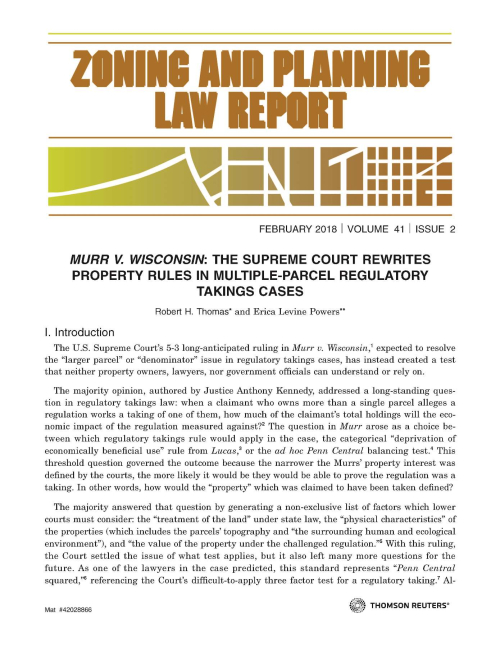
Here’s an article (“Murr v. Wisconsin: The Supreme Court Rewrites Property Rules in Multiple-Parcel Regulatory Takings Cases“), which we authored along with a colleague, published in February 2018’s Zoning and Planning Law Report, about the U.S. Supreme Court’s decision in Murr v. Wisconsin, the case about the “larger parcel” in regulatory takings.

As you might predict, we concluded that the Murr majority’s analysis was vague, unsatisfying, and generally not helpful. Strong letter to follow!

Here’s a passage from the Introduction:

The U.S. Supreme Court’s 5-3 long-anticipated ruling in Murr v. Wisconsin, expected to resolve the “larger parcel” or “denominator” issue in regulatory takings cases, has instead created a test that neither property owners, lawyers, nor government officials can understand or rely on.

The majority opinion, authored by Justice Anthony Kennedy, addressed a long-standing question in regulatory takings law: when a claimant who owns more

Continue Reading New Article: Murr And Other “Blurred Lines”

Sketch

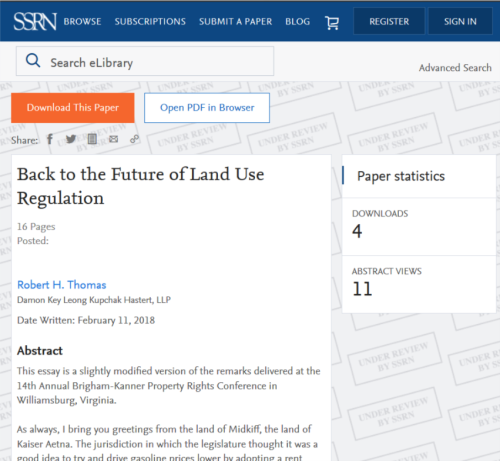
Here’s the (draft) article from our poriton of the first panel at the 2017 Brigham-Kanner Conference, “Back to the Future of Land Use Regulation.” (Also posted on SSRN here.)

This is an expanded version of our talk (listen to the audio here) during the Conference during which the William and Mary Law School awarded U. Hawaii lawprof David Callies the Brigham-Kanner Prize. Our summary of the conference is posted here.

We were part of the panel entitled “The Future of Land Regulation and a Tribute to David Callies,” along with Professors Shelly Saxer and Jim Ely, and past B-K Prize winner Michael Berger. Professor Callies also delivered his opening remarks during this session.

This article has been submitted to the Brigham-Kanner Property Conference Journal which should be published later this year. 

Back to the Future of Land Use Regulation (draft Feb 11, 2018) Continue Reading Back to the Future of Land Use Regulation – Brigham-Kanner Article

Urban_lawyer3.jpg.imagep.980x179

For you land-users out there, be sure to check your inboxes for the link to the latest issue of The Urban Lawyer, the law review published by my section of the ABA, the Section of State and Local Government Law. With articles on privacy and public real estate records, neighborhood opposition to zoning changes, greenhouse gas regulation, planned communities, land use and cannabis, RLUIPA, and more.

If you are not a member of our Section, you really should be because in addition to a subscription to UL, you get to hang with a crew of lawyers, judges, and legal scholars who are smart, fun, and generous with their time. See this post for more on the reasons you should join us.

Want to see what we’re all about? Plan on joining us for our next in-person conference, the 32d Annual Land Use Institute and Spring State and Local

Continue Reading Latest Issue Of The Urban Lawyer