Here’s an article, recently published by the Urban Lawyer (the law review produced by our ABA section, the Section of State and Local Government Law), with our take on the most interesting and important eminent domain and takings rulings from the past year. 

Many of the cases discussed will be familiar to regular readers, but here it is in one place, and in print. 

Recent Developments in Eminent Domain, 48 Urb. Lawyer 939 (2016)

Continue Reading New Article: Recent Developments In Eminent Domain
We all know that the Supreme Court’s 5-4 decision in Kelo is lousy. See “Kelo at 10: Still Stinks, And A Decade Has Not Lessened The Odor.”

Or at least most of us know that. But other than crying in our beer, or trying to get the case overruled (efforts continue!), what is there to do, given that the decision remains “good law?”

Well, here’s some suggestions from our Owners’ Counsel of America and ABA State and Local colleague Dwight Merriam, to soon be published in the Connecticut Law Review, “Time to Make Lemonade from the Lemons of the Kelo Case,” 48 Conn. L. Rev. ___ (forthcoming 2016). 

Intrigued? Here’s the abstract:

The decision in Kelo v. New London only addressed the constitutionality of the eminent domain process used to take Susette Kelo’s home. Given the four corners of the case

Continue Reading New Law Review Article: “Time to Make Lemonade from the Lemons of the Kelo Case”

We like property rights. We really do. And here is a new law review article on property rights. But the jury’s still out whether this will be useful to us (or you) in the practice of law, because, well, the article is about animals having property rights.

You read that right. Property rights. For animals.

Now we’ll admit, our first thought was “is this the quality of legal scholarship that law students are going hundreds of thousands of dollars into debt to learn?”

But really, who are we to judge? We know that cats already think they own everything and everyone, including their putative owners. So what is so outrageous about the rest of the animal kingdom owning things?   

Here’s the abstract:

What if animals could own property? This Article presents a thought experiment of extending our anthropocentric property regime to animals. This exercise yields new insights into

Continue Reading New Law Review Article On Property Rights … For Animals.

A new article worth your time by economist William Wade, “Theory and Misuse of Just Compensation for Income-Producing Property in Federal Courts: A View From Above the Forest,” 46 Tex. Envtl L. J. 139 (2016).

Bill is familiar to regular readers, as he has been a frequent guest poster, and a prolific author. This article is his latest, and focuses on how compensation should be calculated in regulatory takings cases, and contrasts how lawyers view economic losses, and how economists view the same thing (not necessarily the same way). 

We are grateful to the Texas Environmental Law Journal and the Environmental and Natural Resources Section of the Texas State Bar for their permission to post the article. Continue Reading New Article: “Theory and Misuse of Just Compensation for Income-Producing Property in Federal Courts: A View From Above the Forest”

Here’s a newly published article from University of Virginia lawprof Maureen Brady, “Property’s Ceiling: State Courts and the Expansion of Takings Clause Property” 102 U. Va. L. Rev. 1167 (2916). We think it is worth your time reading.

What particularly caught our eyes about the article was its focus on municipal “regrade” projects (such as Seattle’s famous “Denny Regrade” (see our recent post on that here), and how they influenced state courts’ development of constitutional property rights.  

Here’s the abstract:

The Federal Constitution and nearly all state constitutions include takings clauses providing that private property shall not be taken for public use without just compensation. To the extent that scholars have considered the role of state courts with regard to these takings clauses, they have focused around constitutional limits on judicial restrictions of what constitutes property. Little attention has been paid, however, to how

Continue Reading New Article: “Property’s Ceiling: State Courts and the Expansion of Takings Clause Property”

IMG_20160911_163316

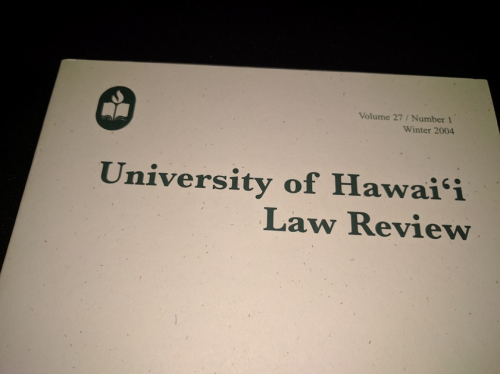
We’re big fans of the University of Hawaii Law Review. Not just because it’s the flagship publication of our alma mater, but mostly because it publishes some worthy and useful articles from time to time (including ours). 

But it’s always bothered us that the subscription service was really Old School. As in to get a subscription, you needed to fill out a paper form and mail it in with a check to their offices. Some of us subscribed, but some of us let it slip. 

Under the leadership of co-Editor-in-Chief Ross Uehara-Tilton (who, coincidentally was one of our firm’s Summer Associates), the UHLR has entered the modern era, and it is now really easy to sign up for a subscription — on-line and with your credit card. Go here, and a few clicks later, you’re done. And what a deal — a mere $35 gets you both

Continue Reading University of Hawaii Law Review – Now (Finally) On-Line

Last year, we posted about the Brigham-Kanner Conference, the annual meeting at William and Mary Law School where we talk all things property rights and award the Brigham-Kanner Property Rights Prize. (By the way, this year’s conference will be held in The Hague, The Netherlands in October. But more on that soon, in a separate post.)

What we are posting today is a follow-up about Mike Berger’s presentation at the 2015 conference. His article — then only in draft form — is a critique of the theories of the 2015 Brigham-Kanner prizewinner, Harvard lawprof Joseph Singer. Recall that Berger was presented with the prize in 2014 — the first and thus far only practitioner to receive the award — which makes this article even more important.  

Berger’s article is now finalized, and has been published by the Brigham-Kanner Property Rights Conference Journal: “Property, Democracy, &

Continue Reading Must Read: Michael Berger On “Property, Democracy, & The Constitution”

A new(er) law review article, worth reading, from Dean Shelly Saxer, “When Local Government Misbehaves,” 2016 Utah L. Rev. 105 (2016). Here’s the abstract:

In this article, Dean Saxer examines the Supreme Court’s decision in Koontz v. St. Johns River Water Management District. In that land use case, the Court held that proposed local government monetary exactions from property owners to permit land development were subject to the same heightened scrutiny test as imposed physical exactions. The Court left unanswered the question of how broadly this heightened scrutiny should be applied to other monetary obligations imposed by the government. Saxer argues that “in lieu” exactions that are individually assessed as part of the permitting process should be treated differently than the impact fees that are developed through the legislative process and are applied equally to all developers without regarding to a specific project. Accordingly, Koontz’s application should be

Continue Reading New Article On Nollan/Dolan/Koontz: “When Local Government Misbehaves”

Read this: “The Accidental Abstention Doctrine: After Thirty Years, the Case for Diverting Federal Takings Claims to State Court Under Williamson County Has Yet to Be Made,” by R.S. Radford and Jennifer Fry Thompson, published in the most recent edition of the Baylor Law Review.  

If the title weren’t enough to tell you what this article is about, here’s a summary:

The Supreme Court has never directly reviewed the question of whether, as a general matter, abstention is required or even appropriate in Fifth Amendment takings cases. Yet in a seemingly unrelated decision handed down more than a decade after Williamson County, the Court held that dismissing such cases would be improper under its express abstention doctrines. The Court has thus created a doctrinal paradox: couched in terms of “ripeness,” Williamson County in fact created a de facto abstention doctrine that applies under circumstances in

Continue Reading Today’s Must Read: “The Accidental Abstention Doctrine: After Thirty Years, the Case for Diverting Federal Takings Claims to State Court Under Williamson County Has Yet to Be Made”

20160126_164326

Austin, Texas, is where we’re at for the next few days, for the 2016 edition of the American Law Institute-CLE Eminent Domain and Land Valuation conference, now in its 33d year. First time we’re in Austin, however, and our registration numbers are looking very good, and we haven’t had this big a turnout in years.

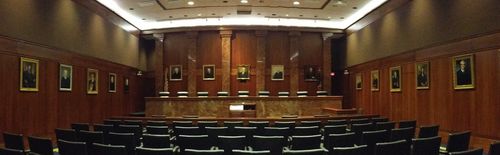
We haven’t been back to Austin in a few years ourselves, so we did what law nerds sometimes do when we go to new towns: visit the local courtroom to check out the scene. So we dropped by the Supreme Court of Texas to take a look. Turns out it was an off-day for the court and it was not in session and the courtroom was locked. But Security suggested that if we asked the Clerk nicely, she might retrieve the key and let us take a look around. And you know what? She did.

Continue Reading ALI-CLE 2016 Eminent Domain Conference: Austin Scouting Report