510E5lC3ILL._SX331_BO1,204,203,200_

Whatever you might celebrate at this time of year — Christmas, Chanukah, Kwanzaa, Festivus, or whatever (or even if you don’t celebrate anything except good cheer and gift giving) — here’s our suggestion for the gift for the takings nerd in your life: Professor Ilya Somin’s fantastic book, “The Grasping Hand: Kelo v. City of New London & The Limits Of Eminent Domain.”

It’s a book that is both scholarly and readable, and filled with details, history, and perspective. You can’t do better than this. Available as both an e-book and in hardback (for you luddites).

Highly recommended. 

Note: Professor Somin is one of the featured speakers at the upcoming ALI-CLE Eminent Domain and Land Valuation conference in Austin, Texas (January 28-30, 2016) where he will talk about the book and recent developments in our favorite area of law. 

Continue Reading Holiday Gift Suggestion For Takings Nerds: Lawprof Somin’s Kelo Book “The Grasping Hand: Kelo v. City of New London & The Limits Of Eminent Domain”

20150910_144339

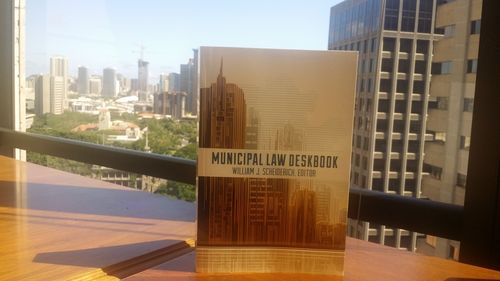
Look what arrived in the mail, a copy of the ABA Section of State and Local Government Law’s recently-published Municipal Law Deskbook, edited by our friend and colleague, Oregon’s Bill Scheiderich

We received a gratis copy because we authored the chapter on Regulatory Takings. The book is designed as a quick reference guide for you muni law types who don’t keep the entire set of McQuillin Municipal Corporations in your library, or for you non-muni law lawyers who want a handy reference guide when these issues come your way:

[The] Municipal Law Deskbook offer[s] legal guidance to municipal attorneys, private practitioners, city administrators, and educators. The book covers a full range of those issues that commonly arise in day-to-day local government administration and the content is intended for attorneys and nonlawyers alike. The chapters cover such topics as when and how federal laws and regulations preempt local legislation

Continue Reading New Book: Municipal Law Deskbook

We’ve covered this topic before (see here, here, and here), but we haven’t heard much about it lately. But thanks to this new article by colleague Dwight H. Merriam, we can get back up to speed.

In “Eminent Domain for Underwater Mortgages: Already on the Way to the Bottom of the Sea of Bad Ideas,” from the Virginia State Bar’s Real Property Section’s journal, The Fee Simple (Spring 2015), Dwight discusses “the foreclosure crisis and how so many homeowners became victims of bad lending practices and a deep economic recession. Many are stuck in their homes, which are underwater with a value far below what was owed on them.” The article explores the question: can eminent domain bail out underwater mortgages?

Short answer: no.

To learn more, click here to view the article.

And what’s the latest that Richmond, California, which was leading the

Continue Reading New Article: “Eminent Domain for Underwater Mortgages: Already on the Way to the Bottom of the Sea of Bad Ideas”

A new article worthy of your time from The Urban Lawyer, the law review published by the ABA Section of State and Local Government Law: “The Power of Eminent Domain in the Aftermath of Hurricane Katrina: Should Common Interest Communities Be Compensated for the Loss of Asssments,” by James R. Conde.

The article (rightly, we think) criticizes the Fifth Circuit’s decision in United States v. 0.073 Acres of Land, 705 F.3d 540 (5th Cir. 2013), a case we wrote up here. The Supreme Court denied review

Here’s the abstract of the article:

In 2005, Hurricane Katrina flooded New Orleans and destroyed approximately 80% of the city’s housing stock. The New Orleans flood generated a corresponding flood of litigation against the Army Corps of Engineers (the “Corps”). After the storm, Congress took steps to repair the Corps’ impaired reputation and to provide disaster relief to

Continue Reading New Article: “Eminent Domain in The Aftermath of Hurricane Katrina”

Grasping_hand

To put on your to-buy, to-read list: lawprof Ilya Somin‘s forthcoming book about the Kelo case and the aftermath, available on June 5, 2015. (We’re in the process of organizing some book talk events with Prof Somin in the fall, and if you have suggestions for venues or want to host one, let us know.) 

Pre-order from Amazon here. The reviews are very good:

“Somin’s thorough rebuttal of the constitutional reasoning and philosophical implications of the Supreme Court’s Kelo decision demonstrates why that ruling was a constructive disaster: It was so dreadful it has provoked robust defenses of the role of private property in sustaining Americans’ liberty.”
 

(George F. Will, journalist and Pulitzer Prize winner)

“By dint of his uncommon thoroughness, Ilya Somin has become the leading and most persuasive critic of the Supreme Court’s ill-fated 2005 Kelo decision.  His close examination of the case’s factual backdrop

Continue Reading New Book Forthcoming: “The Grasping Hand: Kelo v. City of New London & The Limits Of Eminent Domain” by Ilya Somin

It’s not often that we say a law review article is a “must-read.” But this one definitely is, especially for all you regulatory takings mavens: David L. Callies, Through a Glass Clearly: Predicting the Future in Land Use Takings Law, 54 Washburn L. Rev. 43 (2014). A pdf of the article is posted here

From the Introduction:

The subject of takings—the government taking of an interest in real property, either through eminent domain or through the exercise of the police power—has been the subject of continuous litigation for nearly a century. The past ten years have been particularly fruitful, as litigants struggle with the meaning and extent of the Fifth Amendment’s Public Use Clause and the extent to which the overzealous exercise of the police power can sufficiently deprive a landowner of rights in property so that the property has been “taken” by regulation, ever since Justice Holmes

Continue Reading New Law Review Article Worth Reading: “Through a Glass Clearly: Predicting the Future in Land Use Takings Law”

Worth reading: “Legislative Exactions after Koontz v. St. Johns River Management District,” an article by colleagues Luke Wake and Jarod Bona, recently posted to SSRN. Here’s the abstract:

Decided in June, 2013, Koontz v. St. Johns River Management District settled a long-running debate among scholars as to whether the nexus test — first pronounced in Nollan v. California Coastal Commission — applies in review of monetary exactions. In the preceding years, the lower courts had largely resolved this question in the government’s favor — limiting Nollan to its facts, and holding the nexus test inapplicable if a challenged permit requires the applicant to pay or expend money as a condition of permit approval. Further, the trend among the lower courts held the nexus test inapplicable in review of legislatively imposed exactions, regardless of whether the contested condition requires a dedication of real property or money.

Without question

Continue Reading New Article: “Legislative Exactions after Koontz v. St. Johns River Management District”

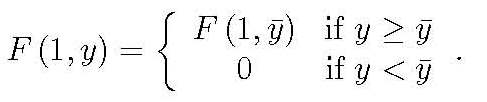
If you, like us, went to law school to avoid things like this:

Untitled Extract Pages

then perhaps this recently-published paper is not going to be your cup of tea.

But seriously, folks, this one might be worth your time, even if you are numbers-challenged, because it is a look at the “holdout” issue from the standpoint of economists.

In “Private Takings,” the authors “examine[] the implications associated with a recent Supreme Court ruling, Kelo v. City of New London.” From the Introduction:

This paper examines the implications associated with a recent Supreme Court ruling, Kelo v. City of New London. Kelo can be interpreted as supporting eminent domain as a means of transferring property rights from one set of private agents — landowners — to another private agent — a developer. Under voluntary exchange, where the developer sequentially acquires property rights from landowners via bargaining, a holdout problem arises.

Continue Reading New Article: “Private Takings” (via Fed Reserve Bank of Chicago)

The use of eminent domain for energy transmission corridors has become a hot topic lately. See, for example, the following posts:

The current center of the controversial issue is the TransCanada Keystone XL pipeline, and there’s been a lot of dis- and mis-information generated. Even Jon Stewart got in on the act.

So it was with relief that we have a new article by our Owners’ Counsel of America colleague William Blake, a partner in the Lincoln office of Nebraska law

Continue Reading A Clear-Eyed Explanation Of The TransCanada Keystone XL Pipeline Eminent Domain Issue

20141104_135324

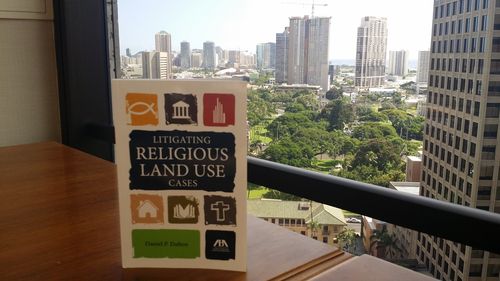
A big thank you to our friend and colleague from Detroit, Dan Dalton, who sent us a recently-published book which he authored, “Litigating Religious Land Use Cases.” 

This book discusses how to litigate such a religious land use case on behalf of a religious entity pursuant to the Religious Land Use and Institutionalized Persons Act (“RLUIPA”)  and the First Amendment. While the First Amendment dates to the founding days of the United States, RLUIPA is a much more recent federal law that can serve as an effective tool in protecting the property interests of religious organizations.

A must-have for any land use lawyer (even if you don’t focus on religious land use cases, or don’t represent religious organizations in such cases), Dan’s book is a great overview of the applicable law, and a primer on the various causes-of-action that can pop up in these type of controversies.

Continue Reading New Book: Litigating Religious Land Use Cases (Dan Dalton)