Here’s what we’re reading this fine summer Monday:

  • Land Use Institute – Although we won’t be able to attend the upcoming annual ALI-ABA program in Boston due to a scheduling conflict, we have attended several times in the recent past, and can highly recommend it. The faculty, as usual, is stellar, and includes colleagues Michael Berger,  Amy Brigham Boulris, Bob Foster, Patricia Salkin, Julie Tappendorf, and Gideon Kanner. 
  • 2011 Takings Conference – Another law conference (November 19, 2011), this one devoted (mostly) to how to defeat regulatory


Continue Reading Monday Round-Up: Vested Rights, Land Use Institute, And More
What we are reading today:

  • Should the Courts Help Los Angeles Commit Fiscal Suicide? – Gideon Kanner’s takedown of the recent California Court of Appeal decision in City of Los Angeles v. Superior Court, No. B225082 (Apr. 12, 2011), which held that in order to make out a claim for inequitable precondemnation activities, the city must actually have filed (or be contemplating filing) an eminent domain action. Because it hadn’t, the property owner could not get summary judgment on the Klopping claim. But as one colleague noted, if the city was not buying up these properties around LAX for a public purpose, just what was it doing? Also worth reading is Brad Kuhn‘s summary and analysis of the case here.


Continue Reading Monday Round-Up

George Mason U. lawprof Steven J. Eagle is familiar to regular readers of this blog for authoring the seminal treatise Regulatory Takings, now in its fourth edition. Talk takings and you will invariably be dealing with his scholarship.

Here’s the latest: Professor Eagle has recently posted a new paper, “Urban Revitalization and Eminent Domain: Misinterpreting Jane Jacobs” on SSRN. The abstract:

This article reviews the implications for land use policy of Jane Jacobs’ The Death and Life of Great American Cities. Fifty years after its publication in 1961, Death and Life remains a clarion call for resistance to monolithic development and to the reigning paradigm of urban planning in the mid-20th century. The article asserts, however, that government officials and planners have learned the wrong lesson from Jacobs. Their emphasis on the top-down imposition of what purports to be varied development is evident in the growth

Continue Reading New Article: Urban Revitalization and Eminent Domain: Misinterpreting Jane Jacobs

VTLREV_coverAs we noted here (when we posted our article), the latest issue of the Vermont Law Review deals with the U.S. Supreme Court’s “judicial takings” case, Stop the Beach Renourishment, Inc. v. Florida Dep’t of Environmental Protection, 130 S.Ct. 2592 (June 17, 2010). 

In eight essays, the authors of several of the many amicus briefs add their post-opinion thoughts. Authors include Ilya Shapiro (Cato Institute), Professor John D. Echeverria (Vermont Law), and Julia Wyman (Marine Affairs Institute). The groundwork is laid in the first article, by Professor L. Kevin Wroth:

If hard cases make bad law, bizarre cases may make no law at all. The recent Supreme Court decision, Stop the Beach Renourishment, Inc. v. Florida Department of Environmental Protection is a case in point. In the Essays that follow, the Vermont Law Review has brought together the reflections of seven lawyers, or teams of lawyers, for amici curiae

Continue Reading Vermont Law Review: Essay Reflections From The Amicus Curiae In The Judicial Takings Case

Zipler Since this is the season for self-congratulatory industry awards, we can’t overlook one of our industry’s highest honors, the Zoning and Planning Law Report Land Use Decision Awards (aka the “ZiPLeRs”). For those of you who do not subscribe to the Zoning and Planning Law Report, the “strangest, or at least more dramatic” land use cases each year are eligible for nomination for a ZiPLeR.

Our colleage Dwight Merriam recently announced the 2010 Awards in the January 2011 issue of ZPLR, and what do you know, a case we nominated “won” the “Home Business Of The Year” Award. We use the term “won” quite loosely, since if you read the facts of the 11th Circuit case, Flava Works, Inc. v. City of Miami, No. 09-11264 (June 25, 2010), involving a South Florida “voyeur/porn dorm” and whether it qualifies as a “business,” this isn’t exactly something we’re going to

Continue Reading What’s An Oscar, Emmy, Or Tony When Compared To A ZiPLeR?

U. Hawaii law student Stewart A. Yerton has published a comment in the most recent issue of the Asian-Pacific Law and Policy Journal, “Procedural Standing and the Hawaii Superferry Decision” How a Surfer, a Paddler, and an Orchid Farmer Aligned Hawaii’s Standing Doctrine with Federal Principles.”

From the Introduction:

This paper will examine the background law and the procedures, strategies, and arguments the Superferry plaintiffs employed in order to attain standing, as well as the arguments the defendants used in an attempt to keep the plaintiffs out of court. Part II will outline federal and state environmental standing doctrine, paying specific attention to cases most relevant to Superferry. The section will conclude with a brief statement of Superferry’s factual background. Part III will analyze four subjects: (1) how the plaintiffs’ lawyers convinced the court to navigate precedent and firmly establish procedural standing in Hawaii, (2) the

Continue Reading Worth Reading: Law Review Comment On Hawaii’s “Procedural Standing” Theory And The Superferry Case

To all of you who attended the first day of the Hawaii Land Use Conference today, thank you. As promised, here are the items I discussed during my two sessions:

  • United States v. Milner, 583 F.3d 1174 (9th Cir. 2009) – the case in which the Ninth Circuit affirmed a finding of common law trespass for the building of a wall on fast land, because the shoreline eventually eroded up to it. Both parties had “vested rights” to an ambulatory littoral boundary. The U.S. Supreme Court denied review, as noted here.


Continue Reading Cases And Links From Today’s Hawaii Land Use Conference Sessions On Coastal Issues And Water Law

What we’re reading today:


Continue Reading Friday Round-Up: Takings Ripeness, Defining “Hawaiian” Cultural Practices, Penn Central, and Judicial Takings

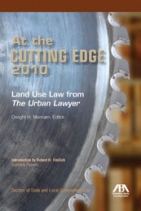
Cutting_edge_2010

The ABA has announced the forthcoming publication of a new book by the State and Local Government Law Section: At the Cutting Edge 2010: Land Use Law from The Urban Lawyer, edited by my colleague Dwight H. Merriam, and which is “[a]n essential resource for practitioners, planning professionals and students, this book provides information and insight into timely issues impacting land use law.”

It’s not available just yet, but is scheduled for publication on December 31, and is available for pre-order here (the usual discounts for ABA/Section members, and for law student members, apply).

I contributed a chapter, Recent Developments in Challenging the Right to Take in Eminent Domain. I received my advance copy today, and it’s a handy little volume that has the latest developments in the law relating to (among other subjects):

  • Cellular telecommunications facilities
  • Exactions and impact fees
  • Trends in green buildings laws
  • Ethical


Continue Reading New Book: At The Cutting Edge 2010: Land Use Law From The Urban Lawyer

The Vermont Law Review has published an article authored by me and my Damon Key colleagues (and fellow law bloggers) Mark M. Murakami and Tred Eyerly. The article is an essay with our thoughts about the U.S. Supreme Court’s decision in Stop the Beach Renourishment, Inc. v. Florida Dep’t of Environmental Protection, No. 08-11 (June 17, 2010).

That’s the “judicial takings” case involving accretion rights and Florida’s “renourished” beaches. Disclosure: we filed an amicus brief supporting the property owners in the case. We argue in the article that despite eight Justices concluding the Florida Supreme Court’s decision in the case was not a judicial taking, the doctrine remains viable. The article suggests a roadmap for how future cases can be analyzed.

Download the pdf here, or get it below.

Of Woodchucks and Prune Yards: A View of Judicial Takings From the Trenches, 35 Vt. L. Rev.

Continue Reading New Article – Of Woodchucks and Prune Yards: A View of Judicial Takings From the Trenches