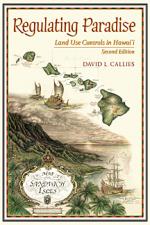
Regulatingparadise Professor Patricia E. Salkin (of the Law of the Land blog) has written this review of Professor David Callies’ Regulating Paradise: Land Use Controls in Hawaii (2d ed. 2010). The review is in the latest edition of the Urban Lawyer (43 Urb. Lawyer 1107 (2011)), the law review published by the ABA’s Section of State & Local Government Law.

Professor Salkin writes:

Unlike mainland states, the history of land ownership and regulation in Hawai’i—dating back to the mid 1800s—is unique and deeply rooted in centralized control both before and after the State became a territory. Callies explains how the State’s oft-studied 1961 land use law continued this trend, with zoning accomplished at the state level. He points out that from this strong tradition of centralized control, however, a new system of land use regulation has emerged with layers of county laws and the influence of myriad federal statutes and

Continue Reading Book Review: Callies, Regulating Paradise (2d ed. 2010)
In our law review article on Stop the Beach Renourishment, Inc. v. Fla. Dep’t of Environmental Protection, 103 S. Ct. 2592 (2010), we predicted that “the fractured opinions in the case will be a boon for academics who may continue the search for the ‘takings quark’ (if not woodchucks) in the pages of law journals.” Of Woodchucks and Prune Yards: A View of Judicial Takings From the Trenches, 35 Vt. L. Rev. 437 (2010).

It looks like our prediction is (thankfully) being borne out: earlier this week we posted a new article from the Stanford Law Review (here), and now comes another scholarly piece on the judicial takings issue, this time from the Cornell Law Review: Eduardo M. Penalver & Lior Jacob Strahilevitz, Judicial Takings or Due Process?, 97 Cornell L. Rev. 305 (2012) (pdf available here). Here’s the summary:

In Stop the Beach

Continue Reading New Article: Judicial Takings or Due Process? (Cornell Law Review)

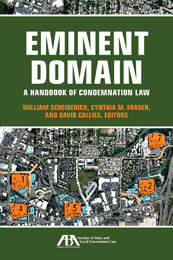
5330215_big To those who were able to join us this evening for the celebration of the publication of Eminent Domain – A Handbook of Condemnation Law, thank you.

The University of Hawaii Law School sponsored the reception, and it was good to see so many colleagues and friends in attendance. U.H. put the event together since Professor David Callies was one of the book’s editors, and six U.H. alums contributed chapters.

I was privileged to author two chapters (Prelitigation Process and Flooding & Erosion), and my Damon Key colleagues Mark Murakami and Christi-Anne Kudo Chock co-authored the chapter Damages Resulting from a Taking: An Overview.   

A complete Table of Contents is available here. This book is an overview of the law from folks who have been practicing in that area for a long, long time. It is intended as a “deskbook” — a quick and

Continue Reading Book Report: Eminent Domain – A Handbook of Condemnation Law

5330215_big Hold the date: on Tuesday, December 6, 2011, from 5:30 – 8:00 p.m., the University of Hawaii School of Law is sponsoring a reception at the Pacific Club, in Honolulu to celebrate the publication of Eminent Domain, a Handbook of Condemnation Law by the American Bar Association.

Since so many of the people who worked on the book are associated with the U.H. Law School (I authored two chapters, my Damon Key colleagues Mark Murakami and Christi-Anne Kudo Chock authored another, the appendix was authored by three Honolulu lawyers who are also alums, and Professor David Callies is one of our editors), the law school is being kind enough to throw a little party. It turned out it was just a happy coincidence that we were all associated with the project, and Professor Callies promises that he did not round up his former students to pitch in. 

The book, as

Continue Reading Book Reception: Eminent Domain – A Handbook of Condemnation Law (Honolulu, 12/6/2011)

ZPLR_11_2011Here’s an article I recently published in the Zoning and Planning Law Report, Recent Developments in Regulatory Takings Law: What Counts as “Property?”, 34 Zoning & Planning Law Report (Thomson | West 2011).

If you subscribe to ZPLR, look for it in the mail (and if you don’t, you should).

If you are not a subscriber (and again, you really should subscribe, ZPLR is one of the better ways, along with Gideon Kanner’s Just Compensation, to keep up with the latest goings-on), the good people at West provide this freebie, as authors are allowed to post their own articles on their web site. So here you go.

Thomas, Recent Developments in Regulatory Takings Law: What Counts as “Property?” 34 Zoning & Planning Law …

Continue Reading New Article: What Counts As “Property” In Regulatory Takings Law?

Cover_42_3_ The Urban Lawyer, the law review produced by the ABA Section of State & Local Goverment Law has published my article Recent Developments in Condemnation Law: Public Use, Private Property, 43 Urban Lawyer 877 (2011).

The article “summarizes recent cases in which the issue was the power of condemnors to take property, including challenges under the Public Use Clause, as well as other challenges on the power to take” (from the Introduction).

This volume of The Urban Lawyer contains this and other articles with updates on environmental law, regulatory takings, land use and zoning, and municipal bond financing. For those of you who are SLG Section members, your copy is undoubtedly in the mail, and the pdf version will soon be available on the Section’s web site. For those of you who are not Section members you get a freebie, at least of my article.

If you are

Continue Reading New Article – Recent Developments in Condemnation Law: Public Use, Private Property

Wade-front-page-small Thanks to the folks at the Environmental Law Institute, who have allowed us to reprint an article from a recent Environmental Law Reporter by William W. Wade, Ph.D., a resource economist with the firm Energy and Water Economics (Columbia, Tennessee). Bill is a frequent author and speaker on the Penn Central issue, and he’s brought much needed clarification to an often confusing issue.

In Sources of Regulatory Takings Economic Confusion Subsequent to Penn Central, Mr. Wade writes:

The Federal Circuit Cienega X decision imposes insufficient financial analysis of Penn Central’s two economic prongs to satisfy either economic practice or the Penn Central test. The decision’s imposed change in value measurement evaluates only one prong of the Penn Central test. Change in value satisfies the economic impact prong but does not establish severity of the economic impact vis-à-vis frustration of distinct investment-backed expectations (DIBE). Mere diminution is well-known

Continue Reading Article: Sources of Regulatory Takings Economic Confusion Subsequent to Penn Central

SLGN_cover_9_2011 The Fall edition of State & Local Law News features my article on the U.S. Supreme Court’s recent decisions in Carrigan and Guarnieri. From the Introduction: 

The U.S. Supreme Court decided two First Amendment cases this Term of special interest to attorneys practicing state and local government law. In Nevada Comm’n on Ethics v. Carrigan, the Court concluded Nevada’s Ethics in Government Law, which requires  elected and appointed government officials to recuse themselves from voting when they might have a conflict of interest, does not violate an official’s right to vote. By upholding Nevada’s ethics laws, the Court allowed state and local governments to continue to regulate the conflicts of interests of elected and appointed government officials and other government employees. In Borough of Duryea v. Guarnieri, the Court applied the long-standing balancing test applicable to government employee speech to government employee union grievances and held that

Continue Reading New Article: Local Govt and the First Amendment at the Supreme Court: Legislative Voting as “Speech” and Union Grievances as “Petitions”

5330215_big The American Bar Association’s Section of State & Local Government Law has just published a new book on eminent domain fundamentals: Eminent Domain – A Handbook of Condemnation Law (available for preorder here).

I was privileged to author two chapters (Prelitigation Process and Flooding & Erosion), and my Damon Key colleagues Mark Murakami and Christi-Anne Kudo Chock co-authored the chapter Damages Resulting from a Taking: An Overview.   

The price is $89.95 with the price of $69.95 for members of the Section of State and Local Government Law (discounts on books and CLE: another good reason to join the Section). There are also discounts for purchase of multiple copies. More details here.

Here’s what the book offers, from the Introduction by my colleague Dan Dalton:

Eminent domain has a long and distinguished legal history, dating from the first limits on sovereign power in the Magna

Continue Reading New Book: Eminent Domain – A Handbook of Condemnation Law (ABA 2011)