Skip to content

Sandefur

We’re starting off the new year with some eminent domain goodness. Tim Sandefur has published “Eminent Domain in the Constitutions of Arizona, Washington, and Other States,” 18 N.Y.U. J.L. & Liberty 167 (2024).

There’s a lot in the piece that will keep you reading, but what we found particularly insightful was how public use/purpose limitations “should operate in practice.” In our opinion, it’s fairly easy to say that the Fifth Amendment (and state constitutions) operate as a robust check on the sovereign power to take property for public use, but a lot more difficult to apply that broad notion to particular circumstances in a way that is both uniform and predictable. Right now, we seem to be operating on a know-it-when-I-see-it basis, but that doesn’t get us to a general rule. This piece goes a long way to getting us to a general rule.

Highly recommended.

Here’s the Abstract:

The nineteenth century was an extraordinarily prolific age of constitution-making. One of the greatest concerns of constitution-makers during this period—particularly in the western states—was the protection of private property against threats such as the use of eminent domain and the damage to property resulting from public works projects. This Article takes the eminent domain provisions of the Arizona and Washington constitutions as a point of departure to examine the innovative ways in which constitution-makers sought to limit government’s power to deprive people of their property. These constitutions—which until the admission of Alaska and Hawaii were the most up-to-date constitutions in America—contain four such innovations: (1) an explicit ban on takings for “private use,” reinforced by prohibitions on judicial deference regarding the definition of “public use”; (2) a compensation requirement for the “damaging” of property; (3) a requirement that payment precede a taking, and (4) a ban on deducting from just compensation awards the amount of purported “benefit” resulting from a taking. The Article traces the origins of these four protections, with reflections on how they should operate in practice.
Check it out

.
Continue Reading New Article: Timothy Sandefur, “Eminent Domain in the Constitutions of Arizona, Washington, and Other States,” 18 N.Y.U. J.L. & Liberty 167 (2024)

Screenshot 2024-12-30 at 10-16-00 Electricity-Caused Wildland Fires Costs Social Fairness and Proposed Solution

For those of you who follow the wildfire/inverse cases (centered in, although not exclusively, California and Hawaii), you might want to check out this article by a fire engineer: Vytenis Babrauskas (aka “Dr. Fire“), “Electricity-Caused Wildland Fires: Costs, Social Fairness, and Proposed Solution.”

As the title suggests, the article is an analysis of the situation, including the legal liability (see Section 5: “Tort Laws, Strict Liability, and Inverse Condemnation”). Dr. Babrauskas argues for abrogation of a lawsuit-based system, and replacement with a compensation scheme akin to worker’s comp.

Here’s the Abstract:

If electric power is distributed by an overhead network of cables, the ignition of wildland fires is unavoidable, although prudent management efforts can reduce the losses. The economic aspects of these fires are driven by tort litigation, which tends to create serious problems of social fairness. The present system does not contain adequate incentives

Continue Reading New Article: “Electricity-Caused Wildland Fires: Costs, Social Fairness, and Proposed Solution”

BKPRJ_13_cover

Screenshot 2024-12-23 at 08-18-04 Brigham-Kanner Property Rights Journal Volume 13 by William & Mary Law School

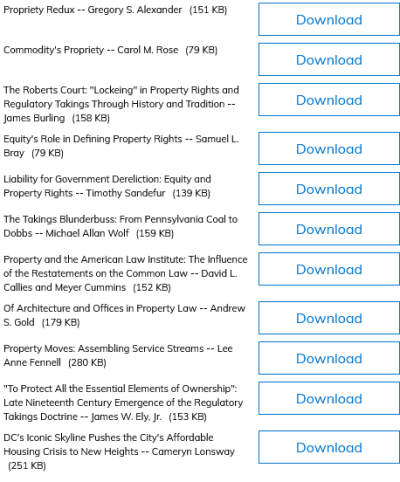
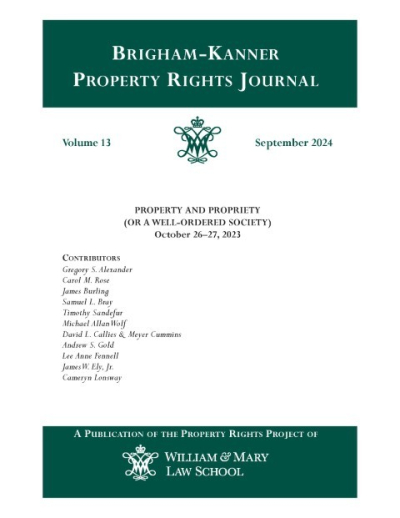
The latest edition of the Brigham-Kanner Property Rights Journal (William & Mary Law School) is out, with intriguing Dirt Law scholarship from the luminaries in the field.

Check out the Table of Contents above, and then go here to download each piece or the entire issue. We will note, with a small bit of pride, that two of the pieces were authored or co-authored by former students of ours (at W&M Law and the University of Hawaii Law School).

All of the pieces are must-reads.Continue Reading Volume 13 Brigham-Kanner Property Rights Journal Now Available

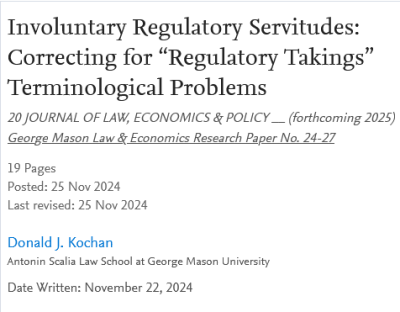
Screenshot 2024-12-09 at 16-13-02 Involuntary Regulatory Servitudes Correcting for “Regulatory Takings” Terminological Problems by Donald J. Kochan SSRN

Check this out, a new SSRN posting by lawprof Donald Kochan (George Mason/Scalia Law).

If this one is not a direct sequel to his earlier work on re-branding the “takings clause” (a piece we think is excellent and is part of the materials we teach in our Eminent Domain course at William and Mary Law), it does at least seem like a spiritual successor.

Here, Professor Kochan suggests that we’re being unclear when we use the term “regulatory takings” to describe those instances where an exercise of some governmental power other than eminent domain results in what feels like an eminent domain taking from the property owner’s viewpoint.

Instead, he argues, we should focus on the burdens the regulations place on an owner’s use (what the common law described as a servitude). To us, that seems very consistent with the Supreme Court’s approach, and proposals from other commentators. And it does focus the inquiry on the right question, namely what effect has a regulation put on an owner’s property rights. As that suggests, this should be a property-centric inquiry, and not on such unknowables such as the “character of the government action,” or whether an owner has “distinct investment-backed expectations.”

Here’s the Abstract:

This essay challenges the use of the term “regulatory takings” in our takings jurisprudence and scholarly discussion. The words we choose when developing doctrine matter. They can, even subconsciously, affect—by reducing, enlarging, distorting, limiting, or accurately shaping—the perceived and functional quality and character of the things they describe.

The better way to frame the inquiry underlying what is often called regulatory takings law should be to determine not whether there is a “regulatory taking” – some special kind of taking – but instead whether there is a regulation that amounts to a taking. Segmenting the judicial treatment of regulatory effects into a specialized analysis that takes it farther and farther away from an enterprise focused on equivalency between the private law of voluntary servitudes and the public law of what we should be calling involuntary regulatory servitudes. Regulations that restrict some but not all sticks in the property rights bundle should be characterized as the involuntary equivalent of the voluntary instrument, mechanism, or transfer that would have been necessary to achieve a parallel result. The essay proposes an alternative test for determining whether a regulation should be deemed a taking based on a comparison between the effect on the bundle from the regulation and determining whether the same effect in the private marketplace would have required a consensual, mutually beneficial exchange with appropriate compensation. This would better serve the meaning and purposes of the so-called Takings Clause.

The essay also documents the usage history of the regulatory takings label. To be sure, “regulatory takings” was not a dominate part of the takings lexicon before 1981. The first law review publication available in Westlaw to use the term “regulatory takings” is from 1965. The first court opinion to use the term came in a footnote in 1977. Briefing in advance of the 1980 U.S. Supreme Court decision in Agins v. Tiburon involved significant invocations of “regulatory takings” language across nearly a dozen briefs. But, the U.S. Supreme Court in its Agins opinion never uses the phrase “regulatory takings.” The first major court opinion to use “regulatory takings” language is the dissenting opinion by Justice William Brennan—joined by Justices Stewart, Marshall, and Powell—in the 1981 case of San Diego Gas & Elec. Co. v. City of San Diego. And, the Brennan dissent may have entrenched the term in the takings lexicon and is likely the impetus for widespread adoption of the term after 1981.

A must-read for all you takings…uh, dirt law…mavens.
Continue Reading New Article (Donald Kochan): “Involuntary Regulatory Servitudes: Correcting for ‘Regulatory Takings’ Terminological Problems”

Here are the cases and other materials we discussed in today’s Section of State & Local Government Law Land Use group meeting on takings:


Continue Reading Links From Today’s ABA Land Use Session

PXL_20241111_181016079.MP

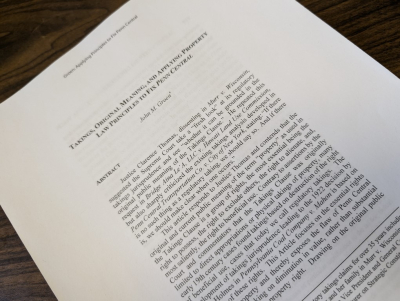
Today’s must-read, a (very) recent article by our Pacific Legal Foundation colleague John Groen, published in the Touro Law Review, “Takings, Original Meaning, and Applying Property Law Principles to Fix Penn Central.”

Get the pdf here.

With a title like that, who could resist? Here’s the Abstract:

Justice Clarence Thomas, dissenting in Murr v. Wisconsin, suggested the Supreme Court take a “fresh look” at its regulatory takings jurisprudence and see “whether it can be grounded in the original public meaning of the Takings Clause.” He repeated this request in Bridge Aina Le’A, LLC v. Hawaii Land Use Commission, but also sharply criticized the existing takings analysis developed in Penn Central Transportation Co. v. City of New York, stating: “If there is no such thing as a regulatory taking, we should say so. And if there is, we should make clear when one occurs.”

Continue Reading New Law Review Article: John Groen, “Takings, Original Meaning, and Applying Property Law Principles to Fix Penn Central,” 39 Touro L. Rev. 973 (2024)

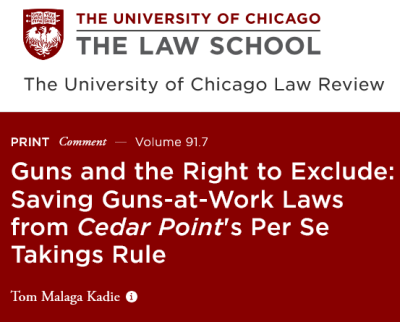
Screenshot 2024-11-04 at 07-50-41 Guns and the Right to Exclude Saving Guns-at-Work Laws from Cedar Point's Per Se Takings Rule The University of Chicago Law Review

The latest issue of the University of Chicago Law Review has this student-authored piece that is worth your time reading. “Guns and the Right to Exclude: Saving Guns-at-Work Laws from Cedar Point‘s Per Se Takings Rule,” 91 U. Chi. L. Rev. 2047 (2024). 

Here’s the Abstract:

The Supreme Court’s decision in Cedar Point Nursery v. Hassid has left considerable uncertainty in the realm of takings law. In Cedar Point, the Court announced a new rule that government-authorized physical occupations of property, even temporary ones, constitute per se takings. But the Cedar Point decision left significant questions unresolved regarding the scope of its per se takings rule and its various exceptions.

To resolve these questions, this Comment looks to the example of guns-at-work laws. Enacted by about half of the states, guns-at-work laws protect the right of a business’s employees, customers, and invitees to store firearms in

Continue Reading New U Chi L Rev Article (Comment): “Guns and the Right to Exclude: Saving Guns-at-Work Laws from Cedar Point‘s Per Se Takings Rule”

Screenshot 2024-10-25 at 13-19-32 Housing and Exactions The Next Frontiers After Sheetz Pacific Legal Foundation

Our outfit (Pacific Legal Foundation) has put out a call for papers. on the topic of land use exactions and housing law. Honorarium included for accepted papers, and there will be a workshop to follow.

Here’s the description:

This workshop seeks to build on the result of Sheetz v. County of El Dorado and chart the course of the next steps in exactions/unconstitutional-conditions law. From Nollan v. California Coastal Commission, through Dolan v. City of Tigard and Koontz v. St. John’s River Water Management District, and now including Sheetz, the Supreme Court has looked to the doctrine of exactions and unconstitutional conditions to ensure property rights are protected. In doing so, it has created a constitutional bulwark protecting the right to build housing on private property, an important stick in the property rights bundle.

The Supreme Court’s unanimous decision in Sheetz held that legislatively-imposed development-fee schedules are

Continue Reading Call For Papers: “Housing and Exactions: The Next Frontiers After Sheetz“

Screenshot 2024-10-24 at 12-28-24 Vacancy Taxes A Possible Taking The University of Chicago Law Review

A new student-authored journal article worth reading, Christine Dong, “Vacancy Taxes: A Possible Taking?,” 91 U. Chi. L. Rev. 1725 (2024).

Here’s the Abstract:

Vacancy taxes are an increasingly popular solution to the paradoxical problem of high housing demand coupled with high vacancy. Cities across the country facing housing shortages have either implemented or are considering adopting vacancy taxes to encourage property owners to rent or sell their property. Soon after San Francisco adopted a vacancy tax with one of the broadest definitions of vacancy, property owners lobbed a constitutional challenge under the Takings Clause, taking advantage of a moment of doctrinal instability.

This Comment seeks to make sense of how this and similar potential challenges would fare, given an expanding, property-protective takings doctrine, but a high constitutional tolerance for taxes. Using the San Francisco vacancy tax as a concrete example, this Comment evaluates possible arguments that the

Continue Reading New Article (Comment): “Vacancy Taxes: A Possible Taking?” (U. Chi. L. Rev.)

Today we have a guest post by New York colleague Jennifer Polovetsky, who writes about the intersection of administrative law (Chevron deference) and public use in eminent domain.Thanks to Jennifer (and to the New York Law Journal) for allowing us to republish her intriguing piece.

_____________________________

Is Judicial Deference to Government Agency Decisions in Eminent Domain Cases at Risk?

by Jennifer Polovetsky

Since 1984, when the U.S. Supreme Court decided the Chevron U.S.A., v. Natural Resources Defense Council case, it has been well-settled law that the judiciary must defer to agency determinations in connection with the interpretation of a statute when the law was ambiguous or unclear (so long as the agency’s interpretation was reasonable and not arbitrary or capricious). See Chevron, 468 U.S. 837 (1984). The Chevron standard has been applied across the board in many legal cases since then.

On June 28, 2024, however, SCOTUS overruled Chevron


Continue Reading Guest Post (Jennifer Polovetsky): “Is Judicial Deference to Government Agency Decisions in Eminent Domain Cases at Risk?”