Screenshot 2024-09-06 at 09-20-48 The Benefits of the Fourth Amendment's Property-Rights Baseline by Nicholas Alden Kahn-Fogel SSRN

Regular readers know that in addition to our focus on Fifth Amendment property rights, we’re also looking at the Fourth Amendment as a vehicle that protects and promotes property rights.

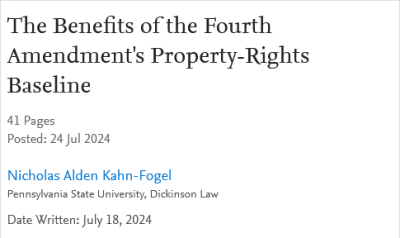
In that vein, here’s a forthcoming article that is worth reading,”The Benefits of the Fourth Amendment’s Property-Rights Baseline,” by lawprof Nicholas Alden Kahn-Fogel.

Here’s the Abstract:

Since 2012, Fourth Amendment claimants have had two alternative doctrinal tests available to establish that government investigative activity constitutes a Fourth Amendment search implicating their rights. First, if the government physically intrudes onto a person, house, paper, or effect to gather information, its conduct is a search, even if the claimant had no reasonable expectation of privacy against the government intrusion. The Court has referred to this directive as the “property-rights baseline.” Second, even in the absence of a physical intrusion onto a constitutionally protected area, if government surveillance infringes a person’s

Continue Reading New Article: “The Benefits of the Fourth Amendment’s Property-Rights Baseline”
81XRFQ5ONQL._SL1500_

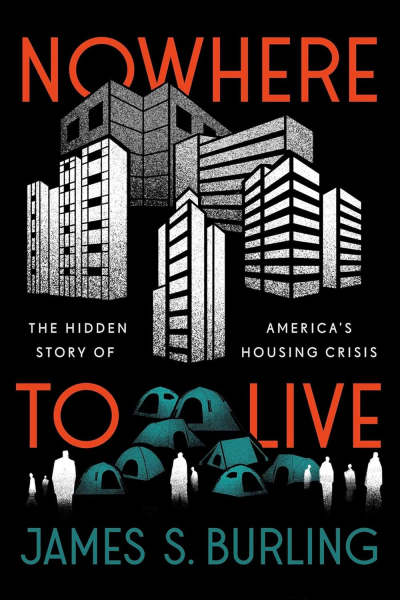
If you are in the California Southland (or plan to be in the next week), please be sure to reserve on your calendar Tuesday, August 13, 2024, to join us in-person for the launch of our colleague Jim Burling‘s forthcoming book, “Nowhere to Live: The Hidden Story of America’s Housing Crisis.”

Here’s a blurb about the book, which is available for preorder on Amazon:

A century of policy mistakes ruined America’s cities and created an unprecedented housing crisis.   
 
For many families, homelessness is no longer someone else’s problem. It is right around the corner, a real threat in their own immediate future. Our housing crisis is the result of a long history of government policies, court cases, and political manipulation. While these disparate causes make up a tangled web, they have one surprising root: the attack on private property rights. For more than

Continue Reading Book Launch Event, Aug 13, 2024: Jim Burling, “Nowhere to Live: The Hidden Story of America’s Housing Crisis”

Screenshot 2024-07-31 at 17-33-40 The End of Means-End Scrutiny by Francesca Procaccini SSRN

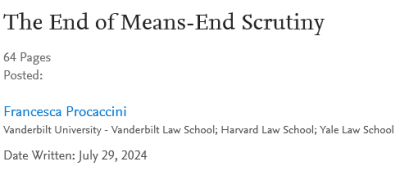
Here’s an article worth reading, just posted to SSRN, Procaccini, The End of Means-End Scrutiny (July 29, 2024).

For your takings and individual liberty nerds, please focus on pages 36-38 (showing how takings analysis is not accomplished by the usual means-ends scrutiny), pages 40-42 (social and economic liberties), and pages 43-44 (searches and seizure).

Why move from means-ends scrutiny to more robust judicial review? Zero in on pages 50-52 (“Transforming Rights from Mediated Interests to Uncompromising Trumps”). We’re thinking the author concludes this move is a bad thing, but we’re not so sure it is.

Here’s the Abstract:

It is black letter law that courts apply means-end scrutiny to evaluate laws that burden constitutional rights. Not anymore. Discreetly and pervasively, this Supreme Court has ousted means-end scrutiny from constitutional law. It has done so through a series of smaller and seemingly unconnected doctrinal incursions, including the introduction of history and

Continue Reading New Article: “The Ends of Means-Ends Scrutiny”

Screenshot 2024-07-14 at 09-00-18 Sheetz v. County of El Dorado Legislatures Must Comply with the Takings Clause by Brian T. Hodges Deborah La Fetra SSRN

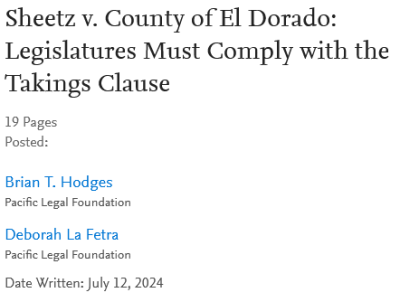
Check this out: our Pacific Legal Foundation colleagues (Brian Hodges and Deborah La Fetra we on our Sheetz SCOTUS team), have posted a new scholarly piece on SSRN, “Sheetz v. County of El Dorado: Legislatures Must Comply with the Takings Clause.”

Here’s the Abstract:

For more than 30 years, the Supreme Court has recognized that building permit conditions requiring a dedication of property to the public implicate the Fifth Amendment’s Takings Clause and are therefore subject to the unconstitutional conditions doctrine as set out by Nollan v. California Coastal Commission, 483 U.S. 825 (1987), and Dolan v. City of Tigard, 512 U.S. 374 (1994). But for nearly as long as the Nollan/Dolan doctrine has been in place, state and lower federal courts have divided on the foundational question of whether the doctrine applies equally to all branches of government, or if it applies only to administrative

Continue Reading New Article – “Sheetz v. County of El Dorado: Legislatures Must Comply with the Takings Clause” (Brian Hodges & Deb La Fetra)

Worth reading: a student-authored piece in the latest issue of the Harvard Journal of Law & Public Policy, “Original Understanding of ‘Background Principles’ in Cedar Point Nursery v. Hassid.

From the Introduction:

But in Cedar Point, when considering a regulation that authorized union organizers to enter certain businesses, the Court held that even a temporary physical occupation was a per se taking requiring compensation.

The Court’s shift to a per se rule is significant because it means a landowner can receive “just compensation” without satisfying Penn Central’s high bar required for regulatory takings. For governments, the Cedar Point holding could pose a heavy financial burden if they must compensate landowners for temporary intrusions authorized under existing regulations. Due to this imposing financial burden, some have suggested that Cedar Point threatens existing civil rights regimes, which at first blush resemble the labor rights regulation at

Continue Reading New Article: “Original Understanding of ‘Background Principles’ in Cedar Point Nursery v. Hassid“

BetterCoastalCommnReportCover

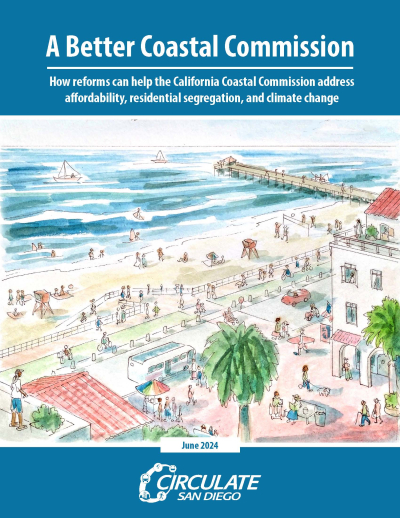
The California Coastal Commission is infamous for being the most out-of-control governmental agency in the nation. This regulatory leviathan fancies itself the undisputed czar of land use and other activities in its fiefdom, the California coastal zone.

Created in 1976 as an agency with regulatory authority across California’s 1,000+ miles of coast (and land in a defined shoreward zone), it has since expanded to its current role as a government-outside-the-government, whose main role it often seems is more about wielding an iron fist over anything that happens in the coastal area, than protecting coastal access and resources while also respecting property rights as its governing statutes require.

The Commission has been blessed with procedures that appear insanely unfair to anyone not familiar with how things work in California. For example, any two Commissioners may file an administrative appeal of a municipalilty granting a development permit to get it

Continue Reading Can The California Coastal Commission Be Reined In?

GPElXhCWkAA3bWK

Here’s the abstract:

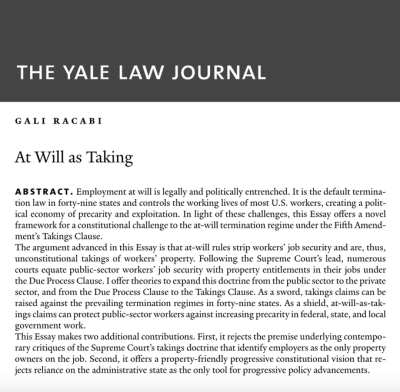
Employment at will is legally and politically entrenched. It is the default termination law in forty-nine states and controls the working lives of most U.S. workers, creating a political economy of precarity and exploitation. In light of these challenges, this Essay offers a novel framework for a constitutional challenge to the at-will termination regime under the Fifth Amendment’s Takings Clause.

The argument advanced in this Essay is that at-will rules strip workers’ job security and are, thus, unconstitutional takings of workers’ property. Following the Supreme Court’s lead, numerous courts equate public-sector workers’ job security with property entitlements in their jobs under the Due Process Clause. I offer theories to expand this doctrine from the public sector to the private sector, and from the Due Process Clause to the Takings Clause. As a sword, takings claims can be raised against the prevailing termination regimes in forty-nine states. As

Continue Reading New Article: “At Will [Employment] as Taking,” 133 Yale L.J. 2165 (2024)

Screenshot 2024-04-09 at 12-04-36 https __pd.pacificlegal.org (Small)

Have thoughts about where regulatory takings are (or should be) headed? Here’s your chance to get in on the conversation, and to shape the future of the law.

Our outfit, the Pacific Legal Foundation, in cooperation with the Antonin Scalia Law School’s Journal of Law, Economics, and Policy, are calling for papers on “Imagining the Future of Regulatory Takings.” There will be an in-person discussion of these papers at the Law School in October 2024.

Here’s the full description:

A century ago, Oliver Wendell Holmes, speaking for the Supreme Court, assured us that “[t]he general rule at least is that while property may be regulated to a certain extent, if regulation goes too far it will be recognized as a taking.” In the ensuing one hundred years, courts have struggled to draw the line defining “too far.” Some still wonder whether such a line should even exist. As Justice

Continue Reading Commit To Submit: Call For Papers “Imagining the Future of Regulatory Takings”

Here’s what we’re reading today:


Continue Reading Thursday Round Up: Pretextual Takings, Squatting, Unconstitutional Conditions

Untitled Extract Pages (Medium)

Check this out. Friend and colleague Steve Davis has authored “Eminent Domain, the Fifth Amendment Takings Clause, and the Rule of Law,” 88 Social Education J. 1 (2024).

As summarized on the Federal Takings blog:

Steve explains the rights guaranteed by the Fifth Amendment to the Constitution and focuses on its critically-important (but lesser-known and appreciated) right to compensation when the government takes its citizens’ private property for public use. The article offers a primer on eminent domain history and abuse, from the application of the Takings Clause to the states to the Kelo decision. Steve goes on to present current, real-life issues before the Supreme Court that affect every-day Americans and explains their background and importance.

The article concludes, “the Fifth Amendment’s essential constraints on the government’s extraordinary and easily-abused power of eminent domain remains as important today as it has over centuries—truly a fundamental piece

Continue Reading New Article: “Eminent Domain, the Fifth Amendment Takings Clause, and the Rule of Law” (Steve Davis, Social Education Journal)