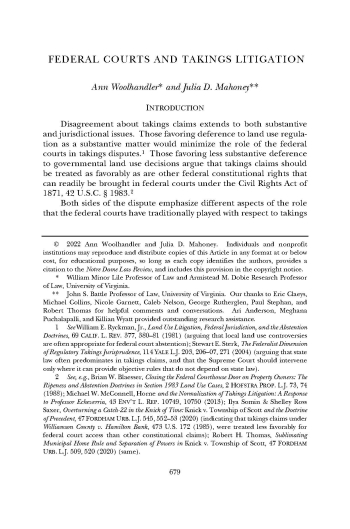
FedCtsTakingsArticlepage1

A new article on takings from U. Virginia Law School profs Ann Woolhandler and Julia Mahoney in the Notre Dame Law Review, “Federal Courts and Takings Litigation.” Get the pdf here.

Rather than try and summarize the piece, we’re just going to cut-and-paste the highlights from the article’s Introduction:

While Knick clearly expands the lower federal court role in takings claims, many questions remain. We do not know how federal courts will respond to the increase in claims—whether they will embrace a robust federal role in land use cases, or use various abstention doctrines to rein them in. While pro-regulatory and pro-property rights scholars have predictably taken sharply contrasting positions as to the appropriate federal court role post-Knick, this Article will recommend a middle-of-the-road approach, based partly on history and partly on an assessment of where the lower federal courts may most usefully contribute to the

Continue Reading New Article: Woolhandler & Mahoney, Federal Courts and Takings Litigation, 97 Notre Dame L. Rev. 679 (2022)

Screenshot 2022-02-15 at 07-42-11 Eminent Domain Reports - Publications IRWA

Check this out: the International Right of Way Association’s Real Estate Law Committee produces twice-a-year reports “which contain summaries of eminent domain decisions and legislation within the United States.” (This is the “international” right of way association, so that last qualifier is important.)

And what is really nice is that they make the report available

We’re posting it here because we’re one of the co-authors. The laboring oars on this are really Brad Kuhn and Jullian Friess Leivas (both from the Nossaman firm), but they were kind enough to ask me for some input.

Brad and Jillian wrote up more at the California Eminent Domain Report.

The report is short, and doesn’t have a lot of fluff. Just what you wanted.Continue Reading IRWA’s Summary Of Major Eminent Domain Cases & Legislation (June-Dec 2021)

Screenshot 2022-01-24 at 11-03-28 “Equitable Compensation” as “Just Compensation” for Takings

An article, from the just-published issue of the Brigham-Kanner Property Rights Journal, about a rarely-covered academic topic, just compensation.

Brian A. Lee (Brooklyn), “Equitable Compensation” as “Just Compensation” for Takings, 10 Brigham-Kanner Prop. Rts. J. 315 (2021).

Here’s the Abstract:

The Fifth Amendment’s requirement that the government pay “just compensation” to owners of taken property is typically assumed to mean “full” compensation, equivalent to the taken property’s fair market value. In this symposium contribution to the Brigham-Kanner Property Rights Journal, I explore an often overlooked alternative understanding of “just compensation” for takings, one freed from automatic equation with full, fair-market-value compensation. Rooted in traditional equity, this “equitable compensation” alternative has significant historical roots, starting with the Fifth Amendment’s drafters’ striking choice not to follow the Northwest Ordinance of 1787’s requirement of “full” compensation, and running through a line of cases and commentary that has emphasized takings compensation’s equitable

Continue Reading New Article: “‘Equitable Compensation’ as ‘Just Compensation’ for Takings” (Brigham-Kanner Property Rights Journal)

If you ever get the opportunity to teach in a law school — either as a full-time legal scholar, or part-time as an expert adjunct practitioner — take it if you can. You might think you know a lot about a particular subject, but there’s nothing like spending time at the lectern in a law classroom in front of sharp and eager lawyers-in-training to sharpen your thoughts, and get you to truly understand a subject.

And folks calling you “professor” can evoke a smile.

Sensei

But if there’s one downside to the law school experience from the teacher’s side of the lectern, it’s grading. Especially at a law school like William and Mary that has a pretty strict mandatory curve. In upper-division courses that we handle like Eminent Domain and Property Rights Law and Land Use — where we’re dealing with some very high-level stuff and the quality of the

Continue Reading The Circle Is Now Complete: A Sampling Of Final Paper Topics From William and Mary Law’s Eminent Domain & Property Rights, And Land Use Courses

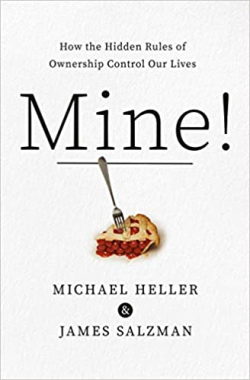
Minebook

We’ve talked about the “playground constitution” before (and written about it). You know this stuff:

The third constitution is what has been labeled the “popular constitution” that exists, unwritten, in the broader culture. I call this the “playground constitution,” embodying rules that a broad swath of the populace believes are part of the legal canon, and which often contain a grain of accuracy but do not capture the nuance of the actual legal rules. For example, “finders keepers, losers weepers,” and possession being “nine-tenths of the law.”

You snooze, you lose. Whomever smelt it, dealt it. Come on, you have surely experienced it. Even you law mavens have, right? There’s all sorts of levels of this stuff, from clients who just “know” that the law says something (when in reality it doesn’t – they can’t take my property!), or judges who assume that a land

Continue Reading What We’re Reading: “Mine! How the Hidden Rules of Ownership Control Our Lives”

PASH symposium

Back in February, we were honored to be part of the University of Hawaii Law Review’s symposium “25 Years of PASH,” a retrospective of one of the Hawaii Supreme Court’s most famous (or infamous) decisions, Pub. Access Shoreline Haw. v. Haw. Cnty. Plan. Comm’n, 79 Haw. 425, 903 P.2d 1246 (1993), cert. denied sub nom., Nansay Haw. v. Pub. Access Shoreline Haw., 517 U.S. 1163 (1996) (PASH).

At the conference, we spoke on the panel about “PASH and the Changing Coastal Environment” (see video here at the 2:02:25 mark if you want to watch our panel’s summations). The Law Review has now published the symposium, and here’s our contribution, Takings PASH and the Changing Coastal Environment, 43 U. Haw. L. Rev. 525 (2021).

For those of you not totally tuned in, in the PASH case the Hawaii Supreme Court

Continue Reading New Article: “Takings, PASH, and the Changing Coastal Environment,” 43 U. Haw. L. Rev. 525 (2021)

Here’s a new law journal article, just published, which we recommend everyone read.

Michael M. Berger, “Whither Regulatory Takings,” 51 Urban Lawyer 171 (2021). Available online here.

If you need encouragement to read it, here’s a sample:

The thrust of this article is severalfold. First, Holmes was right. His simple conclusion on behalf of eight Justices encapsulated the crux of modern government: while government needs to be able to regulate, zealous regulators can “go too far” and, when they do, regulation becomes a taking. The Constitution drew a line in the sand that may not be crossed without consequences. Second, a cautious Supreme Court thereafter left the Holmesian standard intact and nibbled around the edges, adding alternative descriptors that confused and confounded the situation. Third, the solution to the problem of how to define a regulatory taking lies in the simplicity of the common law. One of

Continue Reading New Article (Must-Read): Michael Berger, “Whither Regulatory Takings”

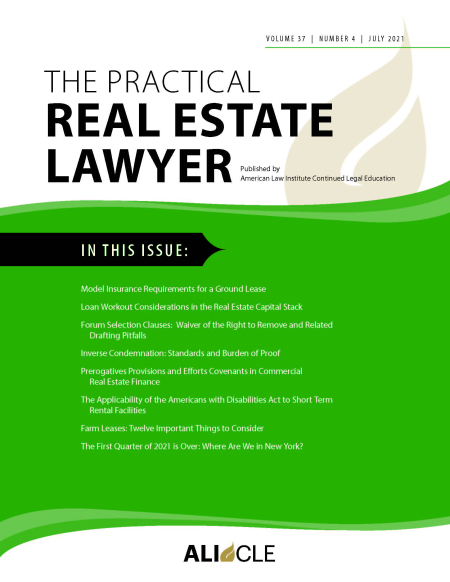
Untitled Extract Pages

Worth reading: an article in ALI-CLE’s Practical Real Estate Lawyer, authored by our friends and colleagues Steve Clarke, Justin Hodge, Jeremy P. Hopkins, and Christian Torgrimson, “Inverse Condemnation: Standards and Burden of Proof.”

A subscription to PREL costs, but for this issue the good people at ALI have made it available for free. Lucky you. But you really should get a subscription — PREL publishes useful articles like this frequently.

And since we’re on the subject of ALI-CLE, we can’t resist reminding you that registration for the 2022 ALI-CLE Eminent Domain & Land Valuation Litigation Conference is underway (including reservations for the limited room block at the Scottsdale Resort). Please register and make your plans to join your colleagues (including the authors of the article!) in January in Scottsdale.Continue Reading New Article: “Inverse Condemnation: Standards and Burden of Proof” (ALI-CLE Practical Real Estate Lawyer)

Screenshot 2021-08-08 at 23-55-14 The Dawn of a Judicial Takings Doctrine em Stop the Beach Renourishment  Inc v Florida De[...]

Here’s what we’re reading today, a recently-published law review article by Brendan Mackesey, The Dawn of a Judicial Takings Doctrine: Stop the Beach Renourishment, Inc. v. Florida Department of Environmental Protection, 75 U. Miami L. Rev. 798 (2021). 

Here’s the Abstract:

In Stop the Beach Renourishment v. Florida Department of Environmental Protection, 130 S. Ct. 2592 (2010), the U.S. Supreme Court granted certiorari to determine whether the Florida Supreme Court had violated a group of littoral property owners’ Fifth Amendment rights—or committed a “judicial taking”—by upholding the state of Florida’s Beach and Shore Preservation Act. Under the Act, the State is entitled to ownership of previously submerged land it restores as beach; this is true even though the normal private/state property line, the mean-high water line, is moved seaward, and the affected littoral owner(s) lose their right to have their property about the water. Although a four-justice plurality

Continue Reading New L Rev Article: “The Dawn of a Judicial Takings Doctrine: Stop the Beach Renourishment v. Florida Department of Environmental Protection,” 75 U. Miami L. Rev. 798 (2021)

Untitled Extract Pages

Here’s what we’re reading today. And this is one of those articles that you should not miss.

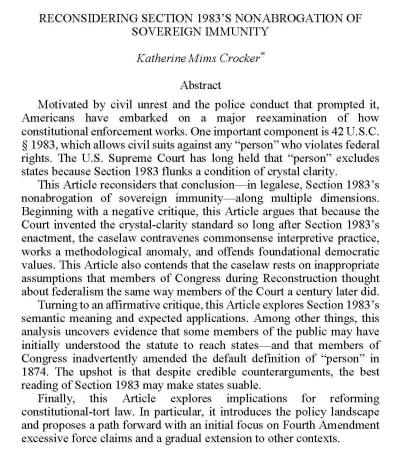
Our W&M colleague Katherine Mims Crocker has published “Reconsidering Section 1983’s Nonabrogation of Sovereign Immunity,” 73 Fla. L. Rev. 523 (2021).

Why is this a “must read” you ask? Because Professor Crocker concludes, “[t]he preceding Parts have revealed substantial arguments for reading Section 1983 to abrogate sovereign immunity, which would make state governments susceptible to damages actions for violating constitutional rights.”

There’s not a mention of our friend the Takings Clause in the article (it focuses mostly on excessive force cases), but it doesn’t take much to see how the analysis Prof Crocker sets out can include section 1983 takings claims.

Here’s the Abstract:

Motivated by civil unrest and the police conduct that prompted it, Americans have embarked on a major reexamination of how constitutional enforcement works. One important component is

Continue Reading New Must-Read Article: Katherine M. Crocker, “Reconsidering Section 1983’s Nonabrogation of Sovereign Immunity,” 73 Fla. L. Rev. 523 (2021)