IRWA header

The International Right of Way Association‘s Real Estate Law Committee produces twice-a-year reports “which contain summaries of eminent domain decisions and legislation within the United States.”

And what is really nice is that they make the report available.

Here’s the latest.

We’re posting it here because we’re one of the co-authors. Hat tip to our co-authors Brad Kuhn, Jillian Friess Leivas, and Ajay Gajaria.

The report is short, and doesn’t contain a lot of fluff. Just what you wanted.Continue Reading IRWA’s Summary Of Major Eminent Domain Cases & Legislation (June-Dec 2022)
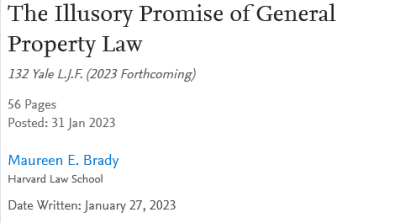
Screenshot 2023-02-13 at 15-12-42 The Illusory Promise of General Property Law

Check this out, a new piece by lawprof Molly Brady, “The Illusory Promise of General Property Law,” 132 Yale. L.J.F. (2023 forthcoming).

If the title alone isn’t enough to grab you, here’s the abstract:

In The Fourth Amendment and General Law, Danielle D’Onfro and Daniel Epps endorse an approach to the Fourth Amendment that defines the scope of protection largely by reference to “general property law”—uniform principles of trespass, abandonment, and so forth—discerned from and informed by the customs and rules of multiple jurisdictions. While their approach attractively reasons from useful common-law and private-law concepts, the specific general-law model they outline has both unresolved internal puzzles and unaddressed external effects.

In this Response, I probe this vision of “general law,” which has the potential to be more open-ended and unconstrained than the general law as it has previously been understood. Even if it did more closely resemble traditional general law, a court’s resort to making general law in a particular context is typically justified by some federal interest or power meriting the application of uniform rules. The authors do not satisfactorily explain that need here, especially given traditional deference to positive state law—and the desirability of some variation reflecting local conditions and expertise—in matters involving property questions in other areas of constitutional law. Further, in justifying reliance on the general law, the authors over-sell its determinacy and stability vis-à-vis existing Fourth Amendment law, which assesses whether an individual’s “reasonable expectations of privacy” have been violated. Given the vagaries of some common-law standards and the breadth of the sources of general law, courts will still be faced with unclear choices within and among them. The general-law approach does not offer guidance on resolving these conflicts and uncertainties, dooming it to the same indeterminacy.

To illustrate with specific examples, I turn to a doctrinal area where the pitfalls of general law—and specifically, general property law—can already be observed: in recent decisions under the Takings Clause of the Fifth Amendment. Decisions interpreting the Takings Clause traditionally “emphasiz[ed] the role of nonconstitutional state property law in defining both what counts as constitutional property and in measuring whether a taking has occurred.” The presumption of deference to state-specific property principles was grounded in a belief that property is an inherently local matter and that different states might opt to recognize and regulate property interests differently. However, two Supreme Court decisions within the last five years—Murr v. Wisconsin and Cedar Point Nursery v. Hassid—have unsettled that longstanding tradition with troubling effects. Takings law also teaches that decisions by courts in federal constitutional cases can influence the direction of nonconstitutional state private law, even though that result is not compelled.

There is an approach that would carry some of the benefits of the general-law model while leaving most of the development of property law to the states. In articles covering the Due Process and Takings clauses, Thomas Merrill has advocated for a “patterning definition” of constitutional property—a set of federal criteria that are met (or not) by the characteristics an interest has under nonconstitutional state law. The idea behind patterning is to provide a baseline, uniform constitutional standard across the states—one of the key purported advantages of the general-law model over the positive-law one—without having courts make a confusing national law of property specific for federal purposes. While private law can helpfully frame and elucidate Fourth Amendment problems, the general-law model offers limited promise for the development of Fourth Amendment doctrine while posing unwarranted risks for the viability of variable state property law.

Get it from SSRN here

.
Continue Reading New Article: Maureeen Brady, “The Illusory Promise of General Property Law”

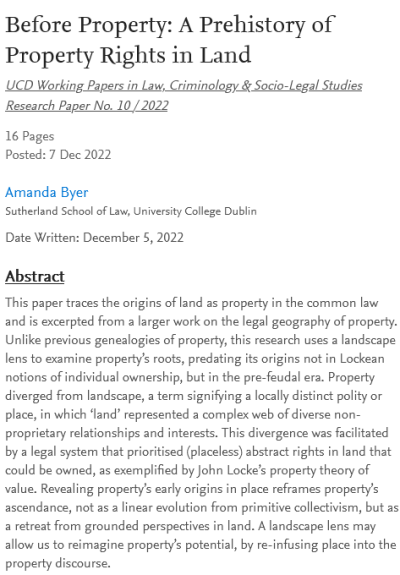
Screenshot 2022-12-28 at 08-32-49 Before Property A Prehistory of Property Rights in Land

We can’t claim to fully understand it (it’s full of words and phrases that frighten and confuse us), but we nonetheless commend to you a recent piece by lawprof Amanda Byer (University College Dublin), “Before Property: A Prehistory of Property Rights in Land.”

Here’s the Abstract:

This paper traces the origins of land as property in the common law and is excerpted from a larger work on the legal geography of property. Unlike previous genealogies of property, this research uses a landscape lens to examine property’s roots, predating its origins not in Lockean notions of individual ownership, but in the pre-feudal era. Property diverged from landscape, a term signifying a locally distinct polity or place, in which ‘land’ represented a complex web of diverse non-proprietary relationships and interests. This divergence was facilitated by a legal system that prioritised (placeless) abstract rights in land that could be owned, as

Continue Reading New Article: “Before Property: A Prehistory of Property Rights in Land”

Here’s your must-read for today, the latest journal article from Michael Berger, “Theft, Extortion, and the Constitution: Land Use Practice Needs an Ethical Infusion,” 38 Touro L. Rev. 755 (2022).

Here’s the Abstract:

There are many ways in which property owners/developers interact with regulators. To the extent that texts and articles deal with the ethical duties of the regulators, they tend to focus on things like conflicts of interest. But there is more. This article will examine numerous other ways in which regulators may run afoul of ethical practice in dealing with those whom they regulate.

And if that isn’t enough to grab you, there’s this:

There may be more to the issue than how to act in narrow circumstances. For one thing, there is the idea that government and the governed need to deal with each other on a level playing field. As one court put

Continue Reading New Article: “Theft, Extortion, and the Constitution: Land Use Practice Needs an Ethical Infusion” (Michael Berger)

Due to our 808 roots, we’ve been fielding a lot of questions related to the ongoing eruption of Mauna Loa on the Big Island.

It’s big, it’s spectacular (see video above), and (for us) it’s law.

The questions (who owns “accreted” lava?, how does the NPS let the public out to see this?, what uses can be made of property covered by lava?) made us realize that we had addressed some of those issues in prior posts. So we’re reposting:

Hope you find useful these things that make Hawaii property law pretty interesting at times.Continue Reading Law Of The Lava – Who Owns New “Accreted” Land? (And Other Questions)

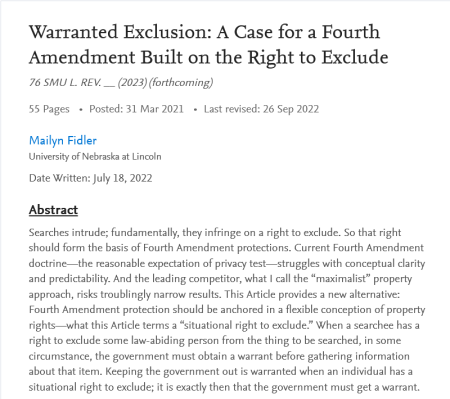
Screenshot 2022-10-02 at 19-57-06 Warranted Exclusion A Case for a Fourth Amendment Built on the Right to Exclude

Check this out: a new article from lawprof Mailyn Fidler (U Nebraska SOL), “Warranted Exclusion: A Case for a Fourth Amendment Built on the Right to Exclude,” 76 SMU L. Rev. ___ (2023) (forthcoming).

The Abstract:

Searches intrude; fundamentally, they infringe on a right to exclude. So that right should form the basis of Fourth Amendment protections. Current Fourth Amendment doctrine—the reasonable expectation of privacy test—struggles with conceptual clarity and predictability. And the leading competitor, what I call the “maximalist” property approach, risks troublingly narrow results. This Article provides a new alternative: Fourth Amendment protection should be anchored in a flexible conception of property rights—what this Article terms a “situational right to exclude.” When a searchee has a right to exclude some law-abiding person from the thing to be searched, in some circumstance, the government must obtain a warrant before gathering information about that item. Keeping the government

Continue Reading New Article: “Warranted Exclusion: A Case for a Fouth Amendment Built on the Right to Exclude”

Screenshot 2022-09-11 at 21-59-15 Northwestern University Law Review Vol 117 Iss 1

Be sure to check out Northwestern Law Review’s symposium issue on “Reimagining Property Rights in the Era of Inequality.” which brought together “scholars of legal history, property, tax, land use, fair housing, environmental law, natural resources and water rights, family law, education, and constitutional law, to highlight new scholarship at the intersection of these fields.”

We found the essay by Professor Fennell (“Streamlining Property,” and the essay by Timothy Mulvaney (“Compulsory Terms in Property“) to be of particular interest. Full list of essays above, or here.Continue Reading New Symposium: Northwestern L. Rev.’s Property Issue

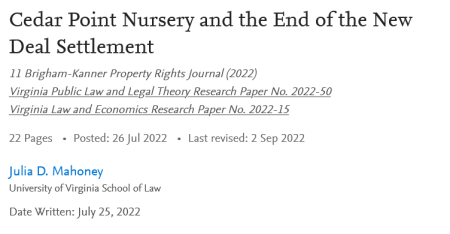
Screenshot 2022-09-08 at 11-03-58 Cedar Point Nursery and the End of the New Deal Settlement

Here’s your must-read for today, a new article from U. Va. lawprof Julia D. Mahoney, “Cedar Point Nursery and the End of the New Deal Settlement.”

Disclosure: we show up in footnote * along with others for offering “comments and conversations” about the piece. 

Here’s the Abstract:

In Cedar Point Nursery v. Hassid, the United States Supreme Court ruled that a California state regulation granting labor organizations a limited “right to take access” to agricultural employers’ property constitutes a per se physical taking. Cedar Point has sparked intense criticism, with critics arguing that the decision threatens to transform the law of property rights so as to “hobble” government land use regulation and even undermine democracy. This Article explains why the objections of Cedar Point’s detractors are misplaced. Far from disabling government regulation or fomenting stasis by favoring the “already haves,” Cedar Point is best understood as another

Continue Reading New Must-Read Article: “Cedar Point Nursery and the End of the New Deal Settlement” – Property Rights Are Civil And Human Rights

IRWA

The International Right of Way Association‘s Real Estate Law Committee produces twice-a-year reports “which contain summaries of eminent domain decisions and legislation within the United States.”

And what is really nice is that they make the report available

We’re posting it here because we’re one of the co-authors. Hat tip to our co-authors Brad Kuhn, Jillian Friess Leivas, and Ajay Gajaria.

The report is short, and doesn’t contain a lot of fluff. Just what you wanted.Continue Reading IRWA’s Summary Of Major Eminent Domain Cases & Legislation (Jan-May 2022)

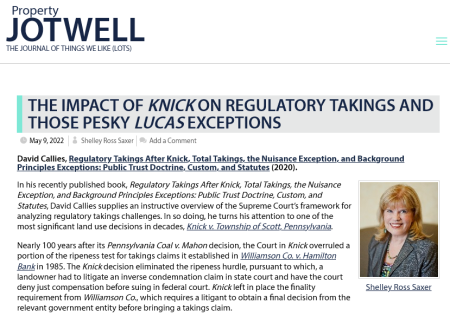
Screenshot 2022-05-13 at 14-45-41 The Impact of Knick on Regulatory Takings and Those Pesky Lucas Exceptions - Property

Check this out: Pepperdine lawprof Shelley Saxer has a piece in Jotwell, “The Impact of Knick on Regulatory Takings and Those Pesky Lucas Exceptions,” a review of U. Hawaii lawprof David Callies’ book, “Regulatory Takings After Knick.”

The review is short and to the point, so we suggest you read it. But here’s a teaser:

This small but mighty book offers a concise history and understanding of takings jurisprudence as it stood before and after the Knick decision. It brings clarity to a convoluted chronicle of takings litigation and presents specific situations where litigants have asserted a total taking claim and the defense has relied on the various exceptions to Lucas.

Don’t miss it.Continue Reading Lawprof Saxer On Jotwell: “The Impact of Knick on Regulatory Takings and Those Pesky Lucas Exceptions”